THE MYSTIC PASSION
A POTPOURRI OF SPIRITUAL PONDERINGS
by Roger Hathaway, during 1980's
Dedicated to the sons of the resurrection.Copyright 8 1992 by Roger Hathaway
TABLE OF CONTENTS (63 articles)
Click on a title to go to that item on this page
Fall Prostrate, Rise Glorified
Notes on the Writing of This Book
FOREWORD
Just as the Almighty God of Abraham is no longer "out there" somewhere, but is within C the stuff of which I am, so also do I know that Satan is not "out there somewhere" but is the nature of my corrupt egoic self. I recognize him as the stuff of my lie, have exposed him, have silenced my fears, and proceed to crush his head. This book is my club, my Word.
A Mystic is a sincere person who swims alone in a spiritual river that the world can't see. He has dedicated his life to one primary pursuit, a personal quest to find God. What makes the Mystic unique is that he proceeds on his journey not by any traditional path, but instinctively turns inward to find God through meditation and insight. He doesn't step forth on the journey; rather he steps within.
Most of the known, published mystics have come from the monastic tradition. I am not from that tradition. But down through the past twenty centuries there have also been many other mystics; if I am to be classified it would be with them. Through history, very few of these challengers of God have written for publication or become renowned in their times. Most were denounced and usually persecuted by the very institutions which parented them. Infamy and castigation is the more probable result for any rebel who dares to follow his own spiritual instincts instead of religion's defined and structured path.
During my years in the Lutheran Seminary there was little study about or acknowledgement of Mystics, let alone validation of such an intimate and personal spirituality. Our studies centered about classes in dogmatics, Greek, exegesis, hermeneutics, homiletics and liturgics - all the technical tools necessary to direct religious practice. But for a lone seeker of personal contact with God, the one who went late at night to the small private prayer chapel to yearn into the darkness there was no guide, no teacher, no class which prepared him. We students dared to speak boldly about God and the Holy Spirit - that was enough; inner spiritual movings were reserved; we left the intimate unspoken. There's something natural about this; we are protective of our inner selves and our private spiritual thoughts. These are things not very clear to us and not very rational and we don't want to debate them.
What is this deep inner yearning that compels some individuals to seek God with a fervency that others don't seem to feel? A Mystic is driven by some compulsion to touch God, to experience God, to see God's face - even if it would mean his life. Such a seeker-of-God quickly learns that he is alone in his search, very alone, and then language even seems to fail him; he finds that real insights into God are something he cannot put into words, something beyond verbalization or communication. He is more alone than ever; there's nothing that he can share with others. What a confusing and frustrating development for a young idealist with evangelistic hopes. The church seems to be just a shallow religion-business organization. Dogma appears to be just an effort by religion's businessmen to define their product; the insights that God reveals to the mind of the seeker are different from such dogmas or creeds.
The traditional churches begin to feel unsatisfying, cold, rigid, and mere mouthings of words. The world seems to be stuck in the shallow activity of exercising a practice of religion while the Mystic sits alone communing with God, or sits quietly yearning for God. Religions are conspicuously a group-practice of superficial motions and emotions which are supposed to catch the attention of a distant God. It becomes obvious why Jesus never promoted churchism or religion.
Anyway, after four years of Seminary, I didn't stay in the ministry much longer than a year. Without clearly understanding why at the time, I knew that I could never accept the business of religion as a path to God. The church was satisfying emotionally, a comfort to those in trauma and provided social acceptance for the insecure, but it didn't promote intimate spiritual contact with God. My radical notions and different kind of spirituality placed me outside the church mainstream, so I left the church, confused and frustrated. I felt totally alone in the world, but I knew that I walked with God; I knew the bliss and the reality of that, and decided to settle for it. Years would pass before I found there were others like me, mystics, who walked similar spiritual paths.
I have come to understand an important difference between religion and spirituality. Religion is dynamic, progressive, social, and active; spirituality is passive, quiet, solitary, and receptive. By its very nature religion stands counter to spirituality.
Although I don't share with some mystics a tradition that emphasizes penance and contrition, I do realize the ugliness of this world scene and, like them, I too despise being here. With St. Paul, I'd much rather depart and be in a higher dimension with God, but I am here - so be it.
One very important difference between me and religionists is that I believe penance is NOT necessary after one accepts forgiveness and adoption as a child of God. If the forgiveness is real, "once and for all," like the Bible says, then I have it. To keep begging for it is not an act of faith. There is life after penance - a new person, a new posture, fresh and clean, forgiven. If the church could ever accept the reality of this kind of complete forgiveness it would be a very different, and more attractive institution.
And "sin" is not some act that a person does, but is the very nature of a person who chooses to be separate from God, who chooses to worship him from a distance, or ignore him from a distance. Sin is the life of a person who has not accepted the full forgiveness of himself, the person who has not bought God's promise. But Christ's blessing is this: for him who believes, there is no more sin. He is changed, a new creature, in a state of grace, a condition of oneness with God, and without the law acting as his accuser, his actions can no longer be called "sin."
So, since I do not identify with sin and guilt anymore I opt for a new stance: that of being a bold, forgiven son of God, standing tall as He created me to be. My real task in this world is to be, with integrity, whatever my destiny offers, as a tool of God, without question, judgment, or reservation. This posture doesn't make my spirituality different from other mystics, but it does permit me to release the heavy anchor of the sinful human ego nature instead of dragging it along and trying to make it holy. It never can be holy; it must be left behind, hanging on a cross somewhere perhaps, while I go on to identify with and develop the new creature in Christ that I am, a child of the resurrection.
It is clear how dramatically the world stands in opposition to spiritual life. For me, this prompts a natural releasing, even rejection, of the world, without argument or moral dilemma. For me, now, there is no good or evil, no judgment of self or others, no guilt or penance. I find that the religion of morality is shallow - a bad substitute for spiritual intimacy with God. Spiritual communion is the path which Christ taught, a natural process which develops from real once-and-for-all forgiveness.
So, my path varies a little from fellow mystics, as each of them varies from each other. Yet there is this in common, that we realize ourselves in spirit and walk with the Father in a reality that is supreme for us, and that we recognize each other as genuine in his experience of God.
Finally, for me the mystic experience is a matter of feeling the reality of two extreme opposites at the same time. On one hand, I feel the ecstasy of spiritual bliss, communion with God who is not external from me. On the other hand, there is an earthly despair, despondence, a depression that can make me physically weak. I cannot describe the powerful yearning to depart, to leave this physical life behind to walk with the Father free and unfettered. I think this experience indicates the triumph of the spirit over a human nature which is left without any recourse. So, I feel divided as I grasp toward God with my hands and kick at life with my feet. I know Jesus understood this because He said one must hate this life to be His disciple.
Therefore, I'm convinced that redemption of the world does not include reconciliation of corrupt earthly nature, but is the freeing of the spirit-of-life, all life (hylozoic), from its bondage to violence, passion, emotion, and earthly love. This is an important theological concept. The Spirit-of-life is the spirit of that which is eternal and almighty and pure, that primal source of all existence for which we use an inadequate reference: "God." Earthly nature, the world, this entire corrupted universe of illusion, this great lie - it is all a distorted reflection of the true eternal reality. It is only a mortal consciousness that we know with our minds, limited and finite, a deceptive reflection of the true, holy, spirit-of-life. The world we know is a lie. A lie cannot be redeemed; it cannot be made true - only its opposite can be true. Sin cannot be made holy. This world cannot become other than the apparition it is. It will all have to be destroyed in order for God's perfection to be realized again. There is nothing here to save, except to free the spirit-of-life, that endows God's own children, from bondage to this world. A corrupt world, like a corrupt person, must be transformed through an experience of death and rebirth in order to find the kingdom of heaven. We now live at a time of history when the old world is dying and a new world will then develop that is not materialistic and corrupt, but rather lives in God.
Until December of 1991, I had encouraged readers, in this introduction, to take lightly what I say and only to claim some truth when it seems to be yours. I cannot let you walk into this material that lightly. I am constrained to provide some little warning. If you know some theology or if you are an active part of the church, you will be affected by the material in this book. You will not be the same person after reading it that you are now. You can disagree with every word of it and burn the thing, but you will be changed. You will not be able to avoid the responsibility of making serious personal decisions about your beliefs, either to disagree or agree, and these decisions may be critical to your salvation. If a light is turned on in the darkness, you will see things, and it is your responsibility to either turn your head or to gaze on them. There may be no such thing as absolute truth, but your soul, or the spirit within you, will awaken from slumber to wave banners or to do battle in the arena into which you are stepping. If you are not prepared for this, I sincerely urge you to set the book aside and do much meditation and prayer before you again pick it up. May the spirit of God flame within you.
Note added, September 1992: Some, who have read this book, remark that they find too much expression of my anger. I was dismayed that a reader might find that so prominent while my real message is, in my mind and intention, so wonderfully freeing and positive. But, yes, anger is revealed, anger and grief! Perhaps it will help you to understand that, for me, history is not something passed and finished. The history of my world is not completed until I bring it to completion, and no one is completed (redeemed) until he has made peace with the negatives (evils) of his life and that process includes anger and grief. For each of us, as we realize the truth about the worlds of our perceptions, and as we accept responsibility for every aspect of our worlds, it becomes possible for us to realize the redemptive process of ourselves and our worlds. As Christ demonstrated the redemption procedure, so must each of us find the redemption of our own worlds. My world has been bad, confirming everything that the sensitive philosopher, Arthur Schopenhauer, described. The bad people and bad circumstances are not something separate from me. They are of my perception, therefore I own something of them. They are crimes against the innocent child/the real me, the divine child of God. I am responsible for permitting them in my world and then for repressing the memories. It is up to me, as it is for each person, to process the redemption within his own perception. I must first admit the evils; Then it is appropriate to express the anger; then the grieving can begin. This is a way of being honest. Angry? Yes, I feel anger beyond words, anger that people of my world could commit the injustices, the persecutions, the tortures, the lies, the obscuration of the Christ behind his earthly mother, the withholding of forgiveness by the church which claims the task of announcing it, and so many more evils. I cannot point a finger at "them" in accusation without including myself, because it is my world. And then there is the grief! Oh, God, the unspeakable and overwhelming grief? Have you stood at Golgotha in the sandals of Mary the Magdalene, and watched someone you love die like that? Have you known the genuine spirituality of the Gnostics, the truth of the Spirit of God in your soul, and stood helpless while a political-power-hungry-church killed your beloved friends who shared your faith? Have you even witnessed from a distance the destruction of the innocent Cathars? Have you felt the despair of the innocent and spiritually hungry souls who turned to the church only to find lies and hate? Have you looked at the injustices you suffered as an innocent child? I have many times wept bitter tears for such sincere and devoted children of God as Spinoza, Nietzsche, Voltaire, Sebastian Franck, Thomas Muntzer, Michael Servetus, and many others. I have lost my breath in convulsive spasms because the grief I felt was too great to bear for these beloved souls whom the church persecuted and killed. These souls are part of my heart; they are not dead, and there can be no peace or redemption of this world until someone shares their pain and grieves. For me, it is MY world that has been so terrible, and for that I am sorry! I repent! I fall prostrate and pray for justice upon my head! I pray for the spikes through my wrists! My world cannot be free until I recognize my responsibility for it, express the anger and feel the grief. MY world and I are not two separate things. So, within the pages of this book, you will find my expressions of anger and grief along with the incredible joy of freedom and return to the eternal Father, our source. Perhaps some readers are more sensitive to the "anger" because they feel its relevance in their own souls. And after the anger and the grief, we, too, can let it all go with the prayer, "Father, forgive them." What a wonderful catharsis of the soul!
Roger Hathaway
1992
The following articles were written at random times over a period of years during the 1980's. I wrote simply as I felt moved to write, but for no agenda, no group, and no other readers. These are just PONDERINGS that are largely unrelated to each other. At one time I wanted to make these a book. But, there is no path from a beginning to an end, so the pieces can be read at random. They are going to resonate ONLY with a person who thinks like a Mystic, who searches for an intimate relationship with a Father who guides and encourages that search.
and I will remember their sins no
more!
In speaking of a new covenant
He treats the first as obsolete.
And what is becoming obsolete
and growing old is ready to vanish
away.
Paul, the Apostle,
To the Hebrews
Guilt is the stumbling block that looms largest on anyone's spiritual path. Anyone who seeks to personally approach God becomes cognizant of his old human nature and is genuinely remorseful. But, to pray for forgiveness publicly on every Sunday through life is not enough; it is too superficial! Doing penance is not the answer either. The spiritual task is to understand one's new nature in Christ, as a new creation, a new person distinct from your old human nature, and become so free of any concept of guilt that the simple idea of guilt seems foreign. This can happen if one simply realizes that any chalkboard list of your "sins" has been erased; and the board is clean and has been thrown away. There is no list of items for you to feel guilty about anymore. God said, "I will remember their sins no more." In Christ your forgiveness is so total and your freedom so complete that the law cannot condemn you anymore. You are so totally free that you may do anything you wish. And that is a statement that few preachers in any church dare to make. You are so free, in God, and already forgiven, that you may do anything you wish. Nothing that you can do, short of denying the Spirit of God within you, will bring condemnation or be held against you in any way. Under the Old Covenant of law, sins were actions or inactions that violated its rules. The New Covenant is different; the body of Christ, and that includes the new you, is free of any death penalty for sins. So, without a law hanging over your head, sin is not something to focus upon. Oh, your actions will still have consequences in your life and you may regret them and there may be severe lessons in store for you because of some actions, but that is all that such things can mean to you, lessons to learn from.
This is a serious matter, and I tell you that there is no virtue or nobility in playing the sinner's role, of beating the chest and crying, "I am a sinner". That is not a display of humility; that is a brazen statement to God that you identify with your old human nature and don't accept the forgiveness, that Christ couldn't have included you in the redemptive plan because your sins are too great, that God isn't great enough to make the atonement include you, but that you are great enough to atone for yourself and this show of humility is your offering.
See what an affront such hypocrisy can be? After God accomplishes the plan and announces to you that you are forgiven and free, you respond by saying, "No, not me; I have my guilt and I am hanging on to it; I will cry and wail and beat my chest and lash my back and crawl on the ground and walk with shoulders stooped and confess every Sunday that I am a sinner, and I won't give up my guilt."
You might respond to the above by saying you have sinned since you last prayed for forgiveness, and that each week there are a few more that should be added to the list, that forgiveness is something you must beg for over and over again, that God didn't forgive YOU "once and for all."
Listen again. What you have done this past week or year does not count, does not show on any list, is not remembered by God AT ALL. Like the New Testament says, "A Christian can do no sin." You are a new creation, a new person, God's perfect child, clean, pure, forgiven, holy, righteous, a saint! That is the way God sees you, - unless you reject Him and insist on identifying yourself with sin.
Sin has unconscionably become a chief tool of religion, by which the priest/businessmen manipulates and exploits Jesus' sheep in order to maintain financial solvency and exercise fearful authority over them. The church (religion) has not accepted the concept of God's forgiveness "once and for all", and each Sunday has you confessing your "sins" and pleading for forgiveness anew. It acts no different than did the Old Testament church, under the condemning law. It is as though Christ never brought his message of good news that you are free. The church still views man as sinner and teaches its followers to walk with shoulders stooped, head drooping, shuffling along in a kind of sickening sweet, self-righteous humility that makes an observer want to puke. Now, think, is that debased religious posture any way for a forgiven child to stand before his Father who wants to see a smile, joy, appreciation, exuberance?
As Christ spoke to a church which refused to listen and refused to give up its law, so do I speak forth at this age to a church which is no different, still refusing to give up its law and still refusing to be the God-realized children of the Most High. Christ had no delusions about how his message would be received then by the church, and he said the church would have to be destroyed.
Today, the church is no better: factious, factitious, hateful, sniping and berating, power-hungry, money focused, ego-maniacal, patronizing, superficial, arrogant, oppressive, manipulating, pontificating, still beating its listeners over the head with law and calling them "sinners." We can only hope that it, too, will be destroyed soon, freeing its captives, and that there might arise a new age of enlightenment, of spiritual sensitivity, and realization of personal union with God.
As far as laws of mathematics refer
to reality, they are not certain;
and as far as they are certain,
they do not refer to reality.
Albert Einstein
A philosopher is, as best he can be, a seeker of Truth. He ponders the eternal questions about the nature of reality, mostly as an attempt to gain some understanding about God, and Truth. Regardless of his educational background, he somehow believes that to discern Truth is to be set free. So powerful is this conviction that each who willfully chooses this path dedicates the whole of his life to the quest. His is usually a quiet search, but he is obsessed with a burning fire within which drives him, and which leads him to ever new arenas of frustration.
The philosopher finds that each answer prompts more new questions. Finding more answers becomes a self-defeating exercise. Answers even become part of the problem. If a philosopher is honest, it eventually becomes clear that for each correct answer, he finds the opposite is equally true at some level of understanding. He is forced to conclude that there are no valid real answers, only relative answers.
If there can be no valid answers, then no valid question is possible! This leaves him without his traditional tools, without hope; he feels abandoned at a spot which feels like an infinite void, an eternal nothingness where thinking is not permitted. Finally, the philosopher becomes a Mystic.
The infinite void that I am trying to describe is what one finds in that state of being "spiritually destitute" of which Jesus spoke in his very first sentence in his sermon on the mount when he said, "Blessed are the poor in spirit, for theirs is the kingdom of heaven." The English translation here is not as clear as is the Greek where "poor in spirit" means spiritual destitution.
The experience of this destitution need not be depressing or frustrating; surprisingly it can be bliss and relief if one can yield to it. It is the release of the finite thinking process; it is freedom from the finite world. To return afterwards to finite consciousness is uncomfortable because one feels devoid of method by which he can consciously continue to walk the path. The Path has become by now ultimate, and more; it is the only true value left recognizable! Paul gives some clue of this walk when he says to "feel after God in the hopes that you might find Him, for He is not far from every one of us, for in Him we live and move and have our being."
To "feel after God" is different than one's customary search for Him through reasoning and limited dialectic process. Rather, it is some undefined process that one person cannot explain to another. It is to walk the path alone, knowing that there is no other way, that there are no teachers, no questions, no answers. All finite concepts must be abandoned and left behind. One's concept of God must be reevaluated and released from the limitation of blind and ignorant consciousness. You must let that old concept of God die in order to realize the incomprehensibleness of His nature with which you are united. To walk on you must confess to yourself that the old God is dead, just as that spiritual philosopher, Friedrich Nietzsche said. "God is dead!"
Blessed comfort and encouragement be to anyone who musters the great courage to let go of that God to whom he had dedicated his soul in order that he might realize Him in Truth. This leap into the void is a death of self, a gambit, which leads to the victory.
I do not pray for these only,
but also for those who believe in me
through their word,
that they may all be one;
even as thou, Father, art in me
and I in thee,
that they also may be in us,
so that the world may believe that
thou has sent me.
The glory which thou has given me
I have given to them,
that they may be one
even as we are one,
I in them and thou in me,
that they may become perfectly ONE.
Jesus, the Christ
per his friend, John, Ch. 17
The religion that calls itself "Christian" attempts to make salvation such a simple exercise as stating one's belief-in-the-name-of-Christ. It places Christ on a pedestal, or cross, and teaches seekers to look upon him, pray to him, believe in Him. "There He is, believe in His name, and you will be saved to go to heaven when you die."
I contend that such teaching is soul-endangering and pernicious, that it makes Christ a serious obstacle to your spiritual growth. Religion teachers are externalizing Christ just like the Old Testament externalized God; that is, they make God to be an individual that is separate from you, someone who is out-there somewhere, in a distant heaven. It was proper back in history during the Old Testament period to externalize God; that was the lesson between the time of Abraham and Christ. The Lamb was not yet sacrificed on the altar; the veil still separated outside worshipers from the Holy-of-Holies - that small room in the temple where God lived. The whole import of the New Testament is to remove the veil, to have God directly accessible, to restore His children to union with Him, and to union with Christ as Jesus makes so clear in his prayer in John l7. The church-temple has been destroyed; the church of ritual and religion and dogma has been nullified; the body of the Lamb was killed for the last time, and the altar is no more - is not out there anymore. Rather, the new altar is within you, in spirit, where also is your God. "Know ye not that ye are the temple of God, and the Spirit of God dwells in you?" (I Cor 3:16; 6:19. II Cor 6:16)
Let's get this clear, that old external God is no more - gone - dead. Nietzsche tried to shout this glorious message to the world and was mocked. Our world despised and rejected another who loved us, who tried to convince us of our Godly greatness. Sadly, our people are convinced they are not great, and that God is still out there somewhere as one who responds to emotional pleas rather than to honest attempts at acting like His beloved offspring.
Well, hear me now. If you wish to stand at a distance and shout your cries to a distant god, that is your choice, your rebellion. But the supreme almighty God of all eternity isn't over there somewhere and you do yourself no favor by thinking that He is. No, He dwells behind the lies you cling to, and behind the terror you feel about looking within your inner self. So, hear the great Paul as he tells you to "feel after Him." Get out of religion and into your inner self! In your quiet self you will find Him.
The time is near.
Let him who does wrong
continue to do wrong;
Let him who is vile
continue to be vile;
Let him who does right
continue to do right;
Let him who is holy
continue to be holy.
Jesus,
according to John
The very title of this article is a misnomer, a common statement made popular by Christians who have misread Biblical passages which actually refer to the ending of this civilization, preceding the inauguration of a new period of history on earth, called an "age". There are no prophecies which indicate that the existence of this planet will be terminated. But there are many prophecies from many different sources which describe events that will occur as this age/era/generation/yuga comes to its natural demise in a natural death. Without getting carried away with the emotion of doom-saying, one is not out of order to take a look at some of the facts on this subject, along with some of the speculations.
Nostradamus was an amazing prophet and seer of the 16th century who foresaw worldwide disaster and destruction near the year 2,000 A.D. He said there would be a third world war with China at approximately this time and that great battle would be a necessary prelude to the birth of the Golden Age, which he referred to as "a reign of Saturn".
Edgar Cayce was a prophet of sorts in our century who has proven incredibly accurate with his medical diagnoses and prophecies. He said there would be a World War III in 1999, that communism will have ceased prior to this time and that our civilization would come to its final end early after the year 2,000.
In 1917 at Fatima, Portugal a vision of a lady appeared to three shepherd children. Messages from this alleged "Madonna" continued to come to one of the children, Lucia, until 1960. The messages seem to be mostly of a warning nature with some descriptions of a coming catastrophe which would destroy much of the world. She said that a sign of the end would be a "bright, unknown light which will be God's sign that he is about to punish the people of the world for their crimes," the light to be seen in the heavens. The Bible gives some details of these events in three parallel chapters in the Gospels: Matthew 24, Mark 13, and Luke 21, and refers to a sign which will appear in the skies, immediately after the battle, indicating the coming again of the Son.
The great pyramid of Khufu at Giza, built 12,000 years ago, has been surveyed and measured with great precision and these measurements have been interpreted chronologically with one pyramid inch equivalent to one solar year. The fascinating results of this work reveals a direct correlation of passageway steps, stone variations, angles, etc. with exact dates of major events in world history. Using a system of interpretation which works with past world history, it is interesting to look ahead into the future to see what is indicated. The pyramid seems to be saying that a new spiritual civilization will begin prior to the year 2,000; the total collapse of the materialist civilization will be completed between 2004 and 2025; and the appearance in the sky of a sign of the Messiah will happen in 2034. (Ref: The Great Pyramid Decoded by Peter Lemesuier, Avon, 1977).
David Monongye, the venerable "Keeper of the Prophecies" of the Hopi Indians in northern Arizona has much to say about these events which are close at hand. The ancient Hopi prophecies state that "after white people who look like Indians come, (he thinks this a reference to the "hippie" generation) then will come a great world war and then the earth will cleanse herself." He says this war will be with people wearing red cloaks, and that they will pour out onto the earth a "gourd of ashes." He interprets this to mean nuclear bombs. By the way, David Monongye is 106 years plus in 1984, is in good health at his home in Hotevilla, Arizona, and daily sits with warm welcomes for visitors from all over the world. He is internationally renowned as a man of peace and has been honored in Geneva and at the U.N. in New York. He received the U.N. Peace Medal which he now always wears. He is a very humble and great man. I've sat many hours with him listening to his ideas.
As we consider the above prophecies, it becomes clear that events in the world today are confirming their accuracy. It becomes relevant how we choose to respond, especially spiritually.
One of the least acceptable responses is that eagerness of millenialists who anxiously await disaster with gleams in their eyes and hunger in their hearts for that moment when they become the reigning authorities and have their chance for revenge against a world to which they have felt inferior. A more intelligent and spiritually appropriate response might be to meditate upon your earthly values and the meaning of life, perhaps reaching a level of enlightenment where you really know that your spirit exists independent from your temporary physical body vehicle. Then you may find some satisfaction with the idea of accepting the death of this era as coinciding with the release of your physical egoic identity, all in preparation for a life more glorious. The transition period of the earth may become personally meaningful to your successful transformation and resurrection.
Theologically, I find this subject quite fascinating, for it seems directly related to the concepts of sacrifice and redemption. Of course, the world is aware of the emphasis that the Christian church places upon sacrifice and redemption as it relates to Jesus, his death and rebirth. Historically, that event was the natural culmination and fulfillment of the religion of our Old Testament which taught that man fell from perfection back at the beginning of that era with Adam and Eve.
One man is identified with the beginning of this game, the "fall", and that is the first Adam. The Bible calls Christ the second Adam and he is identified with the successful conclusion of the process with a "redemption", a paying off of the incumbent debts and restoration of a reality of oneness. Christ is supposed to exist as a perfect union of matter and of spirit, from a genuinely earthly mother and spiritual father. The idea of redemption is then effected when this perfect example reverses the natural order of the game by willingly sacrificing himself through a death experience. This illogical and normally unreasonable move was a gambit that resulted in victory rather than defeat. Such a reversal is the key to victory for anyone. The natural order must be reversed. Other statements in the Bible about reversal are even more explicit but still generally unrecognized for their deeper significance, such as, "the greatest shall become least and the least greatest," and "the mountains shall be made low and the valleys exalted," and "the first shall be last and the last first," etc.
Now we are looking at the death experience of a civilization, which involves the whole planet. The key to victory is this, that through death comes life, that the results are opposite from that which the simple rationale would expect. So, if one's redemption is attained by his realization that things are opposite from what they seem to be, and that sacrifice is the key to victory, does that apply also to the planet upon which we live? MAN fell from God's oneness and was cursed and kicked out of the garden, but what about the planet? Note this: Genesis 3:17 states that the planet was cursed too. "Cursed is the ground because of you; through painful toil you will eat of it all the days of your life. It will produce thorns and thistles for you, and you will eat the plants of the field." (NIV)
In the fourth chapter of Genesis we see immediate repercussions of this fact of the ground being cursed. Cain and Able, brothers, both brought offerings to God's altar, but God rejected Cain's offering of fruit of the ground (Cain was the farmer) and He accepted Abel's offering of meat from his animals. The ground had been cursed and the products which grew directly from it were not acceptable. The meat from animals was acceptable because animals fed from grasses and processed those plants through a death experience and transformation which processed the life force of plants to a higher level of life in the animal. Note that the death process for the plants is a transformation which makes them acceptable again. This typifies the project of "redemption".
We are not here talking about transmigration of souls or of Darwinian evolution, but rather a process of approaching God, of returning to that perfect state in which life was originally created. It is the spirit-of-life which is important, not this physical life. Life exists within every atom, within every sub-atomic particle of energy, within all that is: hylozoic. Life is the consciousness of the spirit of God that is the essence and substance of all realities. Where this life has been adulterated, distorted, and violated, then a cleansing process of redemption is required to restore it to the Godly state of perfection. It is not the soul of a plant that evolves from the plant state, through death, to a meat state, but rather it is life itself which is being redeemed. This life which fills all things, even though it appears lifeless in such things as rocks, does have sentience. St. Paul, in his letter to the Romans in Chapter 8, speaks to this idea of redemption as it applies to all creation, including the physical bodies: "The creation waits with eager longing for the revealing of the sons of God; for the creation was subjected to futility, not of its own will but by the will of him who subjected it in hope; because the creation itself will be set free from its bondage to decay and obtain the glorious liberty of the children of God. We know that the whole creation has been groaning in travail together until now; and not only the creation, but we ourselves who have the first fruits of the Spirit, groan inwardly as we wait for adoption as sons, the redemption of our bodies." (RSV)
So, the perfection of all creation, the purifying and the redemption process is happening right now and we are privileged to live at a time when we can witness the fulfillment of the prophecies about this era of known history. The opportunities for us as individuals are great, but the responsibilities are equally great. There are many warnings that false leaders, teachers and alleged messiahs will appear during this crucial period and that many, even of the enlightened, will be led astray. It is so critically important right now to maintain your own counsel and avoid getting caught up in any movement which detracts from your highest spiritual experience and benefit. There are intelligent energies and forces with great powers which are working to deceive us all. These entities all have one thing in common, they strive to focus your attentions and concerns on finite reality, this world, this life, earthly success. If your conscious mind can be arrested and prevented from flying toward the incomprehensible eternal verities, then you will remain earth-bound throughout this whole transformational period of the end of this age. But, if you can maintain your spiritual mindedness and acknowledge a release from the limitations of time and space and materiality, this will permit you to "graduate" to higher dimensions of existence where such limitations do not exist.
An admonition here would be to beware of any teachers who excite your minds with fearful or material concerns. They may urge you to act in panic and horde canned goods for the time which is coming. The storing of goods may not be bad, but the material focus and fears are effectively limiting. Other false prophets may lead you to hope for evacuation from this planet so you will be "saved" from the transformational experience, with promises that you will return afterward to help build a new world. Ask yourself why people with such limited spiritual consciousness and lack of faith would be used to help build an unlimited spiritual civilization in the new age.
If you have followed the theological gist of the above, the conclusion seems to be that the key to victory is simply the releasing of the earthly self, in a kind of sacrifice, permitting you a new spiritual birth into a dimension unlimited and incomprehensible to the present earthbound mentality. Jesus called it "Heaven." The next thirty or forty years offer the most wonderful opportunity of this entire age for you as an individual to let go of your earthly bondages and to let go of your physical focus which has anchored you to a dense, gross body, and then you may find the reward of final purification through your sacrifice and the eternal enlightenment in the age to come.
"I must go now, and we shall not see each other any more."
"In this life, but in another? We shall meet in another, surely?"
Then, all tranquilly and soberly, he made the strange answer, "There is no other."
A subtle influence blew upon my spirit from his, bringing with it a vague, dim, but blessed and hopeful feeling that the incredible words might be true - even must be true.
"Have you never suspected this, Theodor?"
"No, how could I? But if it can only be true -"
"It is true."
A gust of thankfulness rose in my breast, but a doubt checked it before it could issue in words, and I said, "But-but-we have seen that future life - seen it in its actuality and so -"
"It was a vision - it had no existence."
I could hardly breathe for the great hope that was struggling in me. "A vision? - a vi"
"Life itself is only a vision, a dream."
It was electrical. By God! I had had that very thought a thousand times in my musings!
"Nothing exists; all is a dream. God - man - the world - the sun, the moon, the wilderness of stars - a dream, all a dream; they have no existence. Nothing exists save empty space - and you!"
"I!"
"And you are not you - you have no body, no blood, no bones, you are but a thought."
Mark Twain
The Mysterious Stranger
Energy/power/force on this earth -equals- the force of acceleration which is constantly occurring by the process of thought converting spirit to matter. Although spirit is not some thing, but rather is the power of the mind, it is the primal cause for each moment. As spirit becomes matter it is transformed from a state of rest (peace) to action. This action does not maintain any status or velocity but is constantly being renewed, faster than moment by moment, faster than time. There is only acceleration, the action of becoming matter: E=MC2. There is no matter where there is no perception of it, nor is there any time or space. The truth is that spirit, in the state of rest, at peace, has ALL power. The truth is therefore opposite that of classical physics' belief. The falling apple has less power, and certainly no omnipotence, when it is falling because it is limited to vector and momentum. The process of becoming matter (acceleration) is a limiting activity, binding the omnipotence to specific action and direction and moment, a bondage, a gravity, a heavy and unpleasant event. The freeing-up of this matter is the cessation of becoming, the ceasing of acceleration, to be at state of rest, of non-becoming, of non-direction, of BEING, of the I AM. This freeing-up is salvation, enlightenment, a willingness to non-will, release from the bondage of definition. In total state of rest, there only IS. Omniscience IS. Omnipotence IS. Omnipresence IS. When knowledge or power or identity is directed or defined into Becoming, it is no longer omni but is limited by the property of definition, created by one's perception, brought about by a limited mind (the earthly game). If we could be willing to give up this "game", willing to non-will, we would probably be caught up into the air, physically vanish into the undefined ether, to share omniscience of God, of eternal, undefined, unlimited mind.
Spiritual enlightenment is a step in that direction.
"No, Ananda, no weeping. How often have I told you that
it is in the very nature of things that what we love must
be taken from us? How can it be otherwise? What is born
is doomed at the moment of its birth to die. There is
no other way."
The Dhammapada
Buddha
St. Paul says that we see through a mirror darkly. This is one of the great keys to truth. All of our creation is a reflection of eternal truths, manifest in physical appearance, but it is a mirror reflection, seen in reverse.
Many of the new age people, the Aquarians, the metaphysical students, and the prosperity religions, say with hopeful conviction and enthusiasm that God wants us to have all the good and beautiful things of the world and great happiness here, so they believe pursuit of it in this life is a proper goal, and some even imply that a person's spiritual level is indicated by the amount of material wealth he or she has attained. They don't address the converse; they are implying that poor people have fallen short in their spirituality.
The Bible does not agree with this concept. Jesus says, "Blessed are the poor in spirit". Chapter 12 of Hebrews says so beautifully: "In your struggle against sin, you have not yet resisted to the point of shedding your blood. And you have forgotten that word of encouragement that addresses you as sons: 'My son, do not make light of the Lord's discipline, and do not lose heart when he rebukes you, because the Lord disciplines those he loves, and he punishes everyone he accepts as a son. Endure hardship as discipline; God is treating you as sons. For what son is not disciplined by his father? If you are not disciplined then you are illegitimate children and not true sons."
Is this not clear that we should rejoice in our tribulations, like St. Paul teaches, as we strive to perfect ourselves and walk more closely with our Father? Paul says that Moses would rather suffer reproach and disgrace for the sake of Christ than have all the treasures of wealthy Egypt. The Bible is consistent as it makes clear that rewards and treasures for the faithful are not here in this physical world but are in heaven, the dimension of freedom from this material bondage. It is interesting how this point of view will affect our interpretation of history and of things to come.
The New Testament focuses on attainment of eternal heaven and emphasizes that this world of woe is a painful experience which is necessary on our journey. What we do with ourselves, how we develop spiritually, is of utmost importance. Nowhere does Christ indicate that we should hope for or seek material wealth during this temporary experience. And yet, those who anxiously await the golden age on earth hope for just exactly that; they hunger for the material luxuries.
We have learned that God punishes and chastens his children for the sake of their own progress. So, we can be confident that God is not going to supply golden wealth and bliss during this lifetime to His children because that would cause many to turn from Him to the enjoyment of their wealth and their material comforts and their worldly security. Satan uses wealth as a most effective tool to draw suffering man's mind from God to an attitude of complacency.
Revelation 20 speaks about the judgment and of those souls who were beheaded because of their testimony for Jesus, who did not worship the beast or his image. Those souls come to life in the first resurrection. I think the beast is material wealth and his image is that hope in the mind of people who fill their imaginations with dreams of ever greater wealth.
"Is there no kingdom of heaven, then?"
Peter cried out, terrified.
"There is, Peter, there is - but within
us. The kingdom of heaven is within us; the
Devil's kingdom is without. The two kingdoms
fight. War! War! Our first duty is to chop
down Satan with this ax."
"Which Satan?"
"This world about us. Courage, friends
I invited you to war, not to a wedding."
by "Jesus"
according to Nikos Kazantzakis
The Last Temptation of Christ
I think the world is OF nothing else than that which we call God. There is nothing in earth, heaven, or hell that is not of God because God is the eternal source and essence and substance of all that is. This is not the same as saying that the world is God. I am thinking that this world of activity is an exercise of potentials. This exercise is an unfathomable operation of "forces," forces which were objects of veneration in ancient mythology, when perceptive minds recognized them and named them and worshiped them. I believe that the forces DO have sentience, consciousness, memory, will, emotions, individuality, capability, and intelligence. The forces are manifested into our knowable reality. The forces which function within the bounds of time and space arise forth, appearing as a reflection, out of a seeming void which is beyond time and space. The void has no intelligence as we could possibly understand it. The void has nothing which we could understand. The void is the perfect nothingness. The void is the ultimate essence of God. Everything that "IS" stands in diametric opposition to that which "ISN'T". What IS is the great lie. Everything that IS has no reality beyond anyone's individual perception of IT. That an individual might participate in this great lie is his evil propensity, his perverted inclination, his deep instinctive and seemingly irresistible urge which is obstinate to God. It is that part of anyone which believes that something IS.
Within this exercise of potential, the lie is the opponent of Truth. Both are aspects, or forces, which arise out of the void. There is nothing that is not God. And Nothing is God. Both statements are equally valid. But, in our ignorance, in our myopic vision, with blinders on, we step forth, each onto the stage, to perform exercises-of-potential, where we play the elements of the duality against each other. We each act as the general, as a god, in a war that we each design. There is no other activity in our finite universe than this war between positive and negative, good and evil. WAR is what is happening. This is our dimension of reality. It is based upon a distinction between good and evil (the tree of knowledge of good and evil).
While we are separating good from evil, and knowing how one thing is different from another, we focus our minds upon things. That is, we perceive with our minds only finite items of uniqueness, rather than seeing through the illusion of reality to perceive the eternal oneness of all that seems to exist. Because we persist in distinguishing one thing from another we limit our conscious reality to the perception of only this finite dimension.
Paul said we see through a mirror darkly. A mirror reverses the perceptible image. This concept of reversal is a key to understanding Christ's purpose, and of our own redemption. Jesus gave a few hints about the importance of "reversal" when He said the last shall be first and the first last, and that the mountains shall be made low and the valleys high, and the least shall be greatest and the greatest least. He made enough such statements to convince me that this subject is important to his teaching.
But, I too, did not learn this lesson from His messages or by listening. It came to me as any higher insight comes to anyone, by spirit of the mind, i.e., the Divine Spirit. I write in vain if my purpose is teaching. There is no such thing. Jesus spoke in vain if His purpose was teaching, as it clearly wasn't, and He made clear that it wasn't! When his disciples frustratedly asked Him why he spoke so confusingly He told them that He couldn't teach clearly or else the people would understand, repent, and be forgiven. He came to accomplish a victory over evil and keynote a new age where Christ will reign. Within His words and His life are lessons hidden which the devoted follower might find if he opens his mind to such and persists determinedly enough. The insights that come to the faithful seeker are more closely akin to the incomprehensible void than to the finite. They are not verbalizable. Anything that can be put into words falls short of Truth. The ancient Sanskrit Vedas teach that one is in error to the same degree that he can state his truth. Again, we find a key to ultimate Truth to be the concept of "reversal". And, again we might look at the major lesson of Jesus' life, that the key to "life" is death, that surrender is the key to victory, that the low grave is the path to the high heaven, that service is a function of the master.
How is it that the theologians of all church history have missed the full meaning of that which is the Christ? And, they have not only missed Him, they have built a "Christian" tradition that unanimously focuses the attention of seekers upon the person of Jesus as a finite God, a trap that dooms a devoted one to a bondage of earthly-mindedness, a religion that motivates sincere followers to live earthly lives like Jesus, to think earthly thoughts of love, sorrow, happiness, pity, generosity, unselfishness, neighborliness, and a long list of other emotions which bind the mind to finite reality. Better were a millstone hung around these teachers' necks and they were drowned at birth. I pray forgiveness that in my youthful stupidity I believed and taught such poison. Into the Void do I cry my repentance and my grief and pray that this may be the last emotion for me, and that it may be left in my past.
And I pray that I may deserve nothing, that I may become nothing, that my ego, my mind, my soul, my consciousness, and any other characteristics of my immortal being may be permitted to cease all existence, in transmutation to become nothing, that is to be reclaimed by the eternal as a drop of water is reclaimed by the ocean.
There is an evolution of realization. During the history of primitive cultures around our Adamic ancestors, prior to Abraham, those people venerated many gods. Then came some giants of God teaching monotheism - Abraham, Ahkenaten, Zoroaster - and a higher insight was realized as we came to worship that higher level on the pyramid, that pinnacle stone, that God above all other gods. Two thousand years later came the Messiah who resolved the dilemma of man standing separate from a distant God by teaching a special spiritual oneness. Later, Fritz Nietzsche would expound on Christ's message saying we should realize yet another insight, that the old distant God of gods, that supreme and almighty God of earth and heavens may be considered as he crudely put it, "dead". I understand what he was trying to say.
This teaching comes at a time when quantum physics and particle physicists have concluded that there is no such thing as a particle of matter, that there are only units of energy which seem to be products of and controlled by thought, and that time is not a constant, that it in fact moves backward as easily as forward, and that space is not linear but is curved and relative. Einstein did not say that energy was the same thing as mass in motion; he said that energy is acceleration of mass, that energy is nothing less than state-of-change. Change is the occupation of the individual mind of each person and by the group mind of all. Mind, MIND, MIND! Are there hearers to hear?
The sidewalk that I walk on isn't solid anymore; the next step may be anywhere within or without the finite realm. Since the mind is all there is to reckon with, how is it with the mind? The mind can create history (behind or ahead) as easily as the moment. So what can one know for certain? Nothing. I cannot know that this person whom I believe to be Roger ever existed before this very moment - perhaps I sprang into being this moment with a complete programmed life history in my memory. I cannot know if I am progressing forward in time or backward, if I am learning or forgetting, or anything about the nature of this exercise of potential which I seem to be. In this state of reality there are no constants, no truths, no right or wrong; it is beyond good and evil. The WAR ceases to operate as we drink the power from each opponent, good and evil, by recognizing its relative and impermanent existence, by denying both sides of the war. Can anyone come to any other conclusion after realizing the truths of the modern physicists? Can we continue to look "up" to a God as external from us. If our reality is energy usage which is controlled by our minds, are we not then gods, as the bible says, "ye are gods"? This doesn't mean we are separate gods from that One god, but that we must redefine that which we call God. We can no longer play the victim role as entities separate from greater power.
It is time to take responsibility, each one for his own life and his whole reality. We are not separate from God, but are part and parcel of that which is God. Now, to realize that, it is my purpose to reverse my thinking and to become servant and least, for sake of the goal of surrendering my life to nothing that the victory may be won. The victory is peace!
Abraam had two sons, one by a slave and one by a free woman.
But the son of the slave was born according to the flesh,
the son of the free woman through promise.
Now this is an allegory: these women are the two covenants.
One is from Mount Sinai, bearing children for slavery; she is Hagar.
Now Hagar is Mount Sinai in Arabia; she corresponds to the present Jerusalem,
for she is in slavery with her children.
But Jerusalem above is free, and she is our mother.
by Paul, the Apostle, To the Galatians
A joyous cry sounded throughout the heavens, "The veil is rent! The veil is rent!" The angels and all the host of heaven sang and danced and felt the fullness of the love of their Father. They knew the meaning of this event - while earthbound people wept.
We still weep each year on Good Friday, caught up in the emotion of grief at the memory of an event we have failed to understand. Simple, blind, and ignorant, we gaze upon that man on the distant cross and try to feel his pain that we might increase our sorrow. Perhaps it was not for his crucifiers but for us, his friends, that He said, "Father, forgive them for they know not what they do."
In that era of history between Abraam and Christ, that period of biblical history which we read about in the Old Testament, man was held at a distance from God. Here is the major difference between that period and this era since Christ. Man, back then, perceived himself to be base, ungodly, defiled, unworthy to approach God, and kept separate from Him by means of laws which condemned him and by an intermediary priesthood and by the dark curtain, the veil, which hid the Holy altar from the worshipers. Once each year the highest priest could penetrate the veil to make an offering, to approach the nearest to God that could be permitted.
Then Christ came as the ultimate High Priest, the final intermediary between God and man. His body came to represent the veil of separation, and when His body was penetrated so did the temple veil split apart giving open access to the actual presence of God Himself. No more separation! We were set free from the death penalty which held us prisoners and kept us distant from God! Suddenly, no more priest as intermediary! It is henceforth a whole new game. This is what the word, "salvation", actually means, that we are saved from the penalty we earned by violating our contract, and set free from "unworthiness," and freed from a separation from the real presence of God in person.
So, we have a new and potentially joyous period of history following this good news. But, it didn't work out that way for very long. The new church was led by men of ambition. And the concept of personal spirituality wasn't understood very well, so it was natural and human that these power-hungry men reinstituted a priesthood, and the laws, and the separation of the individual from God again. They soon effected the period of history we call the "dark ages," a debasement of the common person worse than ever before. The new church principalities and powers collected the wealth of the poor by methods of fear in order to create a treasure-rich hierarchy of religious despots for whom pillage and killing were acceptable. Times were dark indeed and a putrescent stench covered the so-called "civilized" western world.
Listen to some words of Jesus as recorded in the Apocalypse of Peter, one of the scriptures discovered in 1946 near Nag Hammadi, Egypt. Jesus is speaking: "They will cleave to the name of a dead man, thinking that they will become pure. But they will become greatly defiled and they will fall into a name of error and into the hand of an evil, cunning man and a manifold dogma, and they will be ruled heretically. For some of them will blaspheme the Truth and proclaim evil teaching. And they will say evil things against each other.. . . And there shall be others of those who are outside our number who name themselves bishop and also deacons, as if they have received their authority from God. They bend themselves under the judgment of the leaders. These people are dry canals."
The name of the dead man would of course be "Jesus." A religion based upon simple worship of Jesus on the cross, as our altars reveal, is not enough. The name of Jesus is not an automatic ticket to the kingdom of heaven. The cunning man would be the Pope. It's easy to see why the church organization in the fourth century did not accept that book into the list of acceptable writings for the New Testament canon!
It was nearly fifteen hundred years after Christ demonstrated His message of reunion with the Father before a few brave souls were able to stand up and protest church laws which forbade the owning of Bibles, and protest that the church was teaching opposite of that which Christ taught.
It has taken another four hundred years before we are beginning to realize what Jesus was saying so clearly. And this seems to be by a mere few voices outside the traditional churches, a few voices of people who have dared to think of the freedom which Jesus taught, of the opportunity to approach God directly, or of the concept of oneness, the central theme of all that Jesus taught.
I remember during my years of Seminary that my questions about this Biblical teaching of oneness upset my professors. They would get angry with me and hint that I was perhaps into occult teachings. They would pass off the clear teachings of oneness in John 17 as meaning "togetherness", "with", or "hand in hand." I tried to understand as they understood, but the concept of oneness seemed so clear and important and central to all that Jesus and Paul taught that I could not let it go. Later, I would resign from the ministry in order to be free to grow in my faith and spiritual understanding.
Because the veil was rent, at the temple and on the cross, we are each now free to approach the Holy of Holies, the very presence of God, and to realize the greatest Truth of all, that there is no separation between the individual and that which he calls God. That is to say there is NO DISTINCTION between the two. No longer can you pray to an external Being, a distant Power, a King who rules in heaven above, because that is not where He is to be found. Being one with AllThatIs, you cannot look outward to pray, but must look inward where you and God have oneship. As we can all read in the New Testament, "Know ye not that ye are gods?"
No, we don't know it very well, do we? In our relative ignorance and blindness, we don't understand this very well yet, but to entertain the idea is a bold, bold step in the direction that Jesus points.
Your mission, should you choose to accept it, is to walk in that direction, along your path. If something inside you feels excited about these concepts, feels compelled to begin that walk, or even to leap headlong onto that path, your life will never be the same. It will be tougher. God be with you.
Henceforth, the Path is everything. There is nought else to compare it to. A single insight into enlightenment is worth more than a lifetime of misery. To have more insights is intoxicating and exhilarating beyond what narcotics can do. The Path is addictive and more than addictive; the path and you become One. Once you experience the path, the fear of leaving it will be more frightening than all the difficult lessons that the path will bless you with. This is serious stuff and henceforth your soul and your spiritual progress will become your real and ever-present concern. You have reached that fork in the path where your decision affects your eternity.
Isn't that wonderful! It is a time for celebration and dancing and singing for the opportunity of the Path is available. Have we waited countless lifetimes for this or does it just seem that way? Think what joy it was for Hercules when he set forth on his path of twelve labors, of the enthusiasm and fearlessness and childlikeness that was his. He knew one thing for sure, that the seeker who dares the Path has all advantages and promises of rewards. The alternative offers no hopes at all. So, celebrate and sing and dance, and know this, that the song and the path and the dance and you are one and the same.
The coming of the lawless one by the activity of Satan
will be with all power and with pretended signs and wonders
and with all wicked deception for those who are to perish,
because they refused to love the Truth and so be saved.
Therefore God sends upon them a strong delusion,
to make them believe what is false,
so that all may be condemned who did not believe the Truth.
by Paul, the Apostle, To the Thessalonians
Every person that I know is a part of my self, a reflection of characteristics or attributes that are me.
We do create our own realities, and these realities are manifestations of the stuff of which we are. I, as a personality, as a being, am many things, both good and bad. In order to see what I really am I can look at people and things in my reality and recognize that whatever they are, I am.
One is bound to this dimension of consciousness by physical and emotional attributes. Enlightenment is the process of releasing the ties to these things by recognizing them honestly and without fear, being willing to change one's nature and behavior, and letting these things cease to be part of the stuff of which one is. This is the letting-go. This is more than just a statement about release; it must be an inner, deep, genuine willingness to be different. Sometimes this is difficult to achieve and one may have to suffer traumatic experiences in life to make it possible.
A valuable exercise toward the understanding of self is to consider every acquaintance, fellow employee, relative and family member. Look at each one honestly and write down what you dislike about that person, or what you like in particular. These are the points which are reflections of your own self. You can only recognize in someone else things that are part of your own self, of your personal reality.
Is there someone who irks you more than any other? That is a good person to start with. What irks you about that person? Describe it fully, in detail. Then examine and find how that characteristic reflects your own self, how it is a part of you.
Write these criticisms down in words, like, "He reflects my pettiness, my gossipy nature, my vindictiveness, my insecurity and fear of others, my feeling of incompetence and lack of self esteem. If I weren't so insecure about my own capabilities I wouldn't have to put others down and be so nasty. Then I could afford to be more tolerant and generous. Actually, I believe I can afford to be more generous, even complimentary. It is a shame that this poor person has to do the job of reflecting such rottenness of my nature. Now that I can see how he is a mirror of me, and now that I change my attitudes, he will be able to change and become more loving too." This is the wonderful work of "peacemakers" whom Jesus said were blessed.
Don't hesitate to be very critical, even to admit your hate toward this other person, which really means your hate toward your own faults. And, don't forget to include your parents, the most important ones on the list. There are aspects about every person which you may hate and some which you may love. Remember that the good points reflect you too. It is usually more difficult to be honest about parents. Perhaps this is part of what Jesus meant when He said you must hate your mother and father to be His disciple. And with this honest criticism you become more willing to realize those faults and those people who reflect them. Your act of releasing, totally, will amazingly enable those persons to be different and you may not see evidence of those faults anymore. As you release and rise above, so will they, because they are stuff of the reality which you create. In each case you will release the person to be free to be whatever he/she wishes and you do not demand any change to be like you wish. In some cases the person may move out of your life, or he may become your dear friend. It doesn't matter. You win either way.
A bird cannot fly until he releases his grip from the branch,
and launches forth.
The forces of heaven rally to support one who risks such leap of faith.
R. H.
ESSENCE OF NUMBERS IN ST. PAUL'S SERMON
Recognizing that numbers have significant meanings in scripture, it has been an interest of mine for many years to understand that significance. The import of numbers seems to extend beyond just that of symbols in esoteric literature, perhaps to the very essence of the nature of reality, even to the substance of reality.
I have long been astounded that Paul would go to the gathering of scholars on Mars Hill in Athens with such an apparently simple little homily as he spoke, recorded in Acts 17. One day as I was reading it, it struck me that his statements correlate with the elementary numbers. Here it is as I see it.
Acts 17:23
(0) represents the VOID, the great infinity, the ALL and the Nothing, the unknowable God.
Acts 17:26 "And hath made of ONE blood"
(1) is the single unit, the most basic element of nature.
Acts 17:26 "all NATIONS of men for to dwell on all the face of the earth."
(2) represents "division," a word nearly synonymous to nation.
Acts 17:26 "and hath determined the TIMES before appointed,"
(3) represents the expression of the two polarities as linear, the function of time.
Acts 17:26 "and the BOUNDS of their habitation;"
(4) represents "form", earth, physical materiality, SPACE.
Acts 17:27 "That they should SEEK the Lord,"
(5) represents change, transition. This is the connecting link between the Kingdom of God and the kingdom of the world. "5" is the number of the Christ, man relating to (seeking) God.
Acts 17:27 "if haply they might FEEL after Him,"
(6) represents experience = feeling.
Acts 17:27 "and FIND Him,"
(7) represents attainment, the perfecting.
Acts 17:27, 28 "though he be not far from every one of us: for in him we live and move and have our being;" as even some of your poets have said, "For we are HIS OFFSPRING."
(8) represents manifestation. We are manifestations of forces of the primal cause, of the progenitor; we are extensions, emanations, projections, happenings, creations.
Acts 17:29 "BEING THEN God's offspring,"
(9) represents conclusion, result, completeness, product.
Acts 17:29 "we ought not to think that the Godhead is like unto gold, or silver, or stone,"
(10) represents the maya, the perception of reality, the reflection of true reality in the appearance of this physical material. Paul is saying that the Deity is not a representation by artists of man's imagination, no, just the opposite - the world is a representation of God, in reflection.
Those who truly practice this work
do not worship by prayer very much.
When their prayers are in words, as
they very seldom are, they are only
in very few words; in fact the fewer
the better.
Anonymous Monk
The Cloud of Unknowing
Out of the eternal silence, which is the mind of God, and
From the Father, which is the voice of God, and
Through the Holy Spirit, which is the sound of God,
Sprang forth a song of sacred sweetness, His Son, His Joy, His Holy Expression, His Christ.
Anointed with the oil of love, the Son thrilled to sing His boundless praise, a Symphony whose name is "MAN."
Now hear . . . you who read this . . . in the faint memory of your mind, the soft distant strain of that song, of how it truly was before you quit the choir!
Hear, you child yet beloved, your Father pleading for your return.
Weep, you stubborn one, for the discord you have sung.
Grieve unto death for what you have done, and then grieve more because your death is a tainted offering.
Feel the desolation.
Empty your soul of all hope.
Let spiritual destitution be your primal pain.
Prostrate, yield to the darkness, aching for the agony of the damned.
Then . . . only then . . . can the Spirit of God begin to fan with whisper breath your faint spark.
Be still and quiet; listen . . . listen for the sweet song of your Father's love.
Be still and quiet; feel the gentle touch of His warmth.
Be still and quiet; know that this is your way home.
Don't hasten to sing your thanks yet; you don't know how.
Just quietly yield and let your Father hug His prodigal to His heart and nurse you lovingly with lullabies you knew those aeons ago, when you were a child. Then, when you can see through tear-filled eyes, look to the hill where your Brother welcomes you with outstretched arms. It was He who came to find you. He who first walked the path back home, and wept innocent tears for you which you could not, and bore your punishment which you could not, and gave His all for you which you could not. Don't thank him yet; you don't know how. Just hum softly for a while, until you learn again the song.
What has been is what will be, and what has been done is what will be done;
and there is nothing new under the sun.
Is there a thing of which it is said, "See, this is new"?
It has been already, in the ages before us.
There is no remembrance of former things, nor will there be any remembrance
of later things yet to happen.
King Solomon
The nature of reality is a function of cycles - from the repeating pulse of the atom to planets in orbit, and from daily personal events to great eras of history. Cycles are ebbs and flows from one extreme to another, from one polarity to another, from positive to negative to positive ad infinitum.
All philosophies, sciences and religions have this in common, that they struggle to learn more about the relationships of the opposing polarities: good/evil, yin/yang, light/dark, growth/decay, war/peace, boy/girl, reason/intuition, love/hate, etc. Everything that exists has an opposite which is its counterpart; together the two make up a whole.
Our world, according to anthropologists, knew man's presence far prior to the time of the Adam and Eve story. King Solomon said that there is nothing new under the sun, that all things which exist have been before but that those times have been forgotten. Geologists cite evidence in the rocks which indicates reversals in earth's magnetic field at regular periodic intervals of approximately twelve thousand years. Ancient Hindu literature teaches that history cycles are completed every twenty-four thousand years, with twelve thousand of progress and twelve thousand of decline. Ancients of pre-record divided the sky into twelve parts and interpreted life itself as relative to these zodiac cycles. Does the knowledge of these ancients hint of previous cycles of advanced intelligence prior to the "primitive" history which our scientists know?
Astronomers figure that it takes approximately two thousand years for us to "pass through" each zodiac sign in the sky, in an apparent order reverse of that in which the constellations actually occur. This is called the "precession of the equinoxes." We are now passing from the area (age) of Pisces (fish) into the area of Aquarius (water carrier). In a few paragraphs we will lay out the zodiac calendar as a tape measure in a format of cycles to look far back into pre-recorded history and ahead into the future.
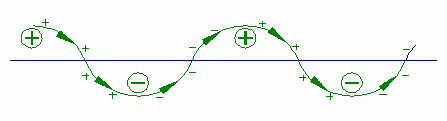
But first, a brief introduction to the nature of polar forces which are operative in cycles. Begin with the concept, if you can imagine it, of an empty universe, VOID (0) of matter, space and time. It is the eternal mind. Of this void there appears a dot, infinitesimal, a UNIT (1), All That Is. We can call it the Father of existence, and let's think of it as voice which is a function of the mind. The dot reveals duality - that which is and that which isn't dot. This dual concept is then the PAIR (2) of polar opposites, the positive and negative forces. The dual energies are the basis for existence but they are still and quiet. Next is needed the space/time experience as a stage for linear expression, and the two energies begin to relate in harmony and rhythm, dancing, undulating, carrying the seed of the Father into "time" (3). This undulating dance can be likened to SOUND, and called the mother since it is a carrier, as a sine-wave curve; it is power. Finite expression of sound is the FORM (4). The stage is completed and there is something of a dance, in perfect rhythm, without change. Now, the Father/mind and Mother/power produce a product, a Son, the WORD (5), the act of the play. Notice how the above capitalized words can represent the numbers from zero through five. The fifth significance, the Word, the act of the play on this stage is the essence of the Christ, the concept of change, the possibility of transformation. Einstein's famous formula, E=MC2, is more than arithmetic; it is a philosophic statement that recognizes change (either acceleration or deceleration) as the substance which makes up our reality.
The sine-wave curve mentioned above, the power of the universe, the Sound of God, is the dance of energies in a path around imaginary positive and negative focal points, like this:
The line of the sine-wave is merely a representation of energy forces which change in polarity each time they change direction to be drawn toward the next focal point. The only rule in this dance is the law of "opposites attract and likes repel." Thus, the result is a dance of pulsing, throbbing, thrusting and receiving, attracting and repelling relationships of energies: Yin and Yang.
Now we will use the sine-wave format as a map for laying out the zodiac periods of history. Along the curve, we place twelve segments, each 2,000 years long, and each with a zodiac name. The position of the end of Pisces will be placed on the zero line because geologists say that the last magnetic field reversal was about 12,000 years ago. This key bit of information makes the whole diagram work and its significance will become obvious.
Geologists cite evidence of more than a hundred magnetic field reversals prior to the last one, all at about equal time intervals of 12,000 years. With such a consistent track record, this should have us expecting another such magnetic reversal at this time, right now. Scientists do admit such a probability. They also watch with concern the opening of holes in the ozone layer above the poles, a radical event in the electro-magnetic field of earth. Based on past history, scientists also speak of probable movement of location for the north and south poles, with a slight shift of the earth axis.
Twelve thousand years ago the earth experienced such a cataclysmic event, between Virgo (virgin) and Leo (lion). The Sphinx, built just prior, in the age of Virgo bears witness to this date, being upper-half female - Royalty (Virgo) and the lower-half lion (Leo), as it stands watch over the great pyramid at Giza, Egypt. It was built at the beginning of a half-cycle of history, a 12,000-year period of limited earthly kingdom (World) of base animal nature. The ancient writer, Plotinus, thought the secret of the Sphinx was the greatest of all secrets, which no one had as yet discovered. And now it seems so simple.
The Bible offers some interesting considerations which are also relevant here. Jesus was born at the beginning of Pisces (fish) which explains the unusual emphasis upon fish in the New Testament - "fishers of men", and the netting of fish by disciples, etc. Jesus came at the end of Aries (lamb) as the "lamb of God", being killed as prophesied in the Old Testament. At the beginning of Aries, Abraham was the significant character, teaching monotheism, a return to spirituality, and venerating the lamb as the sacred object of sacrifice, and predicting the eventual coming of the "lamb of God." Anyone who still venerated the Bull of Taurus was castigated because that age had just been completed.
Our diagram puts Noah's flood at the very bottom point on our sine-wave, the time in history of mankind's ultimate degeneration and depravity. Prior to the flood in Gemini (heavenly twins) is the setting for the story of Adam and Eve. Her two sons were those twins (fraternal), one fathered by Adam and the other by Satan. This story indicates a re-introduction of spiritual values into a civilization which had bottomed out, and renews a contest between good and evil. And might we play with the idea of Scorpio (scorpion) being the serpent of the "fall"? At 10,000 BC we passed from Virgo (purity) into Leo (lion). As civilization was continuing to decay, the purity of the virgin would have to be yielded, accomplished at that time by the probable entombment of the reigning Christ. 10,000 years later the Christ would demonstrate that the tomb couldn't hold him as the stone was rolled away and he would again assume rulership for the next 12,000 years (Aquarius through Virgo). Other recent evidence places the fall of Atlantis at that same time. Atlantis was supposed to have been a civilization of highly advanced intelligence and technology. They could be the very builders of the Sphinx and Great Pyramid, probably in Virgo. Other pyramids wouldn't be built until the age of Taurus, and then as cheap copies because the real meanings had been long forgotten. It is also probable that Antarctica became ice covered at that time, twelve thousand years ago, when the location of the south pole moved to that continent.
Beside the path of ebb and increase of science, religion and history, we can use the diagram to play with philosophical concepts and spiritual correspondences. The cycles of the four seasons, or of the phases of the moon, or of each day could be located on the diagram, fall begins with Scorpio and winter with leo, etc. Perhaps this diagram can provide insights into epistemological mysteries, the process of learning, of the relative values of passing truths, and many other things.
Finally, if the path of history is truly cyclic and if a major earth catastrophe is imminent, what is there for us to learn that is to our real benefit?
First, it is self-defeating to attempt to thwart such an event by chanting Aum or by any means that demonstrates fear, shallow spirituality or self-serving interest. Christ did not refuse the transformation of the crucifixion; you cannot help a chick to break out of an egg; you cannot prevent a seed its death trauma which is necessary before it can become a flower. Nor can you prevent fall and winter without preventing spring; the harder the snow, the more glorious is spring. Worse than causing a crucifixion is any attempt to prevent it.
Such catastrophic disruption of life on earth and all civilization is the death which is absolutely necessary to permit birth of a new kind of society which will be founded on more positive, peaceful and spiritual constructs. This is not the end of the world like some Christians hope for, but rather it is the natural course of history, the end of an age, the end of a 12,000-year period of materialistic focus, followed by the resurrection of the Christ, the very salvation that Christ pointed us toward, the entry into a golden age to come.
The proper course for a spiritual person is that of understanding, acceptance of natural events, and personal spiritual transformation. This is a blessed opportunity for every person to re-evaluate himself, to redefine the nature of that which he calls God, to permit Chaos his own self-destruction, to watch with excitement the ongoing play of God, to play with integrity every one his own role, to release the material and emotional attachments that bind us to limited consciousness, to chase the money grubbers from the temple, and to realize how silly is the lie of appearances which we have used to curtain our worldly selves from our true selves, from God. For each person this transformation event can be an inner experience, deeply personal and spiritual, a death and resurrection out of misery into God's love and grace - redemption. The natural prayer of one's soul might now be "God, have mercy upon me, and may Thy kingdom come and Thy will be done on earth as it is in heaven."
The twelve-thousand year period of World history that is below the horizontal line is ruled by the Prince of Darkness, the Prince of this World of whom Jesus said he had no part. The period of history above the line is ruled by the Prince of Peace, the Christ, a corpus made up of the sons and heirs of the kingdom of heaven, as promised. We are being prepared by the hearing of the good news and by following Jesus example to and through death. This is the path.
The past twelve thousand years have been the periods of six ages from Leo through Cancer, Gemini, Taurus, Aries, and now we are at the end of Pisces. The cyclic program becomes clear as we look at the first six thousand years of spiritual decline (Leo, Cancer, & Gemini) followed by a gradual development again of spirituality.
LEO was an age when man still had higher knowledge but began to abuse it for the purpose of selfish power. He became earth focused, more materialistic and less spiritual. His proclivity was to subvert and twist his great knowledge until it became the practice not of spiritual powers but of earth powers. True spirituality was forgotten as the lionic, materialistic powers were developed. With the assistance of the intelligent earth forces (principalities and powers) magic became the occupation of those who ruled over others. The techniques of "will" power were developed. Earth spirits became more real to man's consciousness as he lowered himself to dimensions where horrid earth spirits dwell. The earth powers became rulers over a mastery-hungry mankind and spirituality was forgotten.
CANCER was an age of greater depravity and decay, a degeneration of civilization. Cancer then was like a period of disease that killed the spiritual nature of man.
In GEMINI the depths of depravity had been reached and there were no qualities of man that were not perverted and base, violent and evil. Near the beginning of this age God reintroduced His Spirit into His Elect race of offspring. While the rest of the world was earning its demise, a few seeds of spiritual mankind were being nourished and protected. Then a worldwide catastrophe washed away the evil generation along with all records of its existence. No nation on earth has any record of that wicked period of history. Adam's family was protected in a garden of the East, a place where the sun rises and brings light to a dark world, a dimension of consciousness where man knew oneness with God and walked with him in purity, a dimension that we cannot yet find or relate to. With the spark of light living again within Men's hearts civilization began to make some progress and we have some historical record of succeeding ages.
TAURUS is the bull of passion. As man progressed from base depravity and violence, his energies graduated to sexual-centered living. During the period of Taurus the bull of passion was both venerated and sacrificed. Along with the force of the bull, men recognized, named and worshipped many other forces; their gods were many. But there was some deep instinct that compelled man to sacrifice the bull as though they knew passion must decrease in order to develop further.
ARIES, the Lamb, saw at its beginning the birth of Abraham who would teach the world to look to one God instead of many. Regarding the Lamb of Innocence, it became the object of veneration and sacrifice as God's children were taught the eventual sacrifice of God's very own Lamb. The Lamb of Innocence represents the innocence of man before he became spiritually awakened. Now he is to become a participant in holy spiritual activity and will not be innocent but responsible for his relationship with this one single supreme almighty God that Abraham, Akhenaten and Zarathustra were revealing to the world. Aries is the age of monotheism. At the end of this age the Christ was killed as the very Lamb of God and innocence was dead. Ignorant mankind could no longer look to an external and distant God pleading for beneficence; man would learn that he is a participant in God, united with Him, with responsibility. Man's separation from God had ended and he was restored to union with full return of holy spirit life.
PISCES is a very different creature from bulls and lambs, being a fish which swims in water. The traditional church has not, since the first couple centuries, been willing to recognize the significance of "fish" in Jesus= life. The early church used the symbol of "fish" as its emblem. Jesus inaugurated the age of the "fish," Pisces, and the early church knew that. The church of the dark-ages tried to erase this information, and the modern Protestant movement has not moved very far from that dark-age religion of Roman tyranny and hell. I think that Jesus came as a "fisher of men," meaning that he came to re-catch the lost sheep of the house of Israel, just as he explicitly stated. The age of Pisces is a fishing-expedition in which the good news of the New Covenant is carried to every spot on earth, in order to re-claim those white-race twelve tribes of Israel who became scattered all over the earth following the Assyrian purge of 700s B.C. God is offering, through Christ, a reconciliation with all those who possess His divine nature. After all, they were created in his image; they are His own children; they are a part of Him, and they will not and cannot be lost. Sheep in Aries, fish in Pisces, our race contains His beloved children!
AQUARIUS is the water carrier. It appears that the symbol indicates greater facility with one's spirituality, a greater freedom yet than that provided in the medium of finite limitation. We can hardly speculate about the nature of this new period of history which we are about to step into. We just don't have the minds yet to comprehend such unknowns. But, we can yield to it and welcome it, even though the transition into it means the death/crucifixion of the old human nature which has limited us so.
Keep in mind that during the ages of decline, from the fall in Scorpio to Gemini, that it was proper and natural for the positive spiritual energies to be attracted to the negative pole and to become impure and degenerate. Now it is proper for the negative human nature and corrupt world to be attracted to the positive, to God the Good, to repent, to be transformed and regenerated and become perfect and holy. We might wonder if during the period of decline people envisioned a God of evil to whom they were attracted as they did what they needed to do to fulfill their proper roles of degeneration.
Church circles would speak somewhat less scornfully of the heretics
if they would only devote a little imagination to visualizing the spiritual
situation in which these religious rebels found themselves. The
heretic knows himself to be dependent upon God alone; he knows that
he must obey his conscience. From the Christian point of view, this
attitude is irrefutable.. . .
Heresy is a poignant illustration of this truth. It presents
the story of persecuted truth - one of the noblest spectacles upon
this earth. The bloodied pages of the story of heresy tell a tale
of martyrs within Christendom. With their heart-rending readiness
to suffer, the heretics represent a continuation of the Passion of
Christ, which will go on until the end of the world.
The staggering idea that the evangelical story of the Passion
goes on into the Christian era can be comprehended only in terms of
a mysticism of suffering; it cannot be understood rationally. It
springs from the deepest reaches of Christian feeling.
Walter Nigg The Heretics
Giordano Bruno ONE OF GOD'S CHAMPIONS
"heretic" 1548 - 1600
Bruno entered a Dominican monastery at age 14 and wore the habit for many years. But he was ill fitted for the cloister and the life of contemplation. By the time he was eighteen he was already doubting the Trinity. To fellow monks he was so incautious as to speak warmly about certain heretics. He threw away his images of the saints and advised one of the brethren to read a more sensible book than the Lives of the Holy Fathers. The inquisition began to take an interest in Bruno. In order to avoid it, he broke his monastic vows and took to his heels. He went to Geneva and there he found that he was even less in sympathy with Calvinistic spirituality. He moved to Germany and stirred up a hornet's nest by his attacks upon the academics, whom he despised for making a trade out of philosophy. His life of restless wandering came to a sudden end when, seduced by longing for his native land, he went to Venice. He had been thinking of a reconciliation with the Catholic Church. He would, in his writings, at times confess that the Catholic Church was "after all dearest" to him. In Venice he was handed over to the Inquisition by a piece of shameful treachery, and thrown into prison to await his trial. At his trial he expressed deepest sorrow and rejected all charges that he was anti-Christian. By means of concessions he hoped to propitiate the Inquisition. The trial ended without a verdict, but Venice turned him over to the Inquisition in Rome. After years in a dark dungeon, he declared at his trial that he had nothing to repent of and nothing to recant. The tribunal found, instead of a broken man, a wonderfully composed heroic soul. The verdict was that he was an impenitent apostate. When the death sentence was announced, Bruno replied proudly to the judges: "Perhaps you proclaim your verdict against me with greater fear than I receive it." He died on a pile of burning faggots on February 17, 1600.
To understand Bruno, we must think of him primarily as a poet-philosopher. He himself felt that a wondrous spiritual affinity existed among true poets, musicians, painters, and philosophers. Philosophy was poetry, and poetry divine truth. For Bruno, thinking was a matter of sketching the images born to his fiery imagination, and for that reason we must not expect precise concepts and definitions in his works. "He aims at the intuitive thinking, at conceptual images of things, at illustration of ideals."
Bruno's philosophical views sprang first and foremost from his reading of Copernicus' works. Copernicus dedicated his Of the Revolutions of Heavenly Bodies to the Pope, only to incur the displeasure of the church in spite of this. Luther was equally adamant toward the astronomer. In his studies of the Copernican system Bruno was struck by the concept of infinity. Consciousness of infinity, which comes to men through the study of astronomy, is one of the most powerful of human experiences. The idea of infinity is a metaphysical concept extremely difficult for the mind to grasp. Herein lay Bruno's real heresy. It was this affirmation of infinity which the Church felt to be the stupendous threat to its system. For, sweep away all boundaries and what was left of high and low? How could they go on speaking of the abode of the blessed and of a heaven to which Christ ascended? The Church had already indicted Copernicus' theory because it saw it as ruinous to its philosophical structure. This was even more true of Bruno's doctrine of infinity, which threatened to dissolve into nothingness the comfort offered by Christianity. The arching firmament of heaven, to which the Christian had looked up beseechingly, would be lost to him, and with it, his last safety. Instead of feeling that he enjoyed God's protection, he would be face to face with a yawning void. The dread inspired by such a view emerges in the outcry of Pascal: "The eternal silence of those infinite spaces makes me tremble."
excerpted from The Heretics by Walter Nigg
The divine, sacred Spirit of God might be thought of as the Mother-type, the feminine, the power, the mate to the Mind, which might be considered the Father. The feminine, then, is the POWER which underlies all existence, the subtle essence of all relationships of positive and negative energies. Male WISDOM wishes to possess power, to conquer her, to force her to submit to Truth, to enter her and fill her with the rapture of wisdom. She longs to be conquered, to be guided, to serve Him, and yield all to Him, and to bear the seed of wisdom to fruition, multiplying and replenishing the universe in order to restore the state of peace and harmony, to dance this dance of God again without dissonance and static, to thrill with the perfect rhythm of the music of the spheres in heavenly happiness forever.
Male is wisdom. Female is power. Perhaps this is how mankind is the image of God. But in this present kingdom of World where the Lie reigns supreme, these qualities have been perverted. We see power as a function of the male, of the sun. It is for us a positive, dynamic, active energy, the combustion of fuel or of some active force like the water at a hydro-electric plant. We feel comfortable with this concept, but this is only natural to this World where spirituality is handicapped. After the passage from Pisces to Aquarius, the worldly type of power will cease to be natural, and with an increasing spirituality a type of power will be developed that is the opposite of this which we now know. It is already beginning to be understood slightly. It has to do with the use of foci of planes of magnetic fields. Whereas we now pass wires through a magnetic field to generate power, then it will be found that spiraling forces of magnetic fields disappear into vacant places, like the "black holes" of the universe. Levitation will be an example of the use of such power. It is difficult yet to envision uses of this kind of energy because civilization will have to change much in order to be compatible with such energies. Such is the female type of energy, natural and peaceful and effective when society becomes spiritually motivated. The male energy is the mind which will direct and dominate the great power. Here is the proper relationship between mind and power, between male and female.
Now we are discharged from the law,
dead to that which held us captive,
so that we serve not under the old written code
but in the new life of the Spirit.
Paul, the Apostle To the Romans
Our dimension of reality consists of our perception of "things" which are the interplay of the two polar opposed forces. Every atom is a combination of different forces, some negative and some positive, working together to be the atom. All forces have their origin at God, are of God, then appearing - as agents of His will. Since they are OF God and act with purpose, they, like EVERYTHING that is of God, have intelligence and consciousness, but not free will; they are subject to the will of the minds of the living creatures which have breath (spirit/pneuma).
While the function of our conscious minds is related to our own dimension of reality, we must recognize the limitations of our minds and of this limited reality. Only when the conscious mind can know itself as it truly is, as limited and blind and tainted by emotion, and as egoic, only then can the self begin to realize Truth.
As we perceive the dual forces playing in opposition (dancing), we see evil playing against good. This is the game; it is futile to deny this opposition by claiming to be above it until such time as the evil/good struggle becomes a vague memory to the conscious mind. Meanwhile, the entire game is played on a field where we are bonded to this kind of consciousness. This is very simple and worthy of much meditation. We exist here at this level of consciousness because we, of our own accord, refuse to release the "values" which we mistakenly think are necessary for our lives. These values serve as prison bars, and we love them and protect them and guard them and fear their loss. We maintain our values with the power of our emotions. We teach and preach prison. Our values consist of such things as homes, attachments to families, friends, and jobs, along with vehicles, items for recreation or sports, and pleasures of emotional satisfactions. We value most basically a desire for security, that we must plan ahead for tomorrow for housing, food, old age, health, children's futures, and any other thing which will tend to make us comfortable and happy with what we might call the "good life".
That is a picture of your prison. You are determined to "live", thus you willingly develop your prison cell to be ever more secure and safe. Cary Grant's Ernie Mott is the story of a free man's demise by succumbing to the world's traps.
Jesus' message was to us prisoners, telling us to free ourselves by breaking the chains of bondage, rejecting the world, dying to it here and eventually in death of the flesh. He said that if you save your "life" you will lose your soul. He said not to worry about tomorrow's food, housing, or clothing. He said to sell it all, give it to the poor, and to follow Him. His message was that life eternal is attainable only through death of this life, the releasing of all the traditional values and material things.
What one runs up against in pursuit of this spiritual path is that an ego is very powerful, that one's conscious self has a survival instinct which opposes its own death. Now, this is not to imply that suicide is ever a noble goal. It is not. The spiritual person releases the values of this life in order to permit the flow of God's spirit within Him, to become an heir of God's "kingdom," a beloved son.
But, yielding up one's ego is tough; it is the experience of the cross when one's ego gasps its dying cry, "My God, why have you forsaken me?"
Let's look at this experience more closely. To suffer the death of the ego is fearful because we don't understand what, if anything, will be left of us. Can you, all alone, in the quietness of your heart, turn to God and pray for the annihilation of the total person that you know as your "self"? Can you say, "I yield completely to you, Father, and may all that I am cease to exist, please. Let my very name be erased from all history. Let there be no conscious memory of my existence and let me have no consciousness anymore. Let my being, whatever it is, return to be one with Thee so completely that there won't even be any memory that this "self" ever existed. And, if this prayer is presumptuous and it is Thy will to deny it, and if it even be Thy will to leave me in hell, then I still pray with all my soul, "Thy will, not mine, be done, my Father, for all the energy of this self belongs to Thee and I can't but rejoice that You might use it in any way at all and for any purpose. So be it, forever. Amen."
There have been and there are now men and women who have prayed such prayers. They are called "Mystics". Down inside every spiritual person there is a spark of the Mystic yearning for the quiet contemplation which is the fuel by which the spark becomes a flame. Earth can permit no greater blessedness than that you might shut it, earth, out occasionally to turn within and mediate. And earth is reluctant to permit even that. This world wants to overwhelm every person with activities, with noise and toxins, and any other possible thing to block you from the quietness of your own self, alone.
As we consider the nature of our bondage here in this world, we can look at the operative forces more closely. There are two primarys: the need for material security and secondly the survival of the ego. The forces which promote these two things are very powerful. Now, let's reveal those forces and see them naked. By exposing them we can release the lie of their power. These are the essential functions of evil and are the forces of that which we call "Satan". Our bondage results from our participation in this farce by "owning" the lie.
Satan can be pictured as the top block of a pyramid of forces, all of which are devoted to the survival of our limited dimensions of reality such as we know. Beneath Satan are these two forces. The one promotes exaltation of the ego, to make popular the egoic statement, "I am God." (Conversely, Jesus teaches, "Deny the self, take up the cross, and follow me.) The other force promotes the lie of material reality, helping you to believe that the "good life" depends upon material comforts, luxuries, and security. This force has been so successful that some churches even teach that God wants us to experience bliss and happiness here in this world, satisfying the ego completely, securing this life. (Conversely, Jesus teaches that he who saves his life loses his soul.)
These forces are pervasive in our world and we are taught their lies while young. The lies are pernicious and seductive, and during these last days they are increasing with great effectiveness. The Bible warns very sternly that in these times some of the elect are in danger of being lost.
So what am I getting at with all these radical notions? This: that the world teaches a bunch of crap which results in a poor quality of spiritual life that really stinks. That if you want more, it is up to you to throw out every moral, religious, political and ethical dogma you've been taught, EVERY ONE, and start from scratch. If you re-adopt any of them, do it on your terms, for yourself alone; take your time about it, and even then hold all convictions slightly suspect. Seek the Truth for yourself, and YOUR Truth shall set you free. I'm saying that you are the only one who can recognize truths that are valid for you, and who can judge when to let an old truth go to adopt a new one, as you grow. Anyone "out there" who tells you that he knows what is the best Truth for you - that person is not your friend.
More precious by far than all other treasures, gold or love or this life itself, is one thing which each of us already has. It is that faint stirring of a whisper within the soul that is the presence of the eternal God, the divine spark, the holy Spirit. It is the only thing of value that one can possess. To search it out and realize its reality, to hold it and breathe its breath is the one task that would be worth countless lifetimes of dedicated effort. Surprisingly, it is very easy. In the quiet stillness of solitude, with a yearning heart, this ephemeral whisper will speak to that part of you that knows no words and you will know that you are loved by the divine. This diaphanous treasure is so fragile at first that it will vanish if you try to touch it with words, so just stay quiet and let it happen. It will return again and again when you set aside the cares of the day, and the noise, when you are yearning. It comes to those of gentle heart and humble spirit, to those who abandon all other hope. This precious contact is so delicate at first that you must protect it and defend it as a fierce dog protects a baby. Later, this baby will become your strength and will protect you. This Spirit of God is like a flower of such delicate beauty and sweet scent that you as a bee will have rapture at its fountain.
This communion with God is something that "techniques" can never achieve. Not by any yoga practice or initiation or by chant or magic-name or by any method can God be commanded. Only by yielding completely, abandoning all hope, in the secret quiet of your own life can you realize His presence. He says simply, "Be still and know that I am God."
Untroubled,
Scornful,
Outrageous -
that is how wisdom wants us to be:
she is a woman
and never loves anyone but a
warrior.
F. Nietzsche Thus Spake Zarathustra
I'm in my fiftieth year now, winter of 1987, becoming more of a child in nearly every way. I've seen adults - no child should ever hope to be one! Many years ago, as a youngster, I tried to learn the ways of the world, but I failed. Some part of me was too defiant - as my earthly father would confirm. No one can honestly define this world as a happy circumstance. For me, defiance proved to be a blessing; because of it I saw through the illusion of phony happiness - to go forth for myself to seek "real" happiness. Like Hercules in pursuit of his quest, I went searching in many wrong directions, some which were even endorsed by the ecclesia (the organized church), which was in the end good because it helped me walk through their dark cloud.
There were many moments that confused me. And since the honorable lady, Virginal Happiness, so determinedly resists her suitors, why shouldn't I settle for the mistress who devotes herself to me with enthusiasm? Her name is "Pleasure". So, we dance often. Yes, she is my frequent companion, when savoring some rich food or doing 130 on my motorcycle or joining in a rousing hymn or feeling a powerful drama or so many other things which thrill my senses and please my ego. Pleasure is a pretty thing. And she's a whore! She even cavorts with the rich! But, I like her, and court her nearly every day. Don't we all? I don't say "I love you" anymore though, because she is so damned fickle.
You know something that really angers me? It's how she likes to be with kids - wants to help them grow up! Pleasure is right there, from the crib on, filling a child's head with thrills and delights, pretty colors, sweet candy, and fairy tales. Kids are easy; pretty soon they are addicted and decide to buy in. They don't know how seriously they have been deceived, that she is a lying substitute for happiness. And worst of all, she's got that God-cursed Santa Claus pimping for her, leading children into her trap. Pleasure, being Santa's mother, makes him a genuine son of a bitch. He is a red-suited lying King of materialism.
Isn't it something that I, we, even knowing the truth about Pleasure, that we would still be so addicted that we continue to devote our lives to the seeking of her favors? How can I, or anyone, ever dare to preach to any person while still coupled to this paramour? What Pontifical, hypocritical, self-righteous arrogance!
Speaking of Pontiff reminds me that Pleasure has an ugly sister. Her name is Misery. She doesn't appeal to me, but she must be good at something - she's in bed with all the law-based religions of the world, preaching guilt and condemnation just like it was something of value to sell. It's a profitable relationship for both - Misery gets satisfied and the church gets the money.
Well, so much for Pleasure and Misery and their evil. Makes me feel nauseous to think about them recruiting beautiful children into their adult disciples. This should make us all angry!
Reflecting on the above paragraphs, perhaps I should mention a few more malefics. First, let's look at the concept of "maturity". Society means by that: the process of conforming to its mold. Good word, "mold". Society says that you must frustrate and suppress your own natural and holy inclinations of achieving your own potential uniquely. Society feels threatened by such a god-like individual who follows his own mind, and will not tolerate it. You MUST wear the ill-fitting, constricting costume that "they" choose for you, designed by law for someone smaller than you want to be. As a youngster you must not investigate, experiment, question, or draw inferences that are of personal value to you. "Don't touch that." "You'll understand when you grow up." "Who do you think you are anyway?" "Who said you could do that?" Be seen and not heard." "Don't ask stupid questions." "When I want your opinion, I'll ask for it." ad infinitum, ad nauseam.
Growth and truth are designed for you by preachers and teachers. Preachers get by easy, by generalizing, because with concerted voice they effectively reduce everybody to their own level of unholy estate, that of "sinner". Teachers have the opportunity to frustrate you individually; they're good at it too. "Don't wiggle; don't daydream; just sit like a stone and upon command spit back what has been programmed into you." GIGO!
Where in society is anyone teaching the following? That freedom is a state of inner-self satisfaction, not a socio-politico-economic situation; or that love is not emotional satisfaction, but rather a matter of happy tolerance and joy in each other's personal self expression and celebration of uniqueness. Ask yourself what kind of responses you have gotten to your expression of your own uniqueness. And what about "quietness"? "Be quiet" is a put-down. Who teaches children that times of quietness are doors to heaven, to bliss, to peace and happiness beyond understanding? Rather, society (parents included) overwhelms you with noise and activity. TV and rock music drown your inner life and light. Who teaches that quiet contemplation is really prayer? The church teaches that prayer is an activity, something you DO. (Exception: there are some eastern philosophies which do teach that meditation is prayer and a place to meet God.)
And who teaches that a child of the most high God should be confident and regal in his bearing, that forgiveness means exactly what God said: "I will remember your sins no more." NO MORE! forgotten, gone, like they never were, so that you can stand tall and proud and KNOW that you've got it made. Rather, the church teaches "humility" as a stoop-shouldered, head hung, scared to speak, needy and degraded posture. And they follow up with the promise that for help you can bring money to church and buy more of the same. Jesus was humble, but the church today would run Him off quicker than did that high-priest of old!
You want truth? Do you? It ain't out there. Sorry about that. All that's "out there" is bullshit, carefully designed and packaged to defeat you just like all of them were defeated who now want to guide you. In their deep anger they pass on to you what soured in their own stomachs. It's no wonder cancer is so prevalent; look at what is eating peoples' insides. You want truth? - find it for yourself. Look inside your own wonderful thoughts.
Another thing: consider the moral dictum of work ethic that society promotes, that he who does not work shall not eat. That is Marxism, not Bible! Jesus took some guys away from their jobs to wander the roads with him, and he even said "Do not labor for food," and "Don't worry about tomorrow what you shall eat or what you shall wear." He was a "hippie".
Jesus showed the way to victory over the established opposing forces, through the cross and death. Jesus was a severe and stern teacher, contrary to Sunday School lessons. He never watered down the severity of consequences for those who deny the path to victory. Read some of the parables that He told, and notice how unusually stern and severe He was. Remember that those virgins who didn't put oil in their lamps were not permitted into the wedding banquet even though they begged. Remember how he told the rich man to sell everything in order to follow Him, and that it is impossible for a rich man to enter heaven. Remember that he said, "If anyone comes to me and does not hate his father and mother, his wife and children, his brothers and sisters - yes, even his own life - he cannot be my disciple. And anyone who does not carry his cross and follow me cannot be my disciple." Jesus made explicitly clear that this dimension of conscious reality is not the kingdom of heaven, and those who seek security and satisfaction here will not be permitted through the gates into His fold for they are not His sheep.
It confounds my mind that any person, let alone the church through the ages, could fail to hear the message of Jesus as clearly and plainly as He gave it. And even without Jesus, the same lessons have been taught by Buddha and Confucius and Zoroaster and Mystics throughout the world. These were people who attained spiritual realization (not "self" realization) and understood the higher truths that God provides to those who truly seek.
As we begin the experience of progressing from one dimension to another, the children of God will be transformed and in the age of Aquarius enter a kingdom of blessed relief from this world's woes. Let's not waste any time focusing our concerns on this world's wealth and luxuries lest we jeopardize our souls and our hopes for life to come. Listen to Jesus words:
"The sons of this age marry and are given in marriage. But those who are considered worthy of the resurrection from the dead and to attain that age neither marry nor are given in marriage, for it is not possible any longer to die; for they are like angels and they are sons of God, being sons of the resurrection." (Luke 20:34-36, literal transl.)
In the happy night, In secret,
when none saw me, Nor I
beheld aught,
Without light or guide, save that
which burned in my heart.
This light guided me More surely
than the light of noonday
To the place where he (well I
knew who!) was awaiting me -
A place where none appeared.
St. John of the Cross
Dark Night of the Soul
In one's spiritual search for reunion with God, there eventually comes a time when the genuine seeker is ready to take that leap of faith and abandon all "self" for the sake of some undefined and unknown union with God. This experience is a terrifying event. It is that moment of opening a door and looking through to see nothing but blackness of infinite void. Knowing there is only one way to pass through that door, one cannot reach out with a foot to feel for floor nor can one feel for a light switch; there is none. One is confronted with the chance to step forth quickly and enthusiastically, without hesitation, into the abyss, not knowing what is there. One can feel very strongly that there will be nothing there, no time, no space, no hope, no God, no past or future, and no self after that first step, but one knows even more strongly that there is no other way to yield to God. This infinite void is unknown because there is nothing there to be known, nothing that the mind can ever grasp. It is desolation, spiritual destitution, annihilation of the egoic self so that there is even no self to know anything further. Such is the leap of faith that Christ took when He stepped through his door, nailed to the cross. He said, "Eli, Eli lamasabachthani" (my God, my God, why have you forsaken me), the primal cry of a spiritual child.
If you ever genuinely feel the reality of that void, there will be a nearly irresistible compulsion to reach backward and grasp something of this finite earthly dimension. The urge will be so strong that your conscious mind would happily return to a life of pain and suffering rather than take that leap. The worst sufferings of life might appear desirable to you in comparison to your fear of that unknown.
Such is the leap of faith that is required of each of us. Yet, we have this, that one has gone ahead and returned to give us confidence. He went to sit at the throne of the eternal Father; he did not stop part way.
But for us, we are not all as fearless as He and we often look for less along the way. Some of us buy into limited concepts of heaven, even heavens with finite dimensions, streets of gold, and so forth. If such is your limited expectation, such will be your reward, permitting you to retain your ego so that you can "enjoy" your heaven.
But for those who leap into the unknown void, there is a cessation of fear, a quieting of the soul and spirit, a peace beyond understanding. After the experience of this void, of this experience of God, one returns to this world a different person. That which is now clear to you is not something you can explain to your friends. You feel estranged, frustrated, confused about life here and its purpose, at the same time you feel compelled to share something indefinable with others and wonder that they cannot understand the wonderful things you speak of. Eventually, you will give it up and realize that the unknown void must remain unknown for every prospective leaper, and that you can do the most good by simply reflecting God's light in your joyous attitude.
Nothing in this world has any value to compare with that subtle light, and now you know that the long, solitary, pain-filled walk is more than worthwhile. Now you know what Christ knows.
The crowning feature of Origen's bold doctrine was that even
the New Testament did not contain the conclusive revelation of God.
The four Gospels alone did not contain all the mysteries of the faith.
They only suggested to Christians the "shadow of the secrets of Christ."
The New Testament must be regarded as the gateway to the eternal gospel
whose pneuma could not even be expressed in letters of the alphabet.
Walter Nigg The Heretics
Michael Servetus, ONE OF GOD'S CHAMPIONS
"Heretic" 1511 - 1553
As a youth he had been a zealous Catholic. But he began studying the Bible and the writings of the Reformers, and this reading transformed him into an opponent of the papacy. His thoughts began to circle incessantly around the figure of Christ, whom he hailed as his sole master. He enjoined Christians to forget the Christ of dogma and return to the Christ of the Bible.
Protestantism, Servetus held, had committed the serious error of accepting dogmas that had formed during the first three centuries of Christianity.
John Calvin (Reformer) had written to Guillaume Farel (a great orator of the Reformation, who first converted Geneva): "If he comes here [to Geneva] I will not let him depart alive."
Seven years later Servetus made the mistake of attending a sermon by Calvin. In church he was recognized, and there were officers ready to arrest him immediately after the services. He was made to stand trial. As an obstinate "heretic" he had all his property confiscated. It became a matter of prestige for Calvin to assert his power in this case; he was forced to push the condemnation of Servetus with all the means at his command. He wrote to Farel during the trial: "I hope that the verdict will call for the death penalty."
On the morning of October 27, 1553 a silent procession led Servetus to the stake. When the executioner began his work, Servetus whispered with trembling voice: "Oh God, Oh God!" Farel snapped at him: "Have you nothing else to say?" Servetus replied to him: "What else might I do, but speak of God!" Thereupon he was lifted onto the pyre and chained to the stake. A wreath strewn with sulfur was placed on his head. When the faggots were ignited, a piercing cry of horror broke from him. "Mercy, mercy!" he cried. For more than half an hour the horrible agony continued, for the pyre had been made of half-green wood, which burned slowly. "Jesus, Son of the eternal God, have mercy on me," the tormented man cried from the midst of the flames.
excerpted from The Heretics by Walter Nigg
My conscious ego-self desires to identify with the supreme power that is within, the omnipotent God, and to realize the bliss of oneness, of Godness. But, it can never do that because my conscious mind is limited, blinded, ignorant and is busy participating in the great lie of earthly reality. My conscious self is my ego, unique, an individual, even given an individual name, determined to be unique. It is like a drop of water in a great river, wishing to retain a unique and specific identity, yet wishing to have conscious control of the whole river. It is only when the shell of this drop is destroyed, yields to the river, and the drop is permitted to die as a unique identity, only then can it be dispersed to become omnipresent throughout the whole river. Of course it then has no longer any unique identity or individual consciousness. There is no longer a self, nor even a history of one, nor any pride or vanity nor smug satisfaction of spiritual realization. The conscious individual self doesn't exist, even in memory. There is only "Godness."
But the instinct for ego survival is strong, and the conscious self does not want to cease to exist. It clings to the lie of being an individual identity more tenaciously than it will ever admit consciously. This instinct for self-survival is the strongest force opposing a seeker of spiritual realization. It is difficult for one to consciously pursue Truth while simultaneously denying the very consciousness which seems to be doing the seeking. This is a paradox the mind cannot deal with rationally, yet the seeker continues to force succeeding footsteps along his path. The path is confusing, sometimes foreboding, and mostly without recognizable reward. Yet does the seeker plod on, driven by an unexplainable force.
The driving force is that Spirit of God which has been dormant within, which now struggles to grow in strength until it can claim victory over the limited ego-consciousness. In quiet meditation, one can admit that there is such a spiritual force at work, and one can even consciously desire to submit to it, but one does not know how to do that. This submission is like a conscious acceptance of crucifixion, a willingness to be crucified, but there is frustration that one doesn't consciously crucify one's own consciousness. How does one become crucified? How does ego release itself? It is no more possible for the conscious mind to engineer its own crucifixion than it is to consciously control one's falling asleep at night. The act of falling asleep is a good analogy for this process of death. The harder one tries to fall asleep the more awake he is, until he ceases the effort and patiently abandons all hope for sleep, then it will come. When the conscious self abandons all hope for unique identity, then will the reward come quietly and there will be no conscious recognition of it at all because the self is no longer. The return to the Father, by resurrection, is like reabsorption into one's source. Just as you are not consciously awake while sleeping, so you will have no conscious recognition of this ultimate glorification.
It is the bondage to this worldly-limited so-called "life" that one wishes to transcend. The Mystic gives his all, abandons his self totally, and will settle for naught less than a return through death and resurrection to the Father's bosom. He holds no hopes or goals or fantasies other than this totally unknown and incomprehensible consequence, and for this he holds nothing back, even yielding the desire to understand something of the place to which he goes.
Imagine for a moment that God is a pond of clear water, so still and smooth that it is not visible; one cannot see the still clear water, but can only see through it. It seems invisible. But when conflict is introduced the surface of the pond is violated and waves run counter to each other and there is splashing and chaos, a scene of violence, making the pond very visible. This is then the substance of our world, of all finite realities including hell, the splashing being chaotic change. This kind of chaos is the nature of our reality and is the opposite of peacefulness. Ultimately, the redemption of the world will be a cessation of the splashing, of such changing, and there will only be the nature of God left. Our world is temporal, temporary. Hell is a continuing consignment to chaos, but is not an eternal damnation because it cannot be eternal; it is limited to a time structure, as are Satan and all other angels which are creations of God in a finite system.
The return of a spiritual contemplative to the Father can be likened to a drop of water in the pond of splashes. If the drop will stop participating in the chaos, give up its violent goals, and yield to the stillness it can be redeemed from its plight and return to that dimension of stillness with the eternal God of peace, the smooth invisible pond surface, or the flat line on the scope.
Remember this one thing: one cannot take peace by force, one must yield to it by abandoning all else, then peace is what will be left.
Look at him! -
Having conquered the forest of desire,
he runs to the forest of new desires;
freed from the forest of desire,
he runs to the forest of new desires.
--All in vain; for he runs into bondage.
Dhammapada by The Buddha
Some of the eastern philosophies teach that there are seven levels of "chakras" along the human spine. I have long felt that there must be some validity to their idea. In trying to understand and categorize the different levels (dimensions) of consciousness of earth life, the seven levels would seem to be defined as follows:
1. Tail-bone BASE-LIFE nearly mindless, micro-VIOLENCE organisms, eat & be eaten.
2. Genitals SEX FOCUS instinct directed, animals, usually small minds.
3. Abdomen EMOTIONS the psychic mind, lower earth-type humans, some reasoning abilities, ruled by emotion.
4. Heart COMPASSION reasoning ability, earth-born humans, highest of earth/finite consciousness.
5. Throat CREATIVE idealistic, rational, "born from above," WORD philosophers, noble, on higher path, spiritual/intangible goals.
6. Forehead INSIGHT wisdom, understanding, God= s elect, Mystics, spiritual, solitaires.
7. Crown ENLIGHTENED transcending mind, God= s Avatars, immortals, enlightened, Christ, Buddha
A person's consciousness seems to dwell mainly on one particular level while overlapping onto the immediate adjacent levels and in some extreme cases to move briefly to more distant levels. Although our civilization is generally at the heart level we seem to have easier facility with the lower three levels than with the more difficult higher levels.
It might be that the path of salvation is characterized by progress upward through dimensions of consciousness. Along that path instincts become less important as one gains reasoning abilities; psychic sensitivity gets left behind as one gains wisdom; reason/logic is not necessary for the enlightened mind which seems to get revelations from God.
Planners make canals,
archers shoot arrows,
craftsmen fashion woodwork,
the wise man molds himself.
Dhammapada
by The Buddha
There seem to be three realities, one - of the unknowable God, and two which are reflections of Him, as follows:
The FIRST, ULTIMATE, REALITY is that of Spiritual Truth, infinite, omniscient, holy, the life of God. This is the reality of Man's spirit, not his soul but that Spirit of Man which is one with God, indistinguishable from the sacred Spirit of God. This reality is fluid and inexplicable and is the only true reality. Any other reality, of any dimension, mental or material, is but a reflection of this. The word "reflection" may not be the best word to describe knowable realities, but because limited realities exist only in one's perception it seems more appropriate than other words. In a way we might consider our limited reality an exercise or expression of the life of God, which it is, but finite reality is not a direct extension of infinity; it is more like a reflection than extension.
SECOND is this finite dimension of World. This is a reflection of the infinite, thus reversed in image. Here is the realm of Jesus, the Christ, enlightenment, freedom, and those forces of God which have consciousness and intelligence, forces which result in manifestation as this universe, this holy creation of God. These forces of God are the angels (messengers), the ministering spirits, and as unique identities are given names. These angelic forces operate through a hierarchical structure maintaining a finite order and stability. We can recognize these forces in the laws of nature. Ancients recognized these forces and gave them names and personalities, shallow, but a step toward Truth. These angels work unseen and unrevealed, never, NEVER demonstrating through mediums and rarely ever being known by personal names or identities for they are egoless servants of the most high God. Man's mind, as a holy child of God, is the operator of this reality, the director of a perfect and peaceable kingdom, a dimension of reality like the garden of Eden.
THIRD is the great lie, the realm of Satan, this very earth world that we perceive by the eyes of our egos, the very opposite of God's good creation. Here is a counter-hierarchy of forces which operate through deception. The members of this hierarchy will present themselves through mediums and will give themselves the names of God's holy angels: Gabriel, Michael, etc. Some even claim the name of Jesus. They are primarily ego, and through their very limited powers and evil consciousness they practice abuse of elemental powers to subvert and oppose Truth, to cause chaos, and to bind the consciousness of any person to this dimension of finite reality. Under the influence of these evil forces, this knowable reality functions as the great lie. One easily holds himself in bondage to it by the ties of emotions, fears, earthly love, and sensual gratifications. Satan is the head of this pyramid of forces which endeavors to do two primary things, to promote the egoic belief in any person that he/she (in corrupt ego self) is in fact God, and secondly to promote and establish a materialistic kingdom, entirely denying all spiritual realization, working very effectively through the organized religions and political systems - all of them.
It is no accident that the church has been the most successful tool of all, by which Satan has used Christ's name to turn men's focus toward an external deity, and to foster the unquestioned conviction that worship is an activity that one DOES. By completely ignoring the full meaning of sanctification, the evil influences have caused religions to gather around the central idea of sin, as though the battle between good and evil is still to be fought. Morality is the paper tiger to whom frightened mankind sacrifices himself and his children.
For those rare individuals who realize their own spirituality the paper tiger is not something to fear, but something to look beyond. Reach out and erase morality as the substance of your religion and you will find on the other side of this paper tiger is freedom and enlightenment, a ceasing of strife and a path to the realization of God's perfect kingdom.
I would like to assume that you understand I am not promoting immorality, but, just in case you are in doubt, please assume it. I think immorality is missing-the-mark, big-time.
I am a part of all that I have met;
Yet all experience is an arch wherethro'
Gleams that untravell'd world
whose margin fades
For ever and for ever when I move.
Ulysses by Alfred Lord Tennyson
The spiritual path is very difficult! I spend my days in yearning, an intense feeling of craving for some indescribable union or knowledge or experience of God. It is a strange feeling, peaceful yet unfulfilled. The very yearning itself IS some kind of relationship but not something I can understand to my satisfaction. It is a contentment that feels like a gentle "high", and is also a kind of desperation which expresses itself as a cry from the soul pleading the words "eternal Father" over and over, running the words together, overlapping them, all being expressed in a plaintive sigh. If I knew a question to ask of God, I'd ask it, but I don't know any. I used to have questions, but they all seem so trite now, and even presumptuous. Who am I to be requiring any answer beyond "Thy will be done"? All my studies, all my learning, all knowledge seems so irrelevant, something that I can't offer anymore. I have nothing to offer, nothing of any value, not life, not soul, not death, not sacrifice, not worship, nothing. My spirit becomes ever more empty and desolate and the words "eternal God" lose their form in a sigh from my darkness so weak and soft and desperate that it seems to lose its form.
This state of mind absorbs my strength and leaves me weak. I have a feeling of repulsion toward physical activity, work, eating, anything worldly. The obligation to maintain this life is a loathsome chore, but I go on doing it anyway without knowing why. There is sometimes a desire to just sit and meditate blissfully and let the body die.
My question in the waking state (in limited consciousness rather than transcendent consciousness) is how to handle this earth-reality responsibly. To offer myself for transcension doesn't work; I am left to reawaken to the limited mind again. I resent most terribly the need to FOCUS my attention on mundane activities. Sometimes I think that if I can just discover the right Truth or understand the right concept I will just vanish, ascend, translate. Sometimes it feels as if I am on the very verge of translation and then as I become conscious of the possibility it is like jerking my own leash to pull me back to woe. And, then I think that perhaps I must stay here because there is some purpose for me. I'm in my fiftieth year and I see no hint of purpose for this life. That angers and frustrates me, and causes me to upbraid myself for not being content.
So I look around - at nature, at people, at this world, - and think that all this stuff is reflection of ultimate Truth, and I think then that my job is to learn, learn, learn and find that ultimate Truth. The next thought is that all learning is limited and finite and as straw, so what is the use of learning more? And, I feel lost, alone in a quagmire of emotions and questions and instincts and struggles that are all irrelevant in the end anyway.
How can I help but wonder if this is perhaps the nature of the true path, if any other person has ever walked this way before. Yet, I would trade this path for no other. Is that a silliness too?
Lazy cowherd counting other's cows,
having none of his own.
What good is parroting of holy texts
if a man will not get up and gather holiness?
Dhammapada
by The Buddha
Faith is not simply the act of trust. It is not even a quality that one can choose to practice if he wants. Faith is a subtle essence that is difficult to describe; it is a quality of character that is somehow inherent in a child of God.
In the turbulence of daily life with the noise and activity, one is constantly overwhelmed and the subtle voice of faith cannot be heard. In grief and despondence one can sometimes hear the faint whisper of faith. Faith is like a deep knowingness within, a conviction, that you as an individual are on a path toward God. Faith cannot be commanded. I cannot tell you to "believe!" and stimulate a response of faith if that faith was not there already. It is not there within every person. But, if it is within you, you will sometimes feel a faint stirring, a desire to step closer to peace or to Christ or to God. Many years may go by before you consciously realize that you are drawn to a spiritual relationship with God. When you do realize such a feeling, you will take a step aside from the busy path of the world in order to taste that "honey of the rock," to experience this strange feeling that stirs within. Perhaps you will reach over and pick up a Bible from a coffee table and open it and read a few words. Perhaps you will be walking alone after dark and look up to the sky and pause to wonder who you are and what you are doing here. If faith is part of your nature, you will take that first step sometime, and that small step will be a turning point in your life. It is a private, individual, unemotional experience that you cannot describe to anyone else. It is a solitary walk and perhaps a feeling that God has just taken your hand. It is the essence of your very life, that very life of spirit within you that doesn't know death. It includes a knowingness that can never be shaken of your relationship to God. It is this in which you can always "trust". But, something inside you already knew that "trust" was too simple a word, didn't you?
And to me too, who loves life,
it seems that butterflies and soap bubbles
and whatever is like them among men,
know most about happiness.
To see these light, foolish, dainty, affecting little souls
flutter about - that moves Zarathustra to tears
and to song.
I should believe only in a god who understood how to dance.
And when I beheld my devil, I found him serious,
thorough, profound, solemn:
it was the Spirit of Gravity -
through him all things are ruined.
One does not kill by anger but by laughter.
Come let us kill the Spirit of Gravity.
F. Nietzsche Thus Spake Zarathustra
I have walked in the Alaskan wilderness, alone, with no place to go. I've felt its chill and been the stranger. Surrounded by vast emptiness, barren distant hills, and endless ground of grass tufts and rocks, a few small trees here and there looking terribly alone. Has anyone else ever felt so alone and unwelcome? There is not a soul around, not even a bird. Scattered patches of snow whisper, "we'll take your warmth". As evening comes, the darkening sky is a theater for stars who watch me shiver. A mean moon denies me the warmth one might expect from such a great light. I walk on, plodding. Each step is heavy work, probably because it seems in vain, headed only ahead, nowhere. The wind whips around me working to reach me through the clothes. I walk on, looking upward, or at the distant trees, looking for God. Are you there? Are you anywhere? I yield, forlorn, to the reality here, having no goal, no friend, no hope, and I wonder why, and wonder what. And, I wonder that I wonder why? Foxes have holes; I don't. A bird, a lone bird, each evening finds a desolate tree where he perches on a high branch to confront a long, dark, cold and lonely night. Each evening he plays his courage and his fear against a foe that man will not look at willingly. What does he think? feel? What do I think and feel? Life is empty. Death is empty. Dark is empty. My spirit is empty. I walk on feeling cold and the pain of being empty, heavy, and lonely. When all is gone, nothing left, when I have yielded to the emptiness and the pain has gone too, then what is this scene, this moment? I don't know. It is so empty.
I know that I know nothing.
Socrates
"Blessed are the poor." Luke: 6:20
Has anyone except Jesus ever lauded poverty? Perhaps Thoreau did, but such exceptions are rare. Siddhartha did. The Mystics did. I am poor, often having reached that point of being flat-broke, with bills to be paid and no money available for them. There is something terrible about it and something frightening. Mostly this is the only emotion one ever feels, very negative.
But, isn't there truly something else at work deep within the mind of one who sets himself up to experience poverty? And why did Jesus call it "blessed," of all things.
If I can be truly honest with myself, in my quiet mind, I can feel a contentment about poverty that is satisfying. Partly it is a feeling of relief from a frantic competitive world. Partly it is a feeling of strength in a contentment that is mine own, unassailable, non-taxable. Partly it is a confidence of spirit, deep within, and some indefinable conviction that a lack-of-world-treasure is a key to heavenly treasure.
But, I do possess a few things, books, tools, binoculars, clothes, my old van. Often I even feel frustrated about having so many possessions and wanting to get rid of some of them. These things feel heavy to me, like anchors, burdens that I resent. There is a part of me that enjoys them, but a greater part of me that wishes for less in order to be more free.
So, having few things or none at all does provide a kind of happiness of spirit that is not possible with wealth. Wealth itself is not the problem, but there is a security, an ease, a material contentment that comes naturally with wealth, and this security is a problem. Being secure in this world chains one to it in subtle but powerful ways. Security prevents one from restlessness and fear of tomorrow. One must deal with and confront the fears which poverty provides in order to transcend them and live the moment on a spiritual level, rather than on a level of material security and contentment. To be content with the moment is the goal, but it must be achieved through struggle and honest introspection. To be materially content makes it impossible for one to struggle really with insecurity. Wealth permits one to bask in the self and be worldly happy. Poverty permits one to look beyond the self and be spiritually happy. Jesus said, "If anyone would come after me, let him deny himself, take up his cross, and follow me."
To realize the self, to edify it, to claim by ego-statement that one is God - all this is the opposite of that path which Jesus defined which is a denial of self and the suffering of the cross unto death itself. The modern trend of happy, self-satisfying, pretty religion results in a comfortable apathy and a deluded peace like the Laodicaeans.
Poverty may well be the very greatest blessing of my life. I may not feel thankful for the difficulties of poverty, but it does help me to realize the Truth in the idea that this physical life is not a valuable treasure. I am thankful for that realization.
Give up both pleasant and unpleasant!
Missing the pleasant is pain, and
finding the unpleasant is also pain.
To lose what one loves is pain.
For which reason, control the senses.
Only he is free who neither likes nor dislikes.
Liking brings grief, liking brings fear.
The man who curbs liking is free from grief
and free from fear.
Craving brings grief, craving brings fear.
The man who curbs craving is free from grief
and free from fear.
Dhammapada
Buddha
Some people practice a technique that has become popular among the new-age groups and the prosperity-religions: A sick man closes his eyes and proclaims over and over, "I am in perfect health." He does not pause to welcome his sickness as a teacher or consider that it might be a natural consequence of something he did, or to wonder at the meaning of it.
No, in his frustration he makes up a lie to cover the truth and attempts to convince his body to believe the lie. Even consciously he knows it is a lie. How sad that he would force such conflict into his own mind and body.
And perilous too, for he enters the play-ground of the great deceiver, the father of all lies, the true master and lord of untruth. And welcome he is; this World's lord will attempt to reward the willing pupil by answering the prayer. Why not let the liar have his wish; the value of the lesson is lost on him anyway.
A different sick man, honest and with integrity, boldly admits, "I am sick." Then he lies down to lose himself in the ill-feeling, in ache and nausea or pain, and yields to the experience. He lets his mind freely experience this thing in its fullness. Blessed is he for by stating his truth he leaves no power for the lie.
It is a wisdom to know that the power of the lie is destroyed by Truth.
No suffering for him
who is free from sorrow
free from the fetters of life
free in everything he does.
He has reached the end of his road.
He has no fixed habitation;
like a swan flown from its lake,
he is serious, he has left his home.
by Siddhartha Guatama
DHAMMAPADA
I sit yielding, head bowed, to the quietness, my succor.
My Father is in the process of sending forth servants to pour from holy cups the Truth which time has hidden. The liar shall continue to lie. The thief shall continue to steal. The flesh shall continue to decay. But those who drink from the cup shall never thirst again.
My body wretches before the great light. I thought I was ready, but now I shield my face, trembling. The great purification has begun; all praise to thee, eternal Father. Have mercy upon me, that I might even see the cup and live. If perchance I drink of it, let it dilute my blood to gush upon a new earth, blessing it and completing my sacrifice. Nevertheless, not my will but Thine be done.
After twelve generations, the path of history forks again, the world blind to it. To the left the path is smooth and easy, welcoming any ego. To the right is uphill, the razor's edge, prepared for God's beloved children: the spiritually destitute, the unrecognized faces, the rejected, and the egoless.
Open Thy gate to me, great Water Carrier, for I have killed the lion. As the bird must let go the limb to fly, so would I let go the mastery and the crown. I leave the earth a toy for those who want it, seeking only to be washed and nourished by quietness, solitude. I would follow the man with the water jar to the upper room.
(Definition from the Lutheran Cyclopedia, 1954, p.725)
[A]The goal of mysticism is the alleged intuitive and emotional
contact with the Absolute. In its practical aspects it is
the attempt to apperceive, utilize, and enjoy ultimate values.
When analyzed psychologically, certain steps in the
Mystic method may be distinguished, which, with variations,
are found in Oriental and Occidental mysticism, Christian and
non-Christian. These are: 1) freeing oneself from wrong;
2) freeing oneself of the phantasmata of the world; 3) depar-
ture into the realm of the pure through contemplation and
yearning; 4) the Mystic view or experience. Thus mysticism
is not so much a doctrine as a method of thought - a reaching
for the Infinite through methods of reasoning and attempted
direct contemplation. The word "contemplation" is frequently
used for Mystic experience in pre-Renaissance Western writers.
[B] Considered historically, Christian mysticism is the culti-
vation of the consciousness of the presence of God, or the
knowledge of God and intercourse with God, through internal
light and the immediate operation of grace, in opposition to
revealed faith, on the one hand, and speculative rational
knowledge on the other. A Mystic is a person who claims
to have, to a greater or less degree, such an experience of
God, one not merely based and centered on an accepted belief
and practice, but on what the person concerned regards as
firsthand personal knowledge.
Only through death is eternal life gained. This life that we think we are living is not really life at all, but is a process of dying from the very moment of birth. We are all terminal cases. The subject of death is only morbid to those who value the lie of life as their highest value. For those who know the Truth, the process of dying is more important. The philosopher finds solace and love and peace in his meditation about death.
It is for me, a refuge, my friend, toward whom I joyfully run. Yet, it is not something I must grasp of my own will. Like a patient bride, I must await its embrace. He is an angel of God's love, a gift, perhaps a reward. Knowing that death will not fail me, and even though I am eager, I am patient. It is the goal, but I must be content with the process of reaching it. This life may be a lie but it is my stage for a time and I must play out my script first, whatever it be.
To enter into the realm of
contemplation one must in a
certain sense die; but this
death is in fact the entrance
into a higher life. It is a
death for the sake of life,
which leaves behind all that
we can know or treasure as life.
Thomas Merton
New Seeds of Contemplation
(0) Out of the infinite and eternal VOID, that which is and is not, this ultimate unknowable, incomprehensible God, there is
(1) the immanent, unbegotten Father of all, the first thought, omniscient, ineffable, above all else that is and above all gods. This is God the Father, the universal mind, eternal and infinite. Since any thing can be known ONLY relatively, the presence of the Father implies a situation where relationship is possible, necessary in order to manifest a knowable reality. We might liken the Father to voice which is a capability, a potential, to result in the nature of Number 2.
(2) RELATIONSHIP, a concept, a recognition of the idea of that which is versus that which isn't, polar opposites, positive and negative. Now, we have the potential of force, power, latent between two items which stand opposed to each other. There is no action yet.
(3) TIME permits the dance of the two opposites. This results in active power, a sine-wave expression, sound. Sound is the bearer of the seed, the carrier of the Father's seed, the mother, the holy Spirit of God. Her nature is that of attraction and repulsion, the essence of any dimension of reality. She is the power of God, the Yin and Yang dance. She is one with the Father.
(4) FORM is the result of sound, an undulating dance of perfect rhythm. So, through time and space, a physical dimension of limited, fluid reality can result. But this dance of God, this perfect rhythm of undulating power, is still fluid and infinite. It is as a perfect sine-wave curve continuing without any change forever, until the Voice and the Sound produce the Word, the
(5) SON - Transformation, Change. He is the WORD, the Logos, the product of sound, that which makes physical substance possible. Physical reality only exists as a function of change, either in acceleration or deceleration. E=MC2 is a formula which states the same thing. There is no constant of any kind in this dimension of appearances which we call "finite". The sine-wave curve representation includes the persons of the church's Trinity, but the Son is begotten in time and space, finite, while the Father is unbegotten and infinite, eternal. The holy Spirit is that power of attraction and repulsion which pulls the pendulum from one polarity to the other, the pendulum at each end of its swing "kissing the Father", and returning again to its other extreme through constantly changing velocity, which is the nature of the Son.
The first five numbers represent, or are essential characters of, the nature of reality. Christ is that nature which is most really relevant to us, as the nature of transformation. Transformation is the real game which is being played; we see our reality constantly changing - from day to night, from sun to moon, from sleep to wake, from sad to happy, from love to hate, from war to peace, ad infinitum. Reality is cyclic from periods shorter than nano-seconds to periods of history over thousands of years. And, because of Christ it is possible for us to progress, to cycle upward through dimensions of consciousness, to be transformed, until we can experience the flat line of the sine-wave, rest, or even oneness with the Father.
The problem in this whole beautiful scenario occurs with the introduction of discord or static, interrupting the perfect dance. We can call this character "Chaos".
In the beginning, God, by the Word, created a universe of forces, messengers of His power, angels, in order to bring into manifestation the physical (all dimensions) reality. Given the nature of reality as the interplay of dual forces, where there was perfection and harmony - there must be the potential for imperfection and discord. So, Chaos was born as a natural result of that potential, with intelligence and consciousness and a will to oppose the perfection and harmony that God set up. Chaos proceeded to establish a parallel system of forces, a hierarchy of angels being directly counter to God's holy angels. This completes the stage for a world at play. Perfect man, of course, encountered the opportunity to have Chaos, and he took it.
(6) EXPERIENCE is the essence of the sixth number. Number six represents experience that can cause discord, that would rob harmony of its power, defeating and limiting any perfect plan for man to live in peace and beauty in the garden. Six represents the force which has power over the abdomen and emotions, digestion and putrefaction, contaminating and toxifying the senses, and causing decay.
Chaos is not an emanation from God nor does it represent the power of God. Neither is it a power of its own, but rather it is a disruption of harmonious power; it is an absence of harmony, a counter polarity of God. It has left its original state in order to defy harmony. The holy Spirit is all power but does not cause or support or generate abuse of that power, that which is chaos and disharmony. The act of defying God's will by eating from a certain tree represents action counter to harmony; it was discord. By this simple beginning Chaos became an effective power in man's life, causing decay and putrefaction which results in death. Without this discord there would be no death.
Another product of Chaos was the creation of a base, passionate, emotional, and binding-love type of mankind, the children of earth. They looked like God's children, but were of a lower passionate nature and did not possess the divine spark of God's Spirit. They did have souls which were the higher (emotional) minds of the earth nature, but still mortal and limited. As Moses tells us, some of the children of God looked upon some of these children of earth and thought they were beautiful, so they married them. Then, we had the final result in all this creation, the children of Spirit dancing with their counterpart polarities, the children of earth. Eventually, over the centuries, the light of the Spirit became so lost that humankind deteriorated to that level of baseness which is the essence of Chaos and the substance of the children of the earth.
(7) ACHIEVEMENT, PROGRESSING, PERFECTING. This is the nature of the number seven. By means of the possibility of progressing, the children of Spirit would be capable of recovering their lost natures. Since the light of Spirit has become so dim, it is rare to be able to discern which children are of Spirit. What's more, many seemingly great persons have been great deceivers. But, as time passes, the light of God's Spirit becomes brighter and the division between the children of the world and God's children will become clearer. Jesus, in John 17, said He was not praying for the world but only for those whom He had been given. This is a distinction between natures of man that has been ignored over the centuries, and just as well, for no one, save God alone, can judge any person on the basis of any actions, and a true child of God will not pretend to try.
(8) MATERIAL MANIFESTATION. Simply 4 plus 4, or form of form. This is a powerful number for children of earth, relating to their bondage to the finite.
(9) CONCLUSION, FINAL PRODUCT. The final number in our decimal system.
(10) MAYA, the finite appearance of reality, counter number to the zero which represents the Void.
"O my brothers! With whom does the greatest danger for the whole human future lie? Is it not with the good and the just?
with those who say and feel in their hearts: 'We already know what is good and just, we possess it too; woe to those who are still searching for it!'
And whatever harm the wicked may do, the harm the good do is the most harmful harm!
And whatever harm the world-calumniators may do, the harm the good do is the most harmful harm.
O my brothers, someone once looked into the heart of the good and just said: 'They are the Pharisees.' But he was not understood."
F. Nietzsche Thus Spake Zarathustra
Sit alone, sleep alone, be active alone,
in loneliness continue the conquest of the self,
even in a forest continue the quest.
Dhammapada
Buddha
The face of God is in a moment of silence, genuine stillness of the mind and of the soul, a face that is not seen or felt but simply known to some quiet part of the mind which awakens to His presence. Anything less than such silence is less than Truth and can possibly be stated in words. Ultimate Truth and that knowingness which knows it are not verbalizable. Gnosis is of the silence; it cannot even be shared. It may be hinted at indirectly, and spoken of only peripherally. Fortunately, else would God's own nature be abused and even sold by those who claim to be his organized church. Christ is the only bridge between ignorance and gnosis, between activity and God, and even He could still speak only indirectly of Truth.
No fire like passion,
no sickness like hate,
no grief like the ego's,
and no joy like peace.
No disease like greed,
no sorrow like desire.
He who knows this
is fit for Nirvana.
Dhammapada
Buddha
A dear friend called me once during the night to describe what first sounded like a nightmare. She was among strange grotesque people who were screaming at her and who began to chase her. She tried to tell me of their indescribable hatred and violence and of their ugliness. She was running from them, terrified, running like a fox surrounded by snarling dogs, here and there, finally running into a cage which had bars all around it, outside which the people raged and poked things through the bars trying to kill her where she was trapped. She awoke in a cold sweat, panic stricken, and called to tell me it couldn't have been a dream; it was too real.
"Yes," I said, "it was real. You visited a lower dimension of reality, a dimension of base consciousness, one corresponding to the tail-bone chakra, where hatred and violence is what they know of life."
It is natural to all dimensions that when one appears from a higher, kinder, more loving consciousness, the residents of the lower dimension will try to kill him or her. That is a natural function of nature. The children of this earth hate children of God; the finite hates the infinite; violence hates peace; the world hates Christ. That is just the way it is. If you do go to a lower dimension of consciousness, you will be hated. If you respond with the emotion of fear, then you give them a handle by which they can grab you, drawing you into their mind of hate. If you can quiet yourself and respond with love and peace, valuing not your finite physical life, then they might kill you but you will have demonstrated a higher path and will have brought them a message like Christ brought to our dimension.
My friend was a blessing to those people in ways that they could not understand, and although her life there was in danger, her higher life, her soul/spirit was in no danger. This event which she described is not an uncommon occurrence, and some readers may be able to identify with it, though most people do not permit the memory of it to last once they awaken. It showed impressive strength of spiritual character that she experimented with conscious recall of the nightmarish experience.
Where the lowest chakra, the tail bone, typifies the dimension described above, the next chakra, sex organs, typifies a dimension of sexual hunger, animal craving, irrepressible and insatiable desires. Each dimension of consciousness is not clearly isolated, but overlaps into adjacent areas. Third is the chakra of the bowels (the abdomen), the seat of emotions, the force which struggles with morality and which manipulates others with tools of obligation and guilt. Emotional consciousness is still carried over very powerfully into our own dimension of reality which is typified by the heart chakra, the consciousness of love.
But, love, as God knows it, cannot be realized until we let go of the emotional aspect of it. We venerate love, write poems to it, worship it, and think it represents God. So also do those in the dimension of the base chakra believe that hate and violence represent God; that is their religion. The elk with its harem and the wham-bam rabbit probably feel that sex is their God-like nature. So it is that we identify the character of God with the powerful influence of the nature of our own particular dimension of consciousness. Thus, isn't it naive for us to think that our emotional love represents the nature of God? Of course it is naive, but such is our mind set in our reality.
As one progresses spiritually, having gained rulership over hate, sex-drive, and emotions, he must then gain mastery over emotional love so as to be free from its bondage.
The next level of consciousness is not clearly defined anywhere and one must brave the unknown, take the leap of faith, in order to walk farther. The next chakra after the heart is the throat, the location of the vocal cords by which we pronounce the word. Having released the lower dimensional limitations, one grows in spirit and in spiritual integrity. As pureness increases, so does the creative power of the Word increase. While one is impure and imprisoned by emotions and love, the creative power of his word is limited and chaotic, confused and cacophonous, dissonant, akin to rock (earth) music. One of the greatest gifts may be that the power of our words is so-limited or we should all have perished long ago.
As you realize more and more your Godness, your purity of heart and mind, and an absence of desires, then shall your creative power become more clear and your responsibility greater. Let this be clear also: that a craving for such power will effectively prevent it, and more dangerously open you to a connection with the lord of this world, Satan, who will grant you phenomenal powers while permitting you to think you are becoming more and more spiritually progressed. Keep in mind also that Satan is not a character who is external from you but is powerfully active in your corrupt ego. Of course you should also keep in mind that God is not an external entity either.
Anyway, the sixth and seventh chakras are the forehead (third eye) and the crown (top of head). While we might speculate the possible meanings of "insight" and "enlightenment," those words are shallow, and the ultimate Truth incomprehensible to the finite consciousness. With genuine spiritual progress there are glimpses into these dimensions of consciousness, but little that can be verbalized in our limited language.
Considering the seven dimensions mentioned, it is important to understand that godless use of the powers of each dimension can produce astounding results. Witch-craft and some ancient and some modern earth religions do utilize the powers of hate, sex, fear, and even love, to work their evil. Some of them claim that the end justifies the means - so if the result satisfies one's will then any means of achieving it is okay. If the result is good, than the method is good. That is false doctrine on its face because by use of earth powers they can do NO good, no matter how noble or socially wonderful it might appear - just as a child of God can do no sin.
Earth powers are accessed by use of egoic will, whereas spiritual power is granted to those who have yielded up the personal will. Earth powers are used to exalt the ego; spiritual power is used to crucify it.
A child of God might read of these dimensions and yearn to release this world of woe, even to run from it in order to save his life. But that is not exactly the way; the way is what Christ came to teach - that by yielding up the ego and human will and this earthly nature of life, then one progresses toward God-union.
Therefore, having left the elementary teaching of Christ,
Let us be moved on toward perfection,
not again laying a foundation of repentance from dead works,
and faith upon God, of teaching baptisms and laying on of hands,
and resurrection from the dead and eternal judgment.
And we will do this if God permits.
For it is impossible for the ones having once been enlightened,
both having tasted of the heavenly gift and
having become partners of the Holy Spirit,
and having tasted the good Word of God
and the powers of the coming age,
to renew again to repentance those who
crucify to themselves the Son of God and
hold Him up to contempt.
To the Hebrews, Ch. 6
[Here is a LITERAL translation from the Greek, of a difficult passage.
It seems to speak to Christians who have experienced God, but have
turned back to the worldly life, perhaps in apathy. Such religionists
are expressing contempt toward our Lord.]
Adam represents the re-introduction into this world of a spiritual consciousness, a reappearance of the influence of God's Spirit into God's Elect. Adam represents a rebirthing of those special children of the one Supreme God, children who will be heirs of the spiritual kingdom of heaven and eternal life.
Adam began as one who was in direct communication with the Father, in a paradisiacal state, in a garden which seems to be a dimension unlike the one we know. When he and Eve exercised their own will to act individually and counter to their spiritual natures, they lowered themselves to a state of nature where one's will-power rules and directs daily life. To be such a master of will-power is very tempting to anyone. Our human nature craves such power, as usurping God-power, as though life depends on it - which it truly does; earthly life depends on it!
The negative side of Will is limited, finite in consciousness; it is the power of the human-nature-ego. It is that characteristic which has its own human self as its highest primary value and concern, and quickly lusts after any promise of self-gain. If it desires the apple, it will take it, regardless of any consequences. It will sell out its integrity for a meal if it is hungry, or for a cigarette, an alcoholic drink, sexual satisfaction, or any other emotional or material desire. That is the nature of egoic will; it has no higher nature. Some theologians mistakenly teach that will is the highest gift of God to man. It is indeed the most powerful force of our human natures, but its negative aspect directs man to oppose God in every instance because its primary value is self-enhancement. While Will, as deliberation, counsel, design, determination (Greek: boule), is one of the seven Spirits of God around His throne, the perverted side of that power is certainly not a high gift of our supreme God, but rather it accredits God's counterpart, the lord of this finite world.
The conscious mind of man works to direct the course of daily life by striving to satisfy whatever desire it wills. Our conscious minds believe the great lie of this dimension of reality. We believe there is something real in matter, that there are absolutes, that moral laws are spiritual, that this life is wonderful, and that God wishes us to be happy with all the good stuff the World can offer. In other words, we like the "Good Life" which prosperity preachers proclaim.
All that is wrong! All those beliefs are setups for man's demise. This worldly life is really just a dimension of hell, if viewed from a higher dimension of consciousness. Looking up at our World from lower dimensions, our earthly reality is a level of heaven. Those dimensions of consciousness are available to you, as you choose. Jesus said the kingdom of Heaven is within you.
It is a great anomaly that within every child of God there is a spark of divinity which does not buy into the great lie, but which in subtle ways urges us to look beyond the world of appearances to some unknown which is higher. That spark is the presence of God, a holy and sacred Spirit that is pure and untouched by the conscious mind. One's ignorant conscious mind cannot even look at or examine this spark because the spark is beyond logic and rational thought and all senses. That Spirit is the nature of the new creation, the new Adam, the Christ, the child of the resurrection. It can never be comprehended by the conscious egoic mind.
So, your conscious mind is really your old human nature, but the divine-spark-within you becomes the new you. Think about this, that the two have opposite polarities. Enlightenment is not the path of conscious-self-realization, but is the very opposite of that; it is the path of yielding up one's consciousness, the death of the ego self, so that the Spirit within can develop and grow and become the motive force of one's being. It is totally futile for any person to dedicate his life to conscious apprehension of eternal God; He cannot be grasped. One can never attain God-realization through any struggle toward Him or by any technique of will; it comes only by yielding one's very tools of cognition - only through the death of ego-consciousness.
The ego self can know that something greater is being realized and that it itself must die, but it can never understand what that spiritual thing might be. The ego must let go and die without knowing the truth; it has been too conditioned to the lie. It cannot be redeemed because it is by nature opposed to Truth, believing itself to be the subject as an individual entity. The ego must be released and replaced by the spirit which knows not individuality nor separation from eternity. The spark of Holy Spirit within God's child is what shall be redeemed from the bondage, saved, restored, born again. The old ego-conscious self must die, just like the human nature of Jesus died.
That part of you that understands the process described here is not the conscious rationale, but is that flame of Spirit within you. It is that deep instinctive feeling within your own being which responds and makes applicable this wonderful process for you, and you don't need to consciously understand its deeper significance.
Hans Denck "heretic" 1495 - 1527
Hans Denck was in a bleak mood as he tramped along the road from Strasbourg to the Palatinate on December 24, 1526. The previous day he had been ordered by the city magistrate to leave Strasbourg immediately. Only two years before, he had been banished from Nuremberg, forced to leave his wife and children behind. Denck didn't show the slightest bitterness at his lot, for he was convinced that this was the price he had to pay for his beliefs. "When I began to love God, I fell into the disfavor of many men, and from day to day it grows apace." He was soft-spoken and inclined to avoid controversy: "I open my mouth against my will and reluctantly speak of God before the world; but the world so presses upon me that I dare not keep silent, and in his name alone I would speak cheerfully, hard as that always is for me."
Here was one of the most engaging personalities in the whole age of Reformation. But because he held religious views which differed from the those of the official party, he was driven from pillar to post and could find nowhere to lay his head.
To be sure, Denck did not have the stature of the Wittenberg Reformer. Luther's gigantic personality overshadowed all other men of the sixteenth century. It was inevitable that an antagonist like Denck should have been crushed by the greater man. "There are some brothers who think they have penetrated the Gospel to its ultimate depths, and whoever does not agree in all points with what they say must be a heretic of heretics," Denck lamented.
Denck considered ceremonies in general as superficial and secondary. The imitation of Jesus was what counted; ceremonies were justified only if they furthered love. Anyone who thought to achieve salvation merely by practicing certain forms was steeped in superstition. Inner baptism was far more important that outer baptism.
Denck thought of love as a spiritual force; the more the Christian loved love, the closer he was to salvation. "Therefore a man should not eat a morsel of bread without considering how God loves him and how he should love God." He esteemed the Bible "above all human treasures," but he did not equate it with God's Word. He was careful not to make an idol out of Holy Scripture. It was, to be sure, the light shining in the darkness, but it could not remove the darkness since it too had been written by human hands. He believed that a man illumined by God could achieve salvation even without Holy Scripture. It depended upon the heart; Denck attributed revelatory powers to the spark in the soul, as the medieval Mystics had done. The inner light, he said, "speaks clearly in everyone, in the deaf, dumb, and blind, even in unreasoning beasts, even in leaves and grass, stone and wood, heaven and earth, and all that is in them, that they may hear and do his will. In man alone, who does not want to be nothing and yet is even more nothing, is there resistance to it."
We may well meditate on Denck's fundamental insight: "It is not enough for God to be in you; you must also be in God." And he believed that "in matters of faith all must proceed freely, willingly, and unforced." He had not too long to live when he voiced the touching plaint: "It seems to me an unjust law that it should not be permissible for one man to think differently from another."
It is revealing of the tragedy of the Reformation age that there was no place within Protestantism for such a man, who was purity itself. There was no room for him in the inn.
excerpted from The Heretics by Walter Nigg
In the quiet of my home, no TV or music playing and no other distractions, I pause sometimes, standing in the middle of the room and let myself become very quiet, and I look about me. What is all this here - furniture, books, clutter, walls? Who I am that stands here pondering? And who is God, and where? My mind seems so empty. How can I approach God? Is he within me somewhere? Then why am I standing here looking about me in this room?
Today I laughed as I realized I was again wondering how to approach God. I can't - EVER; he isn't approachable. He isn't there, so it is nonsense to imagine approaching him. He isn't really within either. The truth is that God isn't anywhere. This is all so inexplicable! My conscious mind is so incapable and limited and ignorant. Can it do no more than feel the anguish of spiritual blindness? Can it never know what God is? Is this not hell?
But there is a part of me that does understand more; I can feel it. I can't touch it though with my conscious mind. This unknown part is very real and powerful and in some way it consumes me, it compels me, it drives me, and from it come words that seem like rays of light. My vain ego wants to claim credit for the words that I write, but the ego is a liar. The words that I write come, a few at a time, awkwardly, faltering, with little insight into what is to follow. The words fill me with a great joyousness but I force myself to remain calm and yielding so the flow will continue.
It never continues very long though, perhaps for two or three pages, and then I am fatigued. The spell ends. I feel numb and my armpits are damp. What can I really know of this experience? I haven't lost any consciousness. There was no trance. I haven't heard words, so I'm not a simple amanuensis. I'm free to phrase words as I choose. There is usually difficulty in using language to communicate the flow of understanding, and I feel that I am crippled at doing it successfully. There is, somewhere unknown to me, some insight that is wonderful and only hints of it can make the transition through some undefined portal into my crippled consciousness. On one hand this is difficult, on another it fills me with sweet joy and happiness.
I'm such an amateur! such a crippled mind, and words are so shallow. Sometimes from way deep within me comes such a welling of a cry that it constricts my abdomen, chest and throat so that the cry cannot be expelled. Then I begin to spasm convulsively, as though sobbing but there is no intake or expelling of breath, and I feel that I am somehow grieving for the tragedy of the life of mankind - a sobbing too deep for conscious words. It feels like the spirit of God is in me sobbing for her children, a terrible grieving that I can't comprehend.
I am so blind and ignorant and my words are so inadequate. Why should I be compelled to write such trivia? Yet I do wonder if I might be describing eternal verities as meaningfully as can be done. I feel so inadequate, but can really do no other.
How different my daily life is from the mystical experience that I described above! I know of no other person, personally, who walks the Mystic path, and have never known one. I feel very much like the Steppenwolf of Herman Hesse, but without the self-pity. I'm convinced that this is my nurturing ground, necessary to my spiritual path. It is easy to accept this as natural. So, I settle for it and am fairly happy. My friends see me as gregarious, laughing, joking, helpful and understanding. I truly enjoy my friendships with many people and look forward each day to being with them.
Sometimes it feels like I am leading two very separate and different lives, but it is only the contemplative path which is satisfying.
I have set you to be a light
for the tribes (ethnon),
that you may bring salvation
to the uttermost parts of the earth.
Acts 13:47
To equate Jesus with the Christ is error. They aren't exactly the same.
Jesus was born into this finite World - the Christ is of eternity.
Jesus was born of a real earthly mother - the Christ of an eternal parent.
Jesus had individuality, an ego, a personhood - the Christ is that eternal characteristic of Sonship which we share, which has unity with the Father without uniqueness.
Jesus is the name of his human nature - Christ the name of God's offspring Elect.
Jesus died on the cross, yielding up the life of the human, the ego, and personhood, in order to be perfectly the Christ.
We state in creeds that we believe the human nature and the divine nature of Jesus, the Christ, to be one. Yes, so! Herein is promise for us that in us Christ may be one with us. But it is not an eternal solution to retain individuality into eternity. Such cannot be. To go to the Father one must abandon uniqueness, let it die, and that is the path.
Jesus showed us the way of that path to God, to yield up the finite self, the conscious ego so that it exists no more. It is only by abandoning our interest in being a self that we can be released from finite reality and realize union with eternal God.
Jesus was just a human man. It had to be so. Were he more than that then his example could not be meaningful to us humans. Christ is Godness, eternal, and is the goal toward which the path points; it is the reward. Jesus said to follow him; he didn't ask us to worship him. We don't worship the human. And the Christ is not an external deity that we can worship. We egos can identify with Jesus the man, and rejoice in the Christ.
Here you are, a withered leaf,
waiting for the messenger of death.
You stand at the threshold,
unprepared for the journey.
Be a lamp to your self,
be like an island.
Struggle hard, be wise.
Cleansed of weakness, you will find heaven,
the land which few find.
Dhammapada
Buddha
FALL PROSTRATE, RISE GLORIFIED
Along the traditional path of the Mystic is that step called purgation, whereby one realizes his sinful and awful condition and then attempts to mortify his self, namely his body and his conscious desires, in order to purge out sin and achieve perfection. These attempts are usually related to moral laws and the practice of asceticism.
Personally, I disagree that such purgation has much value. Humility is an ostensible goal in this purging process, as though it makes one more acceptable to a distant God. But true humility is very difficult. My opinion is that my efforts toward perfection (whatever that is) are as mistaken as any other act the ego might do for itself. I, as ego consciousness, can never achieve any perfection or even step in that direction. To spend a lifetime attempting it is a waste of time.
Enlightenment is, for me, the genuine realization that all such attempts are in vain, that there is no hope but to fall prostrate before God admitting that I don't deserve any mercy. Any feeble attempts at perfection are as ludicrous as dressing up in a gaudy costume in order to parade before God, which he sees right through anyway.
On the other hand, genuine despair is honest and is perfect, perhaps the only perfection possible. This despair is so overwhelming and consuming that it is a fire burning up all dross, burning away the veil of the great lie of this reality which my soul has conceived. My soul is the mind of my ego, mortal. My soul believes in this finite reality, is deceived and is even vain about it. This vanity is my ego, my conscious identity, my separation from God, with an individual name, "Roger". Meanwhile, the spirit, eternal in nature, languishes in the dark while the ego plays and attaches itself to ever more props, believing that the one who dies with the most toys wins.
The spirit never gives up, though. If ever the ego lets down its guard enough to experience quietness, peacefulness, perhaps even self-reflection, then the spirit may be heard as a very faint, very subtle, ineffable voice from the depths of the quietness, from the far distant dark corners of time and space.
Most egos are so instinctively fearful of their own annihilation that they use any means (activity, noise, work, music, emotion, relationships, obligations) to block the consciousness from ever hearing the faint whisper of spirit. Very effective! Yet does the spirit persist within those children of God whom he wishes to call back to Himself, as long as there is a consciousness which might hear! Our loving Father is the Spirit in this process, often trying to pull the rug out from under the ego, to bring a soul to despair, crashing upon the rocks, perhaps laid up in a sick bed where quietness can be a companion. Then the ego is defeated. It has failed to provide the security and happiness that the devil promises and must stand aside, ashamed. This is the opportunity for the spirit to whisper its love and to reveal the presence of God.
Oh, blessed despair! How welcome thou art. Oh, thou tough and relentless teacher, hold me down securely that I might hear more; knock me down again if I get up too soon; thou art my dearest and most faithful friend; never let me go for I should surely return to the great lie for security and contentment. I am so weak and so confused, have mercy upon me and help me to crucify this self which blindfolds my spirit. Destroy me that I may live. Annihilate me that I may be one with God. Humiliate me and crush me that I may hear the whispers of God. Wreck me upon the rocks so that I may perish unless God reaches forth to salvage this worthless debris.
But, aren't purgation and mortification and perfection of the ego wastes of time? One can climb no ladder to prove himself acceptable to God. One can claim no good works before God, saying "See, I'm better than others; I'm good and acceptable now." No, prostrate, one must admit he has no value in this dimension of reality; no potential of any perfection. One must let all those ideas go; let go of body, mind, emotions and soul. One must let go of all hope, even a hope that God might hear the prostrate confession. One must even hope that the conscious mind might mercifully be erased from existence so that God might never have to suffer this individual blemish again.
The Spirit, of whom we really are, does not perish, however; it is not mortal; it is not a participant in the great lie. The Spirit is perfect and has no need for purgation or mortification. The Spirit is the character of that new creation which is left after the conscious ego is crucified. One then becomes glorified in that Spirit and is a child of the resurrection, perfect and holy, a beloved child of God with whom he communes without ceasing.
Yes, this is the way God sees His children after they have yielded all in their prostrate despair. Even though they might continue to bear flesh and emotions and limited consciousness, yet will God not see any imperfections. St. John, in his first letter, chapter 3, says "No one born of God commits sin; for God's nature abides in him, and he cannot sin because he is born of God." This statement is in perfect accord with the New Covenant of Hebrews 8. Even more, we should know that the Elect are born of God from their very conception. Since Jesus repaired the breach of the Old Covenant, sin is not a factor in the life of a true Child of God. St. Peter, in his second letter, says we have "become partakers of the divine nature."
In the process of yielding up all the ego life, one feels forsaken even by God, one dies a kind of death. This is the first death that the Bible talks about. To rise up from that prostrate despair as a new creation, one experiences the first resurrection, is born again, not in the sense of John 3:3 which really says "born from above," but in the sense of a conscious spiritual renewal. You might as well die right then because there is no further perfecting necessary for your salvation; the ego consciousness has been vanquished and is not the real you any longer. Yet, you rise up to continue to live in the body for purpose; you are a tool of the Most High God, reflecting His light in your life, and an ambassador of Him. It is not your job to convince anyone of your truths, but merely to reflect the light and thereby reveal the Christ in your life.
Enlightened ones become
by their stillness - sages;
by their movement - kings
Chuang Tzu
Clear thinking leads to Nirvana,
a confused mind is a place of death.
Clear thinkers do not die,
the confused ones have never lived.
Siddhartha Gautama
DHAMMAPADA
This body of flesh is nothing real in any worldly absolute sense, but is an expression of my higher mind, my Spirit. This body is temporary, a moment of experience, an exercise of agony and a yearning to be free of it in order to return to that place (or non-place) which I cannot even imagine with this limited conscious mind. I am so abysmally ignorant here, so blind, and I feel so forsaken. I can recognize only one real treasure that is my comfort and which keeps me pointed toward my eternal home, and that is my homesickness.
There are no signposts, no guiding lights, no masters to turn to, no courses by stars. No one and no thing can point the way for me through this darkness that seems so impenetrable. Only my homesickness leads me on. Homesickness is my only treasure, my only value, my only real joy. It is such a deep unending cry of pain from the depth of my Spirit that I am overwhelmed by my own despair. Thus is the nature of this lonely joy, and for the sake of it I eagerly reject and denounce and curse all else of this world. And, so is the bitter frustration ever the worse for me that I must bear the misery of another moment in this world, this very moment.
I cry pleading into the darkness where sound cannot be heard. I scream into the infinite silence where there are no echoes, because there is simply nought else for me to do. I have nothing to offer my God except this empty scream. I have no value, no case to plead, no point to argue or claim to make. I am just a cry. And were it not for my homesickness, I would not even be that.
"As when a lump of salt is thrown into water and therein being dissolved it cannot be grasped;
wherever the water is taken it is found salt, in the same way, O Maitreyi, the supreme Spirit is
an ocean of pure consciousness boundless and infinite. Arising out of the elements, into them
it returns again: there is no consciousness after death." Thus spoke Yajnavalkya.
Thereupon Maitreyi said: "I am amazed, O my Lord, to hear that after death there is no
consciousness.
To this Yajnavalkya replied: "I am not speaking words of amazement; but sufficient for
wisdom is what I say. For where there seems to be a duality, there one sees another, one hears
another, one knows another. But when all has become Spirit, one's own self, how and whom
could one see? How and whom could one hear? How and to whom could one speak? How and to
whom could one know? How can one know him who knows all? How can the knower be known?"
From the BRIHAD-ARANYAKA UPANISHAD 2.4
Happiness is something that each person, everyone of us, pursues without inhibition or shame. It seems elusive and we will try any imaginable means to obtain it. In this world, happiness seems inextricably joined with money and material comfort, but even those who possess great wealth still find happiness to be unexplainably elusive.
The yogis teach that one should seek neither happiness nor sadness. They understand the high truth, that great irony, that only when one gives up all hope for happiness will it come. It is the attachment to happiness that prevents happiness. When one genuinely releases attachment to it and becomes actually free from want of happiness, that is the true happiness which is beyond manipulation. True happiness is not fickle, is not judgmental, is not concerned with daily circumstances, is dependent on no externals, and will not abandon one in times of crisis.
The same ironic truth applies to this world. In one instance Jesus said that God loves the world. On another occasion He advises us to hate the world and our own lives too. The truth is that only when we release all attachments to the world, all hopes, all expectations, only then can we love the world and life like God loves, not with passion or emotion but with in oneness with Him. Only when one genuinely denies it, casts it off, will it be possessed. One can only know God's love of the world when he has no desire nor care for things.
And so with God; only when you can release him, stop clinging to that old concept of the distant God above will he fill you and be your oneness. You must let him go. It is not only that he must die, but that you must let him die in order to be saved.
"eternity. It is the kingdom on the other side of appearances. It is
there we belong.
There is our home, It is that which our heart strives for. And for that
reason, Steppenwolf, we long for death."
"Ah, Harry, we have to stumble through so much dirt and humbug
before we reach home."
"And we have no one to guide us. Our only guide is our homesickness."
Herman Hesse Steppenwolf
The early western "Christian?" church, Roman Catholic, was developed by a succession of tyrants who ruled the poor by meanness, threats of damnation, fear, strict laws, moral bondage and severe penalties. A thousand years of this Bruegellian hell brought civilization to its natural consequence: an unprecedented level of ignorance, superstition, and degradation.
The 16th Century Renaissance supposedly brought an awakening where new Christian sects would shirk the oppression and teach forgiveness. And civilization did actually begin to progress and become more kind, but the teaching has been somewhat hollow, a hypocrisy. And Christian churches continue to harangue their religionists with the burden of law and threats of damnation. The only difference for today's church is that it prefaces its hellfire and brimstone with promises of forgiveness - which, of course, it will never permit its devotees to realize.
It is no compliment to the masses that people flock to buy more of the same old hell just because the promo has the taste of sugar.
One cannot point the finger at the Roman Catholic church alone for this mediaeval evil. The palatial finery in which that church dresses its extortion is not much worse than the pretty promises of Protestantism which is merely a frosting concealing a hateful religion that was born of base human nature. Sadly, there seems to be within natural man's nature a psychopathic tendency that he hungers for some grotesqueness, pain, hate, violence and dissonance in his life. And only when someone can put all that evil into capsules, with a sugar coating, will children of earth abandon their church pews for a new pharmacy.
I can already hear the booming protest of religionists who claim that they teach forgiveness and the golden rule. They have not really dared to consciously peek beneath the frosting to examine the putrescent cake which their bowels crave.
Well, I'm here to expose the lie and tell you the good news: that Christ's forgiveness is real and that your new nature has within it the kingdom of heaven. I wish to point you to a goal so wonderful that you will no longer pause to apologize for the human nature which you used to be, but will jump up and run away from it, letting it die as you race forward with head high, feet off the ground, a child of God who knows he or she is heir to the kingdom. Sin, guilt, penance, - all such repugnant words belong to the old human nature, not to you! Good and evil are subjects for debate in the inferno, irrelevant to you. Morality is a religion for gargoyles, not for children of the resurrection.
Now that you are totally free, what will you do with your life? Is that the next question which comes to your sincere mind? Hear me, that is an unnecessary question, born from the old nature, designed to entrap you once again into focusing your attention on earthly activities! I am telling you that it doesn't matter what you do with your life, that this life is no longer the essence of the new you, that this life is not the proper object of your attention, that this life is something you can hang on a cross somewhere and walk away from to walk with God in glorify.
This is understandably a difficult thing for a person who has been conditioned from birth to believe that morality is the key to heaven. Most people will confront a real blockage in their minds if pressed to believe that what they do doesn't matter. The natural self, the old Adam, will immediately say, "does that mean I can kill somebody and it's okay?" The very question reveals a lack of understanding. A child who lives in God is hardly likely to be led to do harm to anyone or anything. Such ideas come from a source different than that of a peaceful and loving God. But those ideas do come, to everyone. Recognizing that they belong to human nature, to the lower self, it is only important not to get caught up in them, not to identify any longer with that ego, but to think and to be the new creation, one with the Father. Then it doesn't matter what this life holds. It is not of the real you. And especially, don't ever burden yourself with guilt because your human nature slips and does things of which your godly self does not approve. There is no such thing as sin for you anymore!
If this message of forgiveness and freedom isn't blowing some old circuits in your mind, then you still haven't understood me, or Jesus, or Paul.
If with Christ you died to the elemental spirits of the universe,
why do you live as if you still belonged to the world?
Why do you submit to regulations?
Paul, the Apostle To the Colossians
Jesus was sinless.
That simple concept has colored each person's image of Jesus, usually picturing him as soft-spoken, clean white, one to whom dirt and sweat are foreign, and one who never did any act of killing - not a bug under the foot or a fish from the water or a microbe in the stomach. No one can understand the Christ, Jesus the man, or what He did, until he understands what sin is.
The Greek word for sin is hamartia, which means non-witness. Martia is the root for the word martyr, one who witnesses his belief with his life. The prefix makes it negative. Ancient Greeks used the word, hamartia, for "missing the mark," as when an arrow misses the bulls-eye. The Bible uses the word, sin, in two ways. First, as a serious act of violating the Old Covenant, something which earned a penalty of death. It is that penalty which Jesus paid, and from which we are now free. Secondly, sin is any act which is contrary to God's will. The penalties for this "missing the mark" are A)none from God because of the New Covenant, and B)consequences that naturally result in this world. While God "remembers our sin no more," according to our contract with Him in the eighth chapter of Hebrews, He does not intervene to save us from the natural consequences of doing contrary to His will. Those consequences are essential lessons for us, and valuable. But, such sin does NOT jeopardize one's eternal life. For instance, if you sock a man in the nose, that might displease God but He won't mark it against you; but He also won't save you from getting a response from the man whom you hit.
The Bible says, "a Christian cannot sin." That doesn't mean he can't commit acts which have been classed as sin by the church; it means that no act counts as sin for one who is in the state of grace, filled by the holy Spirit. How can anyone read Romans 6, 7, and 8 without realizing this Truth? And I John 3:9 says, "no one born of God commits sin; for God's nature abides in him and he cannot sin because he is born of God." II Peter 1:4 says we are "partakers of divine nature." It appears quite clear that we should not even consider our negative actions as sins. The word should be left behind us, as meaning some act which violated the Old Covenant, a contract that doesn't exist anymore. Since that contract has been nullified by Jesus, it is not possible to violate an obligation which doesn't exist. Oh, the law still exists; but our obligation to keep it perfectly has been removed; we've been redeemed from its condemning power.
If there is no penalty for breaking God's law, you cannot be punished for breaking it. Simple. As for all those acts by which one "misses the mark," a true Christian feels deep regret. But, after that contrite feeling, you should get up bold and free and walk on as though it never happened. If God refuses to remember it, you should also step free from it and forget it. Otherwise, your penance becomes an obstacle which handicaps you as one through whom God wants to live and express Himself. You can't follow Jesus to the ascension if you don't leave your cross behind!
Now, imagine again the man Jesus who was also the Christ. He killed, knowingly and unknowingly, just as we do; one cannot survive without killing or having another do it for him. Jesus felt passion, all the emotions of human nature. He cursed others. He violently attacked the merchants in the temple. He was no Casper Milquetoast. He was an earthly real man, one liked by rough fishermen, born of a genuine earthly mother. He is a man with whom I can identify, and therefore I can realize that sin is not something I do but rather that I am free from the accusing finger of law.
If the light is turned on in your room,
and you keep your eyes closed -
your darkness is your own.
R H
Children are taught many terrible things, and among the most disastrous is the teaching of "cause and effect," that if you follow prescribed rules then desired consequences are guaranteed. Rules and laws are taught so they will serve as a basis for successful society, personal wealth, relationships, and as the scientific course to achievement and victory.
Enough of the above is seemingly true that one can convince a pliable child to abandon his pliability in order to become acceptable and to be successful. What no one teaches is that rules are the ties which bind one to a limited, finite, limited, mediocre, limited life. The youngster adopts the program as demanded (not usually willingly), follows the course set by others, and never again recovers his pliability, his freedom, his creative and wonderfully unlimited imagination. He has learned "limitation."
It is tragic that some, who do wish to later recover that personal freedom, attempt to do it by following some recipe - yoga, analysis, etc. There are no techniques to freedom (look again at the young child); rather freedom is the absence of methods, nomenclatures, parameters, and road maps. It is only by letting go of all these things which are not freedom that freedom remains - undefinable, non-secured, open.
It is the idea of limited existence that bonds our real world to the limitation of time itself; that is - it is the idea of sequence of events, of succession, that one thing follows another which binds us to such succession in life. It is the idea of space that causes limited space, preventing us from being other than at one place at a time, or even in every place. It is the idea of uniqueness that causes us to be the ego-centered personNESS while preventing us from seeing our unlimited reality. Yes, these ideas are the ties which bind us to this limited dimension, actually which ARE this limited dimension of reality; and it is these ideas which must be released in order for us to recognize greater truths and God's reality - the kingdom of heaven. It is the idea that this life is one's highest value, and that death is the end of something, while the key to real life is just the opposite, through death.
The world began as a thought (idea) of God. Such is still the nature of its substance, though corrupted by the idea of violation of purity. Thus it is the IDEA which must be released. The mind's core beliefs are the ideas which create one's reality. All core beliefs should be suspect. Can you consider giving-up the idea that effect necessarily follows cause, for the idea that it might work the other way, or for the idea that neither follows either? Think about that. As radical as it might sound, particle physicists have demonstrably proven in their laboratories that time goes backward just like it goes forward and that often effect occurs prior to cause.
Now, as you attempt some technique to achieve a certain result, can you wonder if the result hasn't already occurred and that your actions are just play, because of your limited beliefs? Can you just abandon the idea that you must perform certain functions before achieving results? Can you abandon the idea that your goal lies ahead, yet to be reached? Can you abandon the idea of goal and just live the moment? Can you abandon the idea of moment and just be an experience of God?
"Monks, listen to the parable of the raft. A man going on a
journey sees ahead of him a vast stretch of water. There is
no boat within sight, and no bridge. To escape the dangers
of this side of the bank, he builds a raft for himself out
of grass, sticks, and branches. When he crosses over, he
realizes how useful the raft has been to him and wonders if
he should not lift it on his shoulders and take it with him.
If he did this, would he be doing what he should do?"
"No."
"Or, when he has crossed over to safety, should he
keep it back for someone else to use, and leave it therefore,
on dry and high ground? This is the way I have taught Dhamma,
for crossing, not for keeping. Cast aside even right states
of mind, monks, let alone wrong ones, and remember to leave
the raft behind."
Dhammapada Buddha
Mystics aren't big on miracles. Miracles are usually done to alleviate suffering or fulfill some wishes. Miracles are manipulations of earthly forces. They appear impressive and awesome but are actually not important to the spiritual journey.
For instance, although hypnosis is no miracle, this will serve for illustration of my point; I used to practice hypnotherapy, and for a short time had an office where I worked with patients whom physicians sent to me for specific treatments. Hypnosis appears to be the extra-manipulation of a person's will or conscious mind. I don't do hypnosis anymore because I think it is more beneficial for each person to learn to achieve the same results himself and to realize that his reality is truly of his own doing, that he alone has the power of his reality.
So it is with miracles. Jesus did them because they served a purpose by gaining him the attention and recognition that he needed to fulfill his life mission. With his miracles, note that he emphasized the individual's faith as the effective power which made the miracle happen. Greater than doing a miracle to another person is the teaching to that person something of the spiritual path. It is of no real value to reduce the difficulty of this world experience in order to make life more comfortable here. What does it profit a man if he saves his life and loses his own soul?
On the subject of miracles, it should be mentioned that there are some religious groups which focus upon such manipulations of earthly forces. Some call upon the aid of departed spirits for instruction and help. These people mistake the deceptive spirits who answer them for God's holy Spirits who never would manifest themselves in such ways. The spiritualist type of religion is a trap, awing many people with impressive phenomena which appear to be miracles but are really from the force of will-power. Among the so-called new-age religions, the miracles of healing, prosperity, and the mastery are false carrots which lure many people into their religions which promise glorious life on earth, but which give no value to the practice of releasing all those earthly values. The trap is this, that one's focus of mind is directed toward physical life and worldly things rather than to spiritual goals. The use of will-power to achieve happiness on earth is the very opposite of what Jesus taught when he said, "Deny yourself, take up your cross, and follow me." Jesus could have prevented his own suffering and crucifixion, but he didn't. His example shows us the way to eternal life. If you, on the other hand, call on spirit forces for aid, or if by your own will can prevent your suffering and crucifixion for the sake of earthly happiness, you will have lost everything, and then the lord-of-the-lie, whom you serve, will betray you too. Spiritualism and spirituality are two diametric opposites.
But miracles always have a powerful appeal to people who suffer. And their argument is something akin to this: "Do you believe a loving God really wants me to suffer like this?" My answer is, "absolutely not, your suffering is also his suffering but if that is what it takes to get you to abandon your self and turn to him, then it is worth it." The human mind cannot comprehend such great love as that, that He would go to the death with you, even for you, that you and God might be eternally one. So, keep in mind that you have not yet abandoned all earthly cares as long as you grieve over your worldly plight and have your mind set on alleviating your suffering.
This is a tough teaching, especially for the compassionate person whose heart aches for his fellow sufferers. The answer is this, that you can support another in his suffering with spiritual truths and with faith that a loving God is bringing his children home by means of this path.
It is an awesome thing to attempt to see an individual's experience in real perspective. For instance, imagine yourself standing alone and looking into the night sky. One can feel very alone when doing this, and thinking that you are an infinitesimal dot on a planet with billions of other people like you. And then imagine that there are far more suns in the sky than there are people on earth, perhaps a thousand suns for every person on this planet. Now, how puffed-up do you feel? How grandiose are your dreams? How important is your life? The psalmist once said, "what is man that thou art mindful of him?" Now, realize that God is all-that-is, and imagine that all the reality which you can imagine in our universe is but one level of illusion, that it is all a mind-play of God, like a dream experience of God. So there you stand, feeling somewhat insignificant, just a character in one of God's dreams, of God in the same way that your dream characters are of you. If you could yield, really yield to being true to God's dream then you would be in a reality of the garden of Eden. But you have rebelled, not yielded, and you have chosen to set your own goals of life and to use your own will-power to have your own way. You probably want a happy life on earth and worldly comforts. Those are your own egoistic desires, not God's. If you want to return to the perfect experience of God's dream, then you must die to all of your own desires and yield up your physical life too. It is the exercise and persistent practice of YIELDING to God that is your path home. Miracles of healing and prosperity are exercises of will-power that are very separate from the practice of yielding.
But, there are true miracles of God which do happen! They are born not from man's desire but from the love of God to his child who truly yields to him. Sufferings are attempts by a loving God to pin you to the ground until you quit fighting and yield to him and then He will surprise you with unexpected blessings. Those are the only true miracles. Genuine prayer is truly imagining yourself as a child of God and yielding to Him and desiring only to be that child as perfectly as you can. Then, whatever you need will be provided most wonderfully - but it may be quite different from what your human ego begs for. As God's child, whatever you ask will be granted, but as a human-ego you might be disappointed. If you can practice day by day, moment by moment, being God's precious child, then you will find your needs fulfilled before you even ask and you will feel exhilarated and ecstatic and reborn and you will know the glory that you are being called to. That's God's miracle for you, if you but yield to it.
In the end the contemplative suffers
the anguish of realizing that he no
longer knows what God is.
Thomas Merton
New Seeds of contemplation
We can read the beautiful descriptions of communion with God that some Mystic writers tell. They are in the presence of pure love, or surrounded by light, or feeling a rapturous emotion that signifies the very presence of God. I speculate, though, that Jesus did not experience such things. He was not awed by God's presence or overwhelmed or emotion-stirred, because he did not consider equality with God as something to be grasped. God was not an external being who might come to him as a separate power. Jesus identified with God and presented God rather than "represented" Him. Here we have the successful identification with God in the context of that Oneness which Jesus talks about, where there is no separate God.
It is a radical and revolutionary notion for me to suggest the same kind of identification with God for a person today. Yet, I am convinced that this is exactly what Jesus was praying for in John 17.
I was fortunate that I was not brought up in a church nor educated by one as a child. As a youngster in elementary school and again in early high school I did announce to my mother that "I have to be a minister." Nothing was done beyond that announcement to pursue that goal and there was almost no church contact until I chose it for myself at 18 years of age when I was in Japan in the military service. So, I was never conditioned to view God as someone who sits up in the sky and administers punishment to lawbreakers, as though He would even consider such a silly game. The concept of God has not been for me that he is such a limited identity as being an individual, yet, I can see how Christ did as an individual attempt to present Godness.
In my writings I sometimes speak of redefining one's image of God. Even now, in this writing, it feels erroneous for me to use the terms Christ and God separately. I do it only with hope that it might help for understanding of what I am trying to say.
If Christ's message to us is that we are One with God, then when do we start? The Mystics from the Roman Catholic tradition would never dare to claim such oneness because their religion insisted on a separation between man and God just like the Old Testament religion did. So, Mystics described their communions-with-God in words which others may understand to some degree. But I notice that they did leave open an ineffability that they did not try to describe. I strongly believe that they did feel the oneness but lacked the words or the opportunity to describe it directly.
For me to describe it directly would be a description which would leave an uninitiated person bored, I suspect. It would go something like this: I don't see my self as an object, and I don't see God as an object, and there doesn't seem to be an overlapping of the two, rather I cannot make out any distinction between the two. There is no emotion involved, no fear, no awe, no contrition, no pressure, no anxiety. There is a kind of confidence that is beyond question or analysis. There is not a feeling of trust because that is a relative term and the alternative to trust is irrelevant. I feel as supremely comfortable in my spirituality as possibly could be. I feel no compulsion to stand up and present myself to the world as anything special, nor do I feel it is necessary to alter any daily routine events of my life.
It is difficult to describe such a union; I am pulling words from the human past to use in description, but they are inadequate. There is a sense of beingness that makes relative terms meaningless because there is no situation of differences which might give meaning to any terms. There is no feeling of call to special purpose for life other than just to be that potential which circumstances provide each day. There is no goal for this life because there is no place that I am coming from or going to. There is nothing to achieve beyond living each moment with integrity, being true to myself.
It is clear that this does give a different nature to the course of my life: it is a challenge to be truly true to Godness, to be honest in the presentation of my truth in the world. The ego is still active and self-protective and has learned so many lies and has built such a defense system that it is not easy for the conscious mind to be truly true. "There is a war in my members. The good that I would, I do not." This kind of truth, relative to the individual as it may be, is the only kind of truth that can be called by that very word at this level of reality. It is the only moral obligation for a child of God.
This is a level of Truth that is beyond good and evil, beyond morality, beyond judgment, in which a child of God is totally free, beyond reproof, beyond conscience. Paul knew very well of it and tried to make the point clear in his statements about all things being lawful. This is a critical and difficult concept of the New Testament gospel, of the message of Christ. This is the Truth which shall set one free. This is the Truth that is intrinsic to that oneness with Christ, beyond any idea of sin.
The moral man attempts to shut down, suppress his human nature, believing that evil is something to struggle against. Christ said to not resist evil. For the new creation in Christ, one with God, there is no evil, no such thing as evil nor any such thing as good. A Christian can do no sin. Sin is something that results in guilt and condemnation; it is the world of sinners, of those who are not reborn in Truth, who are not one with Godness. When God said "I will remember their sins no more," that wasn't said with reservations. Once the list is erased and you are new, there is no sin. All is forgiven, even before the event. Sin is not even a relevant subject for discussion for the person who has become a new creation as a participant in God's divine nature.
As I sit here writing this I hear the response of the fearful, of those who feel need for law, of the church-conditioned sinner who can tell me more about sin then I can tell him about salvation. Man does not by nature want to give up sin and guilt. That's why it hasn't been done, or even understood by the church. What I am saying here is as radical as what Jesus and Paul said, but I am spelling it out. The time is here for the children of Spirit to rise up and walk into that promised land, a new spiritual age.
Look at it this way; for the new creature in Christ, life will be lived with a new motivation, a positive force rather than a negative one. Religions would have a Christian resist sin. That is the motivation of old, to resist sin, a negative motivation. Religion has spent centuries defining all the colors of sin, preaching morality and laws and guilt and fearful consequences for the law-breaker. That is negative motivation!
I am telling you that the true Christian can forget all that negative crap, that morality is a bad religion, that you must look within yourself for Truth, and be true to that Truth as only you can - this is the new motivation. Being totally free, with no law to condemn any of your acts, and with Christ's assurance of your salvation, you can let go of all admonitions and rules and dogmas and moral teachings and you can walk free, to look within yourself, experience your Godness and be true to your own self as a new, pure child of God. This is much more difficult than the primitive religion of following rules and suffering contrition and guilt. Man has never been totally free, and by his insecure human-nature he rejects such total freedom. He doesn't know how to do it, and is fearful of trying it. But this is what Christ is all about. You can't serve law and freedom both. Paul says if you insist on law, you will be cursed by it. You can't claim both the law and Christ.
So this was the end of the line.
I had finally come upon the great
Truth: that all was empty; that self
had merely filled in the emptiness;
and that all man's words were empty
labels forged by a mind that doesn't
know a thing about its world and
cannot tolerate a state of unknowing.
Bernadette Roberts
The Experience of No-Self
For anyone to say that he believes in Jesus and is confident of salvation because of Jesus' name - that is a dangerously shallow statement. Who knows what Christ really is that he can believe? We might know a simple meaning for faith, such as trust, but to place that faith in Christ means what? Millions of people readily state that they believe, but Jesus said that in the last days many who say "Lord, Lord, I believe" are liars and they don't have the Truth and therefore these people will be cast away from Him. The organized church is guilty of oversimplifying the process, of endangering souls, of encouraging you to trust simply while Jesus calls you to follow Him on a difficult journey.
In a mystical way, Christness is a river of spiritual energy in which we flow from this world toward God, from one place to another. Along this river-path one encounters many opportunities to avoid the rapids and take refuge in quiet pools of security and material comfort. Christ has made it clear that His path is opposite of that, and that in order to be free of such bondage, like the craving for security, one must be willing to be free and to detach himself from worldly material concerns, to claim poverty and to prefer the difficult path of tribulations in lieu of the world's path to comfort and happiness.
Most churches actually teach that one can have prosperity, luxury, wealth and happiness and that these material comforts are signs of God's love, blessings for his children. Some churches even teach that prosperity is a result of spiritual growth and the mastery of metaphysical principles.
Conversely, Jesus teaches that all prosperity must be renounced, that suffering is the path of progress, that poverty is blessed. When the rich man asked Him what was necessary to be saved, Jesus told him to sell all he owned, give it to the poor, and follow Him. Jesus said, "foxes have holes and birds have nests, but the Son of Man has not where to lay his head; Come follow me." He makes it explicitly clear that such identification with Him requires detachment from all earthly desires and security. Life is the name of the cookie in the jar, into which we have reached and clutched the fist; thereby, trapping ourselves to the jar. Desire, craving, lust, hunger, and security are forces which compel us to keep our fist closed around that cookie. The tragic joke is that the cookie is a lie, and that eternal happiness is only possible for one who is willing to release the cookie and walk away from the jar, to release attachment to this life and walk into death.
That's right. Life as we know it is not really life at all, but is a lie; it is a state of death, which is separation from Truth and God. Giving up material wealth is merely the beginning for one who claims to believe in Christ. It is ultimately necessary to release attachment to life itself, to follow Him to the unknown, to make that leap of faith into the dark abyss, into possible extinction. If you believe Christ, then you will believe His promise that eternal life will result from such a gamble, that the glory of heaven will be there for one who makes that leap. If your words of belief are hollow, then you will find yourself still clinging to some worldly security, maintaining some insurance for yourself just-in-case. But that won't work. It is the very act of giving up the insurance that Christ is demanding, not just words but actual real deeds.
Simply, you can hardly live in a comfortable house with all the pleasures of the world and still claim to be making progress on the path toward God. Are you lying to yourself? Christ is not telling you to commit suicide, for that is never a solution for anything, but He is insisting that you do actual experiences of freeing yourself from possessions, from security, from earthly desires and hopes, and to stay in the flow of the river that is rocky and turbulent. The jarring, damaging, killing rocks in the rapids are the blessings you should be expecting as they will help you detach from this life and help you to walk the path with Christ.
Oh, how quickly you might respond with excuses regarding obligations to your family, that not everyone can be a monk, that there are parents and wives and children who need care. You also respond that a loving God would not expect anyone to do such radical things as I suggest, that He is not going to despise your good intentions and moral practices and attachments to your family.
That is all good Christian logic on your side, isn't it? Most every Sunday you can go to a church and hear sermons preached about the ideal Christian family and your Christian obligations. You feel good afterward and go home to a nice dinner in a warm comfortable home where you can relax and watch TV and you feel that all is wonderful. You feel that Christianity is a nice religion and that it promotes a happy way of life. Well, according to Jesus you are quite wrong!
The truth is that you won't like the Truth today any better than did the crucifiers of Jesus, and your first reaction will probably be to cast this book aside in disgust. If you're still with me, hang on.
Of course, with no implication that harm to another can ever be justified here's what Jesus says about your obligatory love of your family:
"If any one comes to me and does not hate his own father and mother and wife and children and brothers and sisters, yes, and even his own life, he cannot be my disciple. Whoever does not bear his own cross and come after me cannot be my disciple." (Luke 14:26)Here's what the Bible says about understanding Jesus' message: "Though he had done so many signs before them, yet they did not believe in him; it was that the word spoken by the prophet Isaiah might be fulfilled; 'Lord, who has believed our report, and to whom has the arm of the Lord been revealed?' Therefore they could not believe. For Isaiah again said, 'He has blinded their eyes and hardened their heart lest they should see with their eyes and perceive with their heart, and turn for me to heal them.' (John 12)
And here's what Jesus said about understanding His message: "He said to the twelve, 'To you has been given the secret of the kingdom of God, but for those outside everything is in parables; so that they may indeed see but not perceive, and may indeed hear but not understand; lest they should turn again, and be forgiven.'" (Mark 4)
I used to puzzle over those passages, and more like them, and because of my Christian church influence I would explain the severity away by thinking that the words were metaphorical or exaggeration-for-the-sake-of-emphasis, or I would soften the message by some little twisting of words. Now, I know better. Those passages mean literally just what they say. Jesus was stern, tough, severe. He didn't excuse the rich man who couldn't bear to sell all he owned. He didn't excuse the five foolish virgins who had no oil for their lamps and were locked out. He didn't excuse the man who hid his one talent because of his insecurity.
For two thousand years the message of Christ, the real gospel, has been rarely understood and seldom, if ever, taught in public. At the end of this era of history, in the transition period as we begin another era, it is being permitted that some of the Truth be spelled out more clearly. There are those whom God intends to reach and they will rejoice to hear the message. For these children of the Father it will be sweet music to hear the words of Jesus: "He who loves his life will lose it, and he who hates his life in this world will keep it for eternal life. If any one serves me, he must follow me." To follow Him, take up your cross; walk that rocky path to Golgotha, rejoice over the rocky rapids in the river and go to the death with him. These aren't just words! They have real application in this life for anyone who would follow him.
If you think that I am too radical and have distorted Jesus' message, that I don't understand it at all, that no one else in history ever understood it this way, then I encourage you to read some writings of the Mystics. Read and find the severe Truth about the path, the glorious Truth, the gospel that Jesus really taught.
If you are sincere, genuine, and are ready to walk the solitary walk, the lonely path home with no signs to guide you but your homesickness, then your heart will be filled. You will instinctively know that there is no secret to communion with the Father. You will simply yield up the total self and enter the quiet place of your Spirit where you will patiently rest and be nourished. In this stillness, after you have abandoned all hope, and want nothing, then the whisper of God's Spirit will touch your Spirit ever so lightly and you will know that this is more precious than all the world's treasure, and that it is Truth and is real. If you come often to persist in quiet stillness, patiently, just resting in God, then you will be satisfied and will be letting God touch you and love you directly and tenderly. You won't need any sermon from any person to convince you that world-life is a hell and a lie compared to the real world that you are coming to know as your real home.
"Here you see why the thunder commonly strikes the
churches before all other houses, for that God is more
hostile to them than to any others, for in no den of thieves,
no house of iniquitous women are to be found such
blasphemers, such sin, such murder of souls and
destruction of the Church as in these houses of God."
by the young Martin Luther
On Jesus' last evening, before his arrest, he sat with his friends to eat. This was the Jewish Passover meal which had been prepared. Jesus broke the bread and passed it around, telling his friends to eat, that it was his body; taking Elijah's cup of wine he told them it was his blood, and whenever they eat or drink they should remember him.
After his death, groups of the early Christians gathered together and "remembered him" by having a meal together, by sharing their company and love and food. After about three hundred years the church pontificated that this meal should become a church ritual, and they called it a "sacrament." Actually, they didn't continue the meal at all, but substituted for it a token bit of wafer for the people and reserved the wine for the priests, all done very formally without any personal sharing of anything.
That formal church-of-ritual arrested man's spiritual reach by forcing the people to focus their attention upon the physical matter of Jesus' body, rather than listening to what Jesus was really saying. What was he really saying?
Jesus knew this was the end of his physical life. He was about to hang his physical body on the cross and leave it. Beyond the physical person of each of us is the Spirit of life, the Spirit of God, the spiritual life which we want to increase as the physical life decreases. So, it is the physical body that we too, like Jesus, have to leave behind in order to live in Spirit and realize that we too are sons of God. Our physical bodies are just earthly matter, like bread, like wine, like all matter.
Jesus was telling his friends to continue to eat and drink, to realize that physical matter is the same as his physical body, that it's all the same, just earthly stuff. He was telling them to think about him when they eat and drink, and know that this is just physical stuff of limitation and bondage, stuff of the earthly world, all which we must leave behind in order to have spiritual resurrection.
Instead of teaching each person to look beyond the physical, to look where Jesus went, and teaching that his path is our path, the church again captured man's attention and focused it upon the physical body, the physical world, by making a sacrament of bread and wine. So, for church members today there is a little ritual, something elevated far above the meaningful breaking-of-bread together at a meal; a sacrament it is now, an icon before which members may kneel, at least those members who pay for the privilege.
Last evening a friend and I char-grilled steaks for dinner. As I was smacking my lips and so happily enjoying it, I said to her, "We earthlings sure do enjoy sensuality, don't we? But we need to remember that this is just earthly stuff, nothing real; it's just earth stuff."
That's what Jesus was telling his friends at their supper.
"The deified Christian, intimately united
with Christ, virtually becomes Christ himself
through grace."
Meister Eckhart
(Those who don't know this experience don't believe it possible and vehemently
denounce those, such as the Mystics, who do know it. This experience is the result
of living faith rather than from doctrinal faith.)
The Lamb has already been slain, sacrificed, killed.
So why does religion still go through the replay of that death Sunday after Sunday? It's been completed; it's past; it's over. Let's get on with the program! Are men's minds so shallow that they cannot get beyond that one event in history -cannot take the next baby step in this process of learning to walk in Spirit?
Four thousand years ago Abraham revolutionized the instinct to worship by pointing worshipers to one God rather than many. For the next generation of two thousand years God's Children kept that message pure and clear, making it the focal point of their religion.
Then two thousand years ago, Jesus appeared as the Anointed One who revolutionized religion again by tearing down the barrier between man and God so that He would no longer be a separate entity removed from us by some distance. It was dynamic! The early Christians rejoiced as they began a new weekly practice of fellowship and communion on each Lord's Day. But as the Christian church later developed, it was so politically power hungry that it over-ruled Jesus' message and reinstituted an organization of hierarchical powers which again feudalized the worshipers and kept them outside the castle, a step removed from God with an intermediary priest to block their access. They proceeded to milk man's instinct to worship by extorting money from him, and submission. If Jesus' death happened in our day we'd probably venerate the machine gun, instead of a cross, on our altars as an effective distraction from the real import of the event.
Now is the beginning of another generation and time to move on to the next step in mankind's spiritual process. Tragically, we must still go back and play catch-up because Jesus' message of Oneness has been stifled. The Christian church has done a more effective job of killing Jesus than the cross ever did. The cross was just a step for Jesus, giving him the chance to rise again, overcome the death, destroy the church as He promised, and free man from his bondage so that he could be with God for real. What next?
But, it appears that Jesus' death has been practiced for two-thousand years, successfully. Now, I say, it is time for the church to tremble because He will rise again from this death; He is coming again, and will again destroy the organization that is killing Him. Woe betide those who fall in this second destruction of the church.
But, what about those of us who are willing to identify with His resurrection and glorification? We have had terribly little precedent or development of true spirituality and must each be a pioneer in individual walks with God. What does come after the resurrection? This has yet to be explored. The church has not gotten beyond the Sunday-school lesson of Jesus ascending into heaven. Their simple lesson is that "when you die, then you go to heaven." That is a kindergarten level of understanding, but by the time a child goes into first grade he should be getting beyond that!
Jesus played the micro-scene: death of the physical, rising as glorified, and attaining heaven. The macro-play is still running; it is a two thousand year program in which the church has been practicing the death, and making victims of the worshipers. Now the time is here for the Christ to rise again. That means, now is the time for us to rise as new creatures, no longer physical but spiritual. This is how we share and have oneness with Christ's resurrection and glorification. But how do we do it? My thoughts are that I am still physical. How can I become other than physical? Can I enter again some womb and be born differently? Or do I have to wait for this body to die? Has anyone ever achieved this rebirth and stayed alive in the body? Is there any model for me to look to? How can I be spiritual and non-physical? This is all so unknown and confusing. How can God expect us to find the way if he gives us no guidance?
Hear me! If you genuinely ask questions like those, you have taken the first step. Your concern about your spirituality is the oil for your lamp and you won't be found wanting. Your concern will develop and you will find yourself feeling ever closer and closer to God. As for answers to your questions, there aren't many answers. And certainly the preachers don't have them. But your intensity of devotion will bring you understanding that will comfort you and bring you bliss. Continuance in your devotion will cause the sun to shine for you in the kingdom of heaven and you will come to see and know the place as home, and it will become your home - even while you still lug around your heavy body. Heaven is not another place, distant from you; it is merely on the other side of appearances, a state of being that is within your grasp, a oneness with God in which you don't look up in the sky for him, but rather know that you and He are the same in a very special way. Jesus tried to tell us this, and portrayed the best example of spiritual awakeness.
And just as He did it alone, so must you do it alone. There have been many through history that have walked that lone path and found the tree of golden apples - most of them unknown individuals who never knew any fame or material wealth, but who stepped far beyond this world in their spiritual development. Some that we do know of would be some of the Mystics, some of the philosophers. I recognize one as the Buddha, author of the Dhammapada, a Mystic of the highest order and one who certainly did not promote the organization of the spiritualistic religion which purports to follow him. There have been many with words of spiritual wisdom: Zoroaster, Milarepa, St. Francis, Augustine, Herman Hesse, Friedrich Nietzsche, Jacob Boehme, Thomas Merton, Tennyson, Nikos Kazantzakis, Francis Thompson, and others whom you should watch for. And in the end, there still are no teachers; the Spirit of "all that is" lives within you, is you, and is awakened by words that you read, as seen through your eyes, whatever the material may be - daily newspaper, magazines, Bible, poetry, whatever. Inspiration is a two-way street; it isn't just black words on white paper, but is a happening in your reality, a symbiotic event, a spiritual stirring within you.
"Every man must always suffer, die, go
to heaven in the Body of Christ himself,
and none can suffer, die, believe, or be a
Christian for any other."
Sebastian Franck "heretic" (1499 - 1542)
I sit alone in my small apartment in Glenwood Springs, like Steppenwolf without interest in anything anymore. The only music I find pleasurable is Mozart's Great Mass in C Minor, and for the past year, I either have total silence or play this tape.
I'm sitting here to write of my feelings, of my lack of interest in life, and as I sit here I think I have no feelings. I love nothing; I hate nothing. I have no goals. Activity bores me, and meditative silence leaves me blank. There used to be insights, revelations which energized me with a compulsion to write for sharing with others, or just for the joy of seeing the insight put to paper. No revelations now. Nothing. Perhaps this is the answer to some old prayers, that I might be blessed with nothing, that I might realize nothing to be the highest gift of all. It's a Catch 22 situation: With realization of nothing, there is no "highest gift".
A friend died last week, had the funeral in Denver the other day. Those who went said he had a smirk on his face. I envied him the crossing. I don't believe in death, except that it is a word which best describes this which we call "life". The crossing is into real life, some glorious event of awakening from a stupor, or else a termination of ego consciousness - I welcome either.
What could there be for me here? Why should I stay? I don't know any possible answers to those questions. Is there some purpose for my "life" here? I can't conceive any plausible purpose. Do I have realization of higher truths? I realize that for each truth, in some way the opposite is equally true. So what? Have I something to teach? Years ago I did, but not now. The answers have long ago proved to be inane, and now the questions are abandoning me, too. I've no interest in answers anymore.
I do know that this experience of blank-feeling is common to anyone who truly yields to the spiritual path, and I write of it here so that others might know they are not alone in their similar experiences of it.
Before your eyes can see God,
they must be incapable of shedding tears
for any suffering of your own.
Before your ears can hear
they must have lost sensitiveness.
Your voice may not speak eternal wisdom
until it has no power to wound.
Before your self can stand in presence of the
Eternal,
Its feet must have been bathed in the blood of
suffering, penance, restitution.
Then kill the ambition to excel in poor paths of Fame.
Cease to regard this life as your best possession.
Phylos the Thibetan,
A Dweller on Two Planets
A couple of days ago, a great peace came upon me and with it a feeling that I would die soon. Accepting that as truth didn't disturb the joyous peace except to enhance it and through the following days the assurance of this has not diminished at all. It is very nice. And, I have enjoyed playing with the idea. It has me facing that old question of what one would do with his time if he knew he had but a short time to live.
I can't think of anything to do differently. I have no interest in anything in this world and can't think of anything in which I could be interested. But, perhaps there are attachments that are mine without conscious awareness. This can be an opportunity to root them out and be rid of them.
For me the idea of checking out of this dimension is beautiful and joyous and wonderful, a fantasy that I am enjoying even if it turns out to be an error. It is not death I seek, but birth. Some Eastern philosophers think that a spiritual person can know of his impending death a year in advance. That would put me here until the end of 1989. Oh, that seems a long time to wait! On the other hand, I could be wrong about that, and maybe I will get to go sooner. Lately, I seem to be dropping things, spilling things and being clumsy beyond what I have ever been before. I really don't want to deteriorate like that. But it feels like this is due more to a general lack of caring, true carelessness, boredom, and lack of will to do better. I shall try to improve that condition.
It is interesting to write about this. I haven't a clue where I might go with these notes, being more of an observer.
How clear it is to me that all attachments are based on emotions, emotions which color and blind our true minds, unnecessary emotions. This world is truly a dimension of the bowels, the dwelling place of the emotional mind.
Regarding my writings, I wonder if I will continue to work at the manuscript. As I think about the material, many wonderful insights that have served me in my spiritual growth, they all seem so worthless now. So what if nobody knows how the cycle of history functions as an experience of God? It's all just a play (comedy, tragedy, farce) of this dimension of woe. If knowledge could help someone realize that Truth and aid him in releasing this reality, then it might be of value, but knowledge is more often a trap, a growth in attachment. Perhaps my writings will be published posthumously. But this feeling of impending death may be just the indication of a "little death", a transformation experience. That is okay, too.
Postscript: On January 10, 1990 I was injured in a traffic accident. My left leg was crushed and the left side of my skull was cracked with a brain concussion and hemorrhaging. It was two days, in intensive-care, before they dared give me any drugs for the pain. It took several weeks in the hospital and four months before I could limp around. For the weeks that I laid immobile there was a psychological trauma of accepting the helplessness and the fact that life would never again be the same for me. The word invalid became meaningful as "non-valid." This event has proved to be a kind of death for me and a major turning point in this life, leaving me with an unsure and unsecured future. My career field of engineering is no longer possible because of some brain damage and mathematical ability dysfunction. Instead of being the physically and mentally competent and efficacious person I've always been, I am now quite crippled. The moment really is all that I can live now, the future is no longer to be a product of my will. This will prove to be an interesting test of my spirituality.
"As soon as people attempt to frame Christianity within
rules and fit it into a prescribed law and order, it stops
being Christianity. There is a general failure to understand
that Christians are handed over to the Holy Spirit. The New
Testament is not a book, doctrine, or law, but the Holy Spirit.
Where God's Spirit is, there freedom must be; there Moses must
keep silent, all laws withdraw, and let no one be so bold
as to prescribe law, rules, order, goals, and measures to
the Holy Spirit, nor attempt to reach, govern, and lead
those who belong to him."
Sebastian Franck "heretic" (1499 - 1542)
It is to you that I extend the love and grace of the Father. As you seek Him in your sincerity it is saddening that you must confront such a dark cloud of dogma and threats-of-damnation and preachers who beat at you with laws while shouting in your face that they have exclusive truth. How can you follow your own spiritual inclinations if you are assailed from every direction by those who insist that you follow them? I do not ask you to follow me, nor do I claim to have the Truth that is valid for you. My goal is to offer you some support and validation for your own uniqueness without clothing you in my garb.
Statues and idols that are venerated, even worshipped, are called "icons". Hundreds of years ago there was much argument in the western church regarding the value of icons. Some religious leaders claimed that statues and pictures aided worship. Others claimed the things were hindrances which detracted from inner worship. Today, we don't argue about icons anymore, but for some who would not think of promoting such statues, these same ones have made icons of dogmas, of certain rituals, even of certain behavior patterns. Unless you become as they are, believe their teachings, and live your daily life according to their rules, then you are not acceptable to their god! And, these preachers will preach their religion with such fervency and emotional intensity that their rantings get the attention of dogs and cats in the neighborhood. Where did these people get their "truths"? I'll tell you. They arbitrarily chose them, or their teachers back through generations arbitrarily chose them. Each denomination has selected a different type of stew with different ingredients, and each hawks his particular brand as the only true and correct one. And their alleged love is so great that they will condemn you to hell if you buy any other brand. It's no different in this twentieth century than in ancient Greece when the statue merchants in the market place claimed their particular statue was the only one which could answer prayers. Icons still exist.
There is a legend that when Hercules was on his quest for truth, he became convinced that a certain teacher had all the right answers and Hercules stopped searching further in order to rest in this teacher's truth. Within a year he found himself chained to that teacher's altar. Not free at all, he was in bondage to another false teacher. He broke free and pursued his path alone again, and eventually did attain his quest.
Jesus said He is Truth, but he did not spell out any dogmas or practices for His followers. Instead he gave evidence of something much deeper and richer than superficial practices. He urged his friends to seek the Truth for themselves; he never handed it to them in a book or stated it from a pulpit. He told stories that implied Truths but left it to the listeners to get the messages for themselves. If Jesus chose to leave Truth open for his followers, then how can any preacher today defend his effrontery of suggesting he has the Truth for you?
No, it is not to your benefit to permit yourself to be chained to a particular altar. The icons of the religious market aren't a bargain. The point is this, that you don't need some external source to lead you to the gate of the fold where you are to be a child of God's family. It is up to you to listen for His voice and follow the sound that you hear. If you ask directions from other men along the way, they will point in many different directions, saying, "He is there", or "He is over this way." Jesus says not to listen to them, for they are liars. And, He promises the presence of God, God's divine Spirit, and of Himself to be within you on your journey, and that it is not "over there" at all where you shall find Truth, but within your own self.
What I have just said is considered mostly as heresy to the ecclesiastics, to the practitioners of religionism. I am a heretic, yes, I am. How far would I really go with these radical ideas? In the face of a world of religious tyrants I would stand and face the masses, crying out for you to examine with your own minds everything you've been taught, and I mean everything! Let's take a quick glance at a couple icons the church uses to bind your focus to the finite: the "trinity" for instance. Where did the notion of a God of three persons begin? In the Bible, Jesus talks about his "Father" and sometimes speaks of the sacred "Spirit" of God. In Greek the word for Spirit is pneuma which means breath or wind. Is not spirit then a word for something about God, rather than the name of another person? If you think about spirit in that context you will envision perhaps an indefinable omnipotence exercising some kind of inexplicable power; you will be stretching your mind toward the infinite instead of mere restatement of the creed you teethed on. For the religionists this very suggestion regarding the trinity will be considered the worst kind of blasphemy. It certainly doesn't disturb our eternal Father that we might contemplate him and his nature and being; He prefers that to the blank minded recitation of some religious formula. And for those with the fire of God's Spirit aflaming within, this kind of thinking will bring you into the indescribable contact with the living force of God, namely his divine, sacred, holy, Spirit.
The creeds were formulated by a tyrannical church several centuries after Christ in order to limit men's minds to finite thinking, and as a basis from which to persecute self-thinkers as heretics. Whether a creed is right or wrong is not important. Important is the fact that the creeds do nothing to stimulate or promote your intimate contact with an infinite, indescribable and uncreedable God. Neither do dogmas or doctrines or crucifixes or altars. Crucifixes? I've already spoken about how limiting a crucifix can be for the focus of attention. The fact is that Jesus died, is no longer on the cross or in the tomb, is no place where you can picture him. But Christ, sonship itself, does live in some place very relevant to you, within you, within your thoughts if you will.
Am I an extremist? I don't think so. I'm sure the money collectors in today's temples would think me so. And, you might think so as you think back to the church you have been a part of. Your argument might be that these were all good people, doing the best they could, that their social gatherings were nice family affairs and everyone felt happy. An argument might also be that the church is serving people at the level which is needed by them, and that it provides soil in which to grow. I have used that argument myself in the past in attempt to say the church is doing some good in the world. Yes, the church is a matured social institution which does satisfy many people, but when do these people ever really experience intimate spirituality? Except in a rare Sunday service, is there any evidence that these people are concerned with their spiritual growth? Spirituality is a solitary walk, so solitary that Jesus said one has to break all attachments to parents and families in order to follow Him. A church group is a family that one can get attached to very easily. There you feel happy and comfortable with your path, and your activities are mere social gatherings. You've bought an icon that satisfies you.
It has to become more clear that salvation is a process of releasing attachments to family, church, even old concepts of God. Preachers use the word "salvation", but they don't know what one is being saved from or going to. They just state simple concepts like hell and heaven. That isn't enough. Hell is the separation from God that happens when a person becomes attached to anything finite, anything on this earthly plane, any emotion or fear or insecurity or "love". Heaven is that dimension of consciousness in your inner self when you are free from all earthly anchors, having become one with the Spirit of God. Hell and heaven aren't places in time and space.
Jesus went into the temple once and chased the money collectors from it, and later had the great temple of Jerusalem destroyed; He even had a parallel type of temple destroyed: His own body. We have no evidence that he ever encouraged any building of temples or churches. Because of Jesus' message and the way His followers understood Him, the writer of the book of Hebrews felt compelled to say that they should not totally forsake meeting together, as was the habit of some, but they should encourage one another, and do it all the more as they see the final days drawing near. The church has used that passage to promote itself, but has totally neglected the intimate personal spiritual growth which Jesus' followers understood to be the real value. It is significant that they had to be admonished for neglecting group communions.
I am encouraging you to find some quiet time in each day to go within yourself and meditate about God. Read the Scriptures some, and read some writings of Mystics: St. John of the Cross, Teresa of Jesus, Thomas Merton, Bernadette Roberts, Sebastian Franck, Giordano Bruno, Jacob Boehme and others. These people tried to explain the experience of walking the path to God, the mystical experience of communing with Him who calls us. They didn't preach at anyone; they simply loved. Their love is not earthly love which tries to manipulate and obligate another person and which is filled with emotion, but theirs is that love of God which is non-judging, unquestioning acceptance of another's uniqueness as being a child of God. You would also benefit from reading the Dhammapada, a scripture as holy and inspired as any in the world, just a small book in which Siddhartha Gautama, the Buddha, teaches to a different culture the same teachings that Christ taught, that the path to salvation is through death of the self and all its attachments.
As for my own bitter attitude toward the western church, including all the various organizations, I would like to say that I am not bitter at the individual teachers and preachers because they are just passing on what was taught to them. But, my anger is directed at the fact of history, that the dark ages had to happen, that law and guilt and condemnation have become a religion in place of the glorious gospel of Christ. I am filled with bitterness because such a dark gloomy cloud has rested over the world and that the occasional spark of light and glory who appeared was always ignored or misunderstood, and usually persecuted.
Now, at the beginning of a new era of history, the earth is in transition from a material-and-passion-focused society, unto a more spiritual kingdom. In order for this transition to happen the light will be recognized and the Spirits of God's children will overcome the dark gloom and doom. We will enter a dimension of higher consciousness, free of the emotional mind and the psychic mind and the "earthly love" mind, where material acquisition won't be the measure of success, and where the presence of God's Spirit will satisfy all the longings of his children.
Then we will be able to understand and appreciate the glorious message of Jesus' beatitudes. Even though these words were some of Jesus' first teachings, hardly anyone understood them. At first glance the words appear simple, but preachers must really struggle to make a sermon from them. Jesus is describing the path for a seeker of God. The meanings are deep and worthy of meditation. For instance, the first beatitude is "Blessed are the poor in Spirit for theirs is the kingdom of heaven." What does it mean to be poor in Spirit? The Greek words, properly translated, mean "spiritually destitute", which means a state of consciousness where you realize that you as "self" have nothing to offer God, nor even right to address Him, nor any hope at all, nor claim to anything except abandonment. It is the experience of a Mystic. This is a heavy spiritual realization for the self to experience, but if and when it happens, that person will then feel the presence of God, His mercy, and feel the contentment of salvation, permitting the ego-self to be left behind so that you can be the new creation, a higher consciousness, empowered by the mind of Spirit. This experience of spiritual destitution cannot be understood or even imagined by one who has not experienced it. So the words of Jesus' teachings have been quite empty for the traditional religions.
Remember how Jesus would sometimes scold his followers for being so slow to understand. Why was that happening? Simply because the message was NOT the simple Sunday-school-level teaching that the church has proclaimed all these years. He wasn't just teaching simple love and peace and brotherhood. No, His message was largely opposite of what people wanted to hear. People want words to comfort them in this world, to make their lives better and happier, to make this wicked way of life their paradise! Love and peace and brotherhood would do just that. Note, for example, that Jesus didn't speak out against social injustice; that is not his religion. He advised servants to obey their masters, not to rebel.
Just consider in your meditation whether war or peace is more beneficial to one's spiritual growth. In peace, with security, warm housing, food to eat, loving family, admiration from others - who is willing to become detached from that? During the trauma of war, one is often able to recognize the evil of this world, that it is a lie and a trap, and one becomes more willing to look to God and release this whole mess. Did Jesus preach against war? Not at all! Actually, He said He did not come to bring peace, but to bring a sword. Would a loving God abandon His children to the lie of world peace? Think about it.
Leo Tolstoy, in his Critique of Dogmatic Theology, examined the
orthodox church catechism and with anger and contempt called
orthodox doctrine a lie. He said he was duty-bound to expose
it because it was not only a outrageous insult to the intelligence,
but also a blasphemy against the Holy Spirit: "I had once read
the so-called Godless works of Voltaire and Hume, but never
have I had so firm a conviction of the utter untrustworthiness
of a human being as that which overcame me in regard to the
authors of the catechism and theologies."
Leo Tolstoy (1828 - 1910)
Critique of Dogmatic Theology
The word "God" is something that the "godly" say with a feeling of reverence, often with a feeling of caution, as though it is some-thing precious or perhaps dangerous. There is often a feeling that God is watching-down on us and can read our minds so we better speak the word carefully. Of course, there are also those who abuse the word, but they are not the subject here. I would like to deal with the issue of personal relationship to this unknown character which we call God.
When I try, often, to fathom some understanding of God, I review the traditional views, such as that of a benevolent dictator who lives somewhere up in the sky, or of him as a type of father, or of him as a ghostly presence who is everywhere at the same time. As I progressed in spiritual growth over the years my concept of God became ever more vague until there was no more concept of him at all as an individual. There are so many things that I cannot visualize or conceptualize, like gravity, the source of the wind, the transfer of electricity, cold, an infinite universe, the nature of an atom, the operation of nerves in the body, and so many more things. If I can't understand these things that are "real" to my physical world, how can I ever begin to understand the nature of God? So, I give up the task of trying. Now, I just don't know who or what or where or how God is, and am confident that I never will know with this conscious mind, probably not with subconscious or superconscious minds either. Sometimes I think of God in terms of the word, "Father," but I don't understand that either; I certainly don't think of Him in the sense of "daddy" because that would be terribly irreverent.
Not knowing who or what to speak to or how to speak, I admit that I don't know how to pray. Oh, I can mouth words; I can mimic the prayers that religion uses; I can recite the Lord's Prayer, but my understanding of it is extremely shallow. Jesus used the word "Father" from the position of Sonship, and we may do that too, but the meaning is still too shallow in my limited and ignorant conscious mind.
Years of struggle with this have not brought me closer but have carried me farther away from answers. I've written some things about the nature of God that sound metaphysical, or that echo attempts of ancient seekers, such as Gnostics, to define Him, but they are ultimately words with little depth, and I am holding out for more. In my last year of Seminary I was given an assignment to write a term paper on the subject of "Prayer." The Professor was easy and the paper wouldn't have to be anything very great; almost any good attempt would do. But I struggled and struggled with that assignment and never did submit it, getting an incomplete for that course. I've thought about that over the many years since and I think I could less ably write the paper now than then. How can I write a paper about communicating with something of which I have no understanding.
Did I just refer to God as "something?" For me that word seems just as accurate as the word "someone." God has ceased to be a "someone" for me, and the word "something" isn't much better. During the Old Testament period of history defining God was easy. His presentation was similar to that of a person, a powerful ruler which we revered from a distance, through priests. But Jesus changed all that and taught a Oneness with God that is not simple. This Oneness begins to make important the only name God ever gave for himself: "I am." Important, yes; understandable, no. How am I One with God? What does it even mean to be in God's image? I know that many preachers have explanations of how we are made in the image of God, but their explanations are usually something for Sunday School children. To realize God's nature in one's self is to experience something beyond mystical miracles. The glimpses that we might briefly experience on some rare occasions in our lives are enough to convince us that the kingdom of God is everything and all this world is dross, but there is nothing that can be put into words, nothing to review in one's mind, nothing for the conscious mind to analyze or even think about. No, those brief glimpses or experiences of God belong to one's Spirit, not to the earthly self. Eastern philosophers call the happenings Nirvana or Samadhi; we might call them ecstasy or bliss; Jesus called it the peace which passes understanding.
That's all there is! For the seeker on the path, those moments are everything; let the world disappear; let the body collapse and rot; let go of everything, everything! Light the faggots! I won't scream for long, and then I'll be free! The rational mind is nothing in comparison to a moment of enlightenment; let it be gone. And then what have we got? Nothing we can even think about! There is, although, a feeling of ultimate confidence in the kingdom of God, that it is the final reality, the only sure eternal whatever.
After such unexplainable realization, the simple definitions of God that religions teach all seem so trite and meaningless. God is not a father in any manner that the conscious mind can understand. The power and presentation of God are not a person called the "Holy Spirit." God is not a person. God is far greater than any person-ness, than any individuality, than any concept of omnipresence or omnipotence or omniscience. One begins to realize that God is "all that is," even being all that is finite, too. As the eastern philosophers have always taught, "there is nothing that is not God." There can't be! And now the particle physicists have concluded that there is no such thing as matter, that our reality is nothing more than the product of thought, God's/ours, existing only in our perception. That leaves us not even knowing the substance of our own finite "material," let alone understanding anything about the nature of God.
So, here I sit, ignorant of God and of everything else, too. What can I do but yield, yield my ignorant consciousness to the idea that God somehow IS, and that's all I can know. Amen.
"We do not dispute concerning the way to Christ, but
on his relationship to God the Father, on the Trinity,
predestination, freedom of the will, the nature
of God, the angels, the state of the soul after
death - on a multitude of things which are not
essential to salvation; things which, in Truth
we can never know unless our hearts are pure,
for these things must be comprehended spiritually."
Sebastianus Castellio "heretic" (1515 - 1563)
Often I pause to ponder what this life is all about; is there any purpose, any value? I feel so tired of it all and anxious to go on. Yet I am bothered by the thoughts of the ancient ones, the eastern sages, who taught that this life has a purpose, that the purpose is to progress toward enlightenment and thereby reach the heavenly state.
I am bothered by that idea because it sounds so right, so proper, so satisfying and reasonable. After all, if God put us here it must be for some purpose! Yet, I am torn apart down deep inside me because there is a subtle influence hinting that it isn't at all true, that there is no purpose for life here, that this life has the same value as a bad dream, that from some level of higher consciousness this life really is just a bad dream.
My basis for values as I ponder these ideas is always in reference to the life of Jesus. He had little to say about morals, mores, customs, ethics, cultural values, societal issues, laws, human rights, ideals, oppression, relationships, psychology, war, family, earthly life, economics, politics, life/death, philosophy and even religion. He wasn't into causes. Regarding religion, He only indicated that it had to be ended. The idea of love which Jesus taught has been so abused that it is hardly understood at all while people make of it an emotional thing. Regarding the value of this life He taught that one must despise it, hate this life and this world. He never taught that one should value this life for any earthly purpose, but only to yield to the Spirit of God. And then He demonstrated that this life should be released, let go, unto the death of the body. His message is that the body is worthless, but the life of the Spirit is everything. The end of this earthly life brings the great reward, the fulfillment of God's promise, the celebration of life which has no earthly limits, the very glory of the eternal.
So, how screwed up are we, really? Society places such a high value on "life" that people go to extremes to save every life at any cost, even babies which have no possible hope of having quality of life along with elderly who wish to have their release into the "hereafter" but are prevented from it until their insurance money is depleted. There is something holy about the design of "nature" that we can come to understand. Nature shows us how lives are ended without any emotion at all as creatures kill and eat other creatures. Perhaps ultimate holiness is that the Spirit of life in every creature is released to share again the existence of God.
And this release of the Spirit from earthly prison is what Jesus taught by word and example, and is the very simple message that the church has failed to teach. But, nowhere did Jesus or any other messenger of God ever teach that suicide is an honorable exit from this life, nor am I espousing it. That would be the placing of a high value on life in a negative way, just as the ascetic places a high value on materialism by renouncing it.
The question still hangs, doesn't it, "what now should I do with my life?" I have said before that it doesn't matter, but perhaps that should be qualified a little bit: it does seem to matter that I seek spiritual realization. And as long as this life is a war between the dualities, a chaos of discord, there is still the goal of obtaining some kind of peace, the cessation of the struggle, not merely through death of the body but through realization of the Spirit of God, which is eternal life, which is for each of us the kingdom of heaven. I know that the kingdom of heaven is obtainable here from this life; Jesus said, "the kingdom of heaven is within you."
Other than the above, I can think of no answers to the question of what is proper for this earthly life. Jesus didn't give any directions, either. This seems to be an area open to every person, and I like that idea. As you become realized in the Spirit of God you will naturally walk the spiritual path (with some stumbling) and the question of proper actions becomes null. The blessing of God that is yours is that you and He are one and that the Spirit of God is become more and more - you.
"It is one of the great principles of Christianity
that everything that happened to Jesus Christ
must be experienced again in the soul and body
of every man."
Blaise Pascal "heretic" (1623 -1662)
Memorial
Redemption is a transformation through death unto eternal life.
The above statement can be phrased thus: Your Spirit of life which is one with the Spirit of God can be saved, released from the bondage to the world, through a process of your conscious yielding and abandoning of "self" unto its natural death, whereupon your eternal self will know union with the Father eternally.
From birth we develop toward the goal of death. "Life" is a process of dying. This is a glorious process and death is the wonderful goal, a door that opens instead of closes. Death is the message of Christ. It is all-important. It is the victory, the opportunity of redemption. There is no other value on earth to compare with the treasure of death. Death is the process of being born into real life.
Isn't it interesting that the world and the church lament death instead of glorifying it? See how utterly wrong the world has been. The world venerates what it calls life, rejoices at births, devotes national economies to the improvement of quality-of-life. That is the gospel of the world. Mark Twain had it right when he said we should grieve at a birth and rejoice at a death.
Imagine a different world where society recognizes the value of redemption and in its schools teaches lessons about yielding oneself to God, and celebrates deaths as graduation ceremonies. Play with that scene in your mind a little bit, and you be will laughing with St. Paul as you say, "Death, now where is thy sting?"
Okay, let's assume that you have actually reversed your thinking and see death in a different light, as a joyous goal toward which we progress through the process of abandonment of this world. Next step: don't seek a noble death, that you might die for some noble cause, but hope that your death might be unheralded, perhaps even ignored. The ego-self which you are abandoning is not well served by fame. A legacy serves to venerate the ego and keep the memory alive. Your abandonment of it is phony if you set your death up to be an "honoring" of the worldly self which you were in this life.
Got it??? It's radical and revolutionary isn't it? It grieves me that this material appears to be radical when it is but the simple message of Jesus. When Jesus went through the drowning of his human self, before John the Baptist, He knew the significance of yielding to the flood of drowning water, and that is why God spoke and said He was well pleased. Most of the people that John was baptizing were having their sins washed away, experiencing a cleansing, but Jesus was yielding the human nature to a death.
Now, we go on to a more far-reaching idea. We have reached that time in history when the world is going to experience a major transformation, the death of a materialistic earth-bondage civilization - your world. What part will you play in this? It is not enough that you as an individual understand your redemption and rejoice in your goal, but you have spiritual brothers and sisters throughout the world who walk the same path. Sure, we each walk the solitary walk, but it is a happiness to know that God is drawing a large family of his children toward the same goal, and your voice and your example are important. God will make of your humble example some use which you may never realize, but don't thwart your value by seeking bright lights and fame. Be content with your quiet pursuit, and be willing to share, without preaching, with those who seek of you. Don't seek to tell much, but share comfort and support in each other's unique pursuits. That's enough. God will handle "Truth". You and I don't have that burden.
"O Christ, Creator and King of the world, do you see these things? Can it be that you have become so altogether different from what you once were, so cruel and self-contradictory? When you were still on earth, none was milder, gentler, more
forbearing; like a sheep before its shearer you uttered no sound though you were beaten and spat upon. Have you now wholly changed? I implore you, by the name of your Father, to ask whether you really ordain such punishments for those who disagree in interpretation of your commandments and instructions; whether you would truly have them plunged underwater, the flesh flayed from their bones with clubs, their wounds strewn with salt, pricked by swords, roasted over feeble fires, and with all possible agonies tormented as long as possible? O Christ, do you command and do you approve these things? Are those who torture these victims really your representatives in this butcher's work?"
Sebastianus Castellio "heretic" (1515 - 1563)
[Note: he described actual tortures which Roman Catholic Inquisitors actually used against Christians who questioned any church teachings. Historians estimate that more than fifty million Christians were killed by that Papal wickedness during the terrible Dark Ages!]
We humans are a species of organism which lives on this planet and has a primary function, we are "eaters." Eating is one primary voluntary function that all humans have in common; we can't help but breathe and sleep but we can choose to not eat or we can choose to eat very little. We ALL choose to eat.
Regardless of all else in "life", regardless of our choices of values, principles, vocations, cultures, industries or other unimportant temporary interests, we finally benefit the planet just like any other organisms do, by eating and excreting and then we die.
Regardless of philosophies and religions and economics, most everyone dies without ever addressing the one question of importance: "whence life?" What is life? For us, life is consciousness, awareness, knowingness, sentience and thinking. But what is the basis for life? The question is not about the physical material of flesh which still exists after life has left it; we are asking about a life-force which we can hardly even define, but which empowers every one of us and which we protect and nourish and support with very strong instincts. The physical organism lives only briefly and apparently with but two most basic primary purposes: propagation and "living," - accomplished by eating and excreting, just like any other simple organism.
Regardless of all other accomplishments, history merely continues on and on: societies develop and decline; technologies awe and then bore; man sometimes rules and is sometimes victim; the new comes and then goes. The human thinks he reigns over all because he has destructive powers, as do all eater organisms, by which he can hold others hostage. His creative capabilities are merely products of his destructive powers, by which he can manipulate some physical materials to form something tangible. Any non-tangible creations (ideas, imaginings, chimeras) are designed to serve a third value after eating and excreting: self-aggrandizement. And that's it! There you have the laboratory study of the human organism, not very different (except for the self-aggrandizing drive) from any other organism a laboratory might examine.
Any opinions from the organism itself are myopic, biased and unworthy of note.
The contemplation of such an idea as that expressed above would be enough to cause hysteria in the mind of some thinkers, but after the hysteria subsides the conclusion still stands. Each person may then realize for himself the truth of Solomon's message when he said there is nothing new under the sun and that all is vanity. But this is such a hard lesson! Each person feels that his very existence would be jeopardized by such an admission of seeming worthlessness. And the mind begins frenzied defenses of its beliefs in its own worth, and somewhere a spiritual mind might even look beyond tangible life for non-tangible reasons in its defense. This mind might question why there might exist such a worthless design, if it could be by accident, if it could be by intention of something great and unknown. This mind can use its abilities to ponder, to imagine, to open itself to possibilities that haven't been imagined before, to look beyond its ego for something unknown that might be greater. It might abandon the security of its fortress (ego, the idea of uniqueness) and be willing to let go of its defenses (blinders) and be willing to free from the limitations of time and space, to yield to the unknown infinity. Yes!
And then this Spirit who has dared will realize that his very existence was truly in jeopardy by an admission of seeming worthlessness, and how glorious is the result! How sweet the taste of the infinite! How opprobrious the return to finite ego consciousness!
What happened? Where was I? Where did I go? Did I go someplace? Was it sweet light that filled me? - no not light exactly, but something like that. Infinity? Is that what that was? Was that God? It didn't seem like a person like God. Maybe God isn't a person. Is God infinity? Am I a part of infinity? But I think I am finite. How can I be a part of the infinite? Can I give up the finite for that? I would, willingly, eagerly, hungrily! Does that mean I, this ego identity, would not exist as a unit anymore? Of course. Alright, I'll go for it, run toward it, focus on it, yield to it, leave everything and abandon my self for it, to it, thrust toward it and yield to it - both!
The "I" that takes that walk to the infinite is not the ego name by which one calls himself, but is the incomprehensible Spirit-of-God, that spark of divinity in which we are one with God, that is the Spirit of life that empowers God's children. Now one can see clearly that the infinite and eternal God would not recognize, value or reward personal egos and vanities which would be nothing more than to support ego-satisfaction and ideas of the good-life in this finite prison. And one can see clearly that it is only one's own limitations, that he has adopted in this finite hell, that prevents him from the infinite, from his return to God. One can look in a mirror and see himself as a specific and can know how difficult it is for a specific to deny itself to become non-specific. One's ego, by its very nature, wills its specific identity and its survival.
The god of specifics, and any other ideas of uniqueness, is the lord of this world, the great deceiver, the father of lies (John 8:44) who rules our realm and our lives and to whom natural man turns to pray for earthly rewards, and who answers those prayers of his petitioners. Eternal God seldom grants earthly treasures or rewards or even relief from pain. All those things are from the beneficence of this world's god, as Jesus told us, and said that He, Jesus, had no part of him. Religion serves this world's lord to the extent that it focuses any attention on earthly satisfactions or attainments of happiness here.
Religion cannot promote the infinite, the non-specific, the eternal, without denying itself, without teaching individuals to go within themselves and abandon all worldly thoughts, including all hopes for the so-called "good-life," all values, all laws, all guilts, all punishments, all goals and ideals and imaginings, and there abandon the self to the unknowable infinite and eternal (which we simply call "God"). No teacher or preacher or sage can guide an individual through this experience; it is a solitary effort and a solitary walk into "oblivion" that each must make. When teachers reveal the truth of this to any person, that person must then release the teacher in order to take the solitary walk, and that would be the demise of organized religion. Religion, instead, promises freedom while holding captive those who hunger and thirst after Truth. Religion is just another function which satisfies organisms which live to eat, excrete, and be vain - and then to die without ever daring the bold step toward the true eternal God.
Jesus, as the Christ, made all this message explicit in his demonstration of the path to God by owning-not this world, nor serving its material values, but by releasing it completely and dying to it completely and yielding himself completely to the Father. Jesus showed that the church of laws and organization had to be overthrown in order to release its captives and he never promoted any churchism or religion, but proposed prayer "in a closet" as a solitary co-union. Jesus taught the same message that Buddha had taught in the Dhammapada, but the religions which resulted from each have become tools for the lord of this world, to whom petitioners pray without realizing they know not the eternal God. And the lord of this world is served by all the organisms which eat, excrete and then die; the finite realm is thereby nourished and LIVES on.
"I conceive God as the immanent and not as
the external cause of all things. I assert,
in fact, that everything lives and moves in God,
just as did Paul, and perhaps also all ancient
philosophers, though in different fashion; and
I may also say, as did all ancient Hebrews,. . .
But if there are people who think that my Treatise
on Theology and Politics starts from the assumption
that God and nature are one and the same, they are
entirely mistaken."
Baruch Spinoza "heretic" (1632 - 1677)
Thomas Muntzer "heretic" 1490 - 1525
Muntzer was a product of Catholicism. But the emptiness of the Church became all too evident to him. He spoke of "wretchedly dilapidated Christendom," contended that it had become a "bestial mockery," and that never in his life had monk or priest been able to show him "the proper practice of religion." Corruption had begun early, he maintained, and evil had set into Christendom at the start. Immediately "after the death of the disciples of the Apostles the stainless virginal church was made a whore by spiritual adultery, that the scribes might benefit."
Muntzer charged that Luther was reducing Christianity to bourgeois respectability. Christ had come to set a fire upon the earth; the turning of his message into a comfortable middle-class religion was bound to strike a heretic like Muntzer as sheer betrayal.
Muntzer saw Wittenberg becoming the center for an idolization of Scripture which came dangerously close to making a paper pope out of the Bible. He regarded blind trust in the Bible as baleful and wrong. Christians, he held, should not be taught that God had spoken once in the Bible "and then vanished into the air." True salvation consisted in the eternal Word of God; every preacher must have revelations, for otherwise he could not truly announce the good tidings. The central issue with Muntzer was the living conception of a God who directly addressed man. "They talk directly with God!" Luther exclaimed with a shudder upon hearing of Muntzer's claim.
Muntzer's proclamation of direct revelation emerged from a mystique of suffering borrowed from Mystics like Johann Tauler (1300-61), whom Muntzer loved and studied. In Muntzer's letters he declared that "no one can feel God's mercy unless he has been abandoned," and that "only in poverty of Spirit can the regiment of Christ be established." He who had not suffered the night of abandonment did not know the artistry of God. Muntzer would have none of the honey-sweet Christ who would be the worst of poisons in this fleshly world.
Muntzer fell into the hands of the princes, who avenged themselves in terrible fashion. He was stretched on the wheel until he screamed with pain, while the fat duke who watched him grinned scornfully and asked: "Thomas, does that hurt?" There is no proof that he weakened under torture - nor would such weakening mean anything. But, according to Luther, he died an obstinate heretic, refusing to recant in spite of the most fearful tortures. Certainly there is something terribly moving about his appeal to the princes from the scaffold (where he died) "that they be not harsh to the poor people."
excerpted from The Heretics by Walter Nigg
The world began as a thought of God, and exists as a thought of God. The Mind of eternal God is the Father and His Spirit is the power. The thought proceeding from the mind, empowered, produces a Word which is the product or Son. A "word" is some-thing! Once a thought is thought, it is transmitted forth into the ether as a word which then exists of its own self, on its own. This Word is thereby an offspring of the Father which we call "the Christ." A word has reality and energy and is finite by the fact that it has a beginning. And every word that God thinks, or that we think, goes forth with power, consciousness, sentience and a rationale of its own. That is the nature of a thought. Every thought that one thinks is either a new creation or is part of something that already exists (having been thought before) and that one has tuned into, to know for oneself.
The conglomerate of all the thoughts that have ever been thought becomes a huge operating whole of energy which we might think of as a great mind on its own or as the universal-mind. Each one of us is a part of this great world-mind because this is the dimension of reality we were born into (the frequency band where we live) and our thoughts are not unique or isolated from this world-thought. And we do benefit this universal mind as we think thoughts, because our energy of thinking, especially our emotion, becomes the fuel for this great mind, permitting it to survive and operate with power. There are two kinds of thoughts: first those of negative nature: all these share the common nature of an individual will rebelling against its source (father) and against its purpose, trying to direct its own life, trying to act as God instead of yielding to its true father; all these thoughts are limited in scope, finite, tied to earthly consciousness and reality. Secondly there are those thoughts born from a posture of yielding to eternal God: of freedom, open-ended, fearless, breaking the ties of earth. The finite (negative) thoughts add to the power of the wicked World and limitation. The infinite spiritual thoughts are in harmony with the true eternal God who began and is still behind all that is.
Angels are also thoughts of God, some which denied their father/creator for the sake of promoting themselves and calling themselves gods. Other angels are thoughts of God that serve Him without question or reservation, that stay true to the purpose for which they were originally thought. Our earthly World reality is ruled by the dissident angels or thoughts; the chief one which turned away from its father was named Lucifer. The story of Adam and Eve represents the fact that at some time in history, about 7,500 years ago, God reintroduced into this world children who were not creations of earth's god, but rather, children of His own who were energized by his holy Spirit, children who with the help of God's Spirit could break free from the bondage of the World's god and by their powerful thoughts of freedom and yearning for the true Father could help in the redemption and return to perfection His perfect world which He created in the very beginning.
So this defines for us two gods: for us who live in this finite world the most obvious one is the god we turn to for earthly aid and presents - the universal mind, the world-god, limited, and feeding on the emotions of pains and pleasures of all people, ever strengthening its own reality, creating sub-thoughts (people), which then create more sub-thoughts, becoming ever more powerful. Most people consider this great world-mind as god, and it truly is that for those who turn to him. But the true eternal God is the supreme, unlimited mind that is above and beyond the earth's lord. The true God is the incomprehensible verity that had the first thought.
Let's look further into the nature of these two gods and the process that produced this world. Normally when we think of our real world, we perceive it as something very solid and tangible, made up of matter, of atoms and molecules, real material substance. It sounds very radical to suggest that our world is not that at all but is only made of thought, like an apparition, a hallucination or a dream. For thousands of years ancient philosophers have been suggesting just exactly this. The eastern religions have stated that the world is but an illusion in our minds, that there is no real matter. Doctor Albert Einstein proposed the same idea and supported it with mathematics. Since then great scientists around the world, particle physicists and scientists of quantum mechanics have demonstrated in their laboratories that there is no such thing as matter. They have found that an atom contains no real matter but consists only of units of energy, fluid and relative and influenced by thoughts. They can prove no reality other than each person's individual perception of it. In other words, reality is for each person an apparition, like a hallucination. Now, our individual perceptions or apparitions are not totally unique because thought is the nature we share and we are all tuned into thoughts which we share commonly. We cannot prove that something is real just because another person agrees with our perception. Like in any dream, the persons appearing in the dream all participate in the same lie, each person believing the others to be as real.
This radical idea about the nature of reality is revolutionary and has been revolutionary for thousands of years with only a small percentage of people recognizing its Truth. It is still revolutionary for all of us who want this world to be real and to be improved and to become our paradise, our place for happy-life, our heaven, with love and beauty and satisfaction for everyone.
Let's start at the beginning with the first thought that we can consider, that forerunner of our finite dimension of reality and of our world. It emanated from eternity, from the eternal mind of an infinite and unknowable God beyond all dimensions and all imagination and time, the Supreme God which is above all-that-is, above which there is none other. This eternal God, from the infinite void, thought a thought, empowered by Spirit, which then existed as His Son. And His Son became the instrument of creation of God's perfect world. It was through that Word of God (Christ) that our world was thought into being.
To think a thought is to define a concept in the mind; it is an act of limiting to time and space something of the mind which has been intangible; it is the creation of something finite. It is thusly a concept which emanates forth from the thinker's mind to exist on its own. Just like a radio signal sent forth, it is no longer under the control of the transmitter. And being sent forth with energy, this thought has power, its own power. This thought has more going for it than just ignorant momentum and direction and some power; it is born of the mind and has properties of the mind such as sentience and reasonability. That is the way with all thoughts, God's or ours, and once a thought is thought it goes forth to exist as an individual, by nature seeking to be fruitful and multiply.
Thoughts that are true to their fathers live only to serve Him and the purpose for which they were created. Thoughts that have abandoned their true fathers seek strength and security by uniting with other similar thoughts; through a simple and natural process of rhythm-entrainment one easily locks in step with other thoughts of like nature.
There are several kinds of thoughts of different natures, the most ignorant thoughts being born of the most base emotions of anger, hatred, passion, fear and violence; the higher level of spiritual thoughts are born from little or no emotion. Emotion is the base fuel for worldly thoughts, the stronger the emotion - then the more powerful on earth the thought will be. Ancient magic, voodoo, witchcraft, and other such phenomena demonstrate the very effective use of this method of power for their creation of good or evil.
Before dealing with earthly abuses of thought, let's get back to the beginning of it all when the eternal God, through His Son, created this world. The creation was perfect. And sent forth as finite, it existed of its own self. Perhaps the world was thought into existence as complete with trees and man and woman; perhaps it was done in six actual days; perhaps it was created only as a perfect universe with potentials to evolve. Anyway, this thought was sent forth by the statement of the Word. So, the thought of World went forth with energy and continued to think and to exist and to create sub-thoughts and to develop perfectly. Angels and forces and all things were created to perfect the fullness of this limited creation.
Eventually one of the very high powers of the created realm, an archangel called Lucifer, looked about and saw no others greater than it, and knew itself in sole control of its power so it turned away from its father, and claimed its own godship. A thought - on its own, with power - is a powerful and potentially dangerous thing, having the ability to create sons of its own, sub-thoughts, children, forces, principalities, governors, anything. So it did. But claiming itself to be the God besides which there is no other, it was no longer perfect; it had rebelled and lied and made itself separate from its Father; it was in error; it was corrupted; its knowledge was no longer of its Father but was of its own self; it now had ego; it claimed independent individuality. It had fallen! It could have continued to recognize its father and to serve him, its creator, but it did not; it violated and broke that perfect connection. And acting very differently from the true God Who frees His creations, this new god for the world uses wicked powers of punishment and evil to dominate and tyrannize all that he rules. He's a politician.
As this thought-creature, this rebellious angel Lucifer, understood a god to be one who can create and self-will, it was certainly not in error about recognizing itself as a god. Every thought has the capability of creating sub-creations and of directing its own course once it has been released from its thinker, its father. It was just wrong in turning away from its father to act contrary to its intended purpose. And the eternal God permitted this dissident power to battle His faithful servants and to go forth to corrupt all the creation, spreading the knowledge of good and evil and spreading the knowledge of becoming godlike with powers of will.
So the world continued to develop under the rulership of that corrupt power. Mankind developed and flourished while chaos reigned. Without its true father this prodigal angel couldn't do very well at all and could do nothing good. The world became a mess.
That angel, through its powerful world-mind, continues to operate as the lord of this reality and it is supported and strengthened and fueled by the service of all his subjects, his creatures which he has created, his race from Cain and from Esau, and by the power which drives them - their emotions. The lord of this world is a finite lord, operating only within the bounds of time and space, but operating very effectively. He commands service of his creatures by rewarding those who use their emotions and who focus upon attainment of earthly/material achievements and possessions. We might call the lord of this world "Mammon." Mammon sits on the altars of all the modern religions of the world, calling to worship all who pray for the-good-life," commanding the focus of their attention, their "thank you-gimme" prayers, their flagellations and their offerings.
So, the eternal God has a problem. He will not recall or annihilate that prodigal thought which He created, lest he deny the basic right of freedom, yet He wishes to return the World to its perfect state somehow. Since a time had come about eight thousand years ago that all the people of the earth were creatures of "mammon," and they did not have any part of the Spirit of Truth within them, it was impossible for them to recognize the true, indefinable, eternal God. So God created children of His own, represented by the story of Adam and Eve, who lived in communion with Him and possessed His divine Spirit within them. But, no sooner were God's perfect children in this corrupt kingdom than they were tempted by this world's lord to learn what he already knew, that they too could become gods. Only later did they learn that to become "gods" they would have to turn away from their Father and come to know evil, and have their creations (offspring) corrupted by it. Yet the divine Spirit of God did continue to live within the minds of these special children of His. Now the project would be to somehow save or redeem these children who are His own, and to restore His original thought of World to its perfection, reclaiming it from its deceitful lord.
These children would have to learn that their salvation could only be accomplished by dying to this world, rejecting all it has to offer, releasing all ties, and then each walk the solitary journey to his true father, the eternal, supreme God who is above all others. Each solitaire who accomplishes this sacrifice of all world goods and who walks this path to God is a benefit to the plan of redemption. But it would be so very difficult! These children had combined with the children of the earth ("the Sons of God looked upon the daughters of men") and had come to know the powers of will and the lies about happiness and the enticements of pleasure, wealth and luxury. The very values for which these children had learned to live would be the very things they must reject, the very ties they must break, and God's children would again have to YIELD to their true father, an unknowable and incomprehensible God who offers no enticements of tangible rewards.
Through the idea and process of God's children yielding to him, to become realized in the Christ, in His being and His purpose as our true Lord and true selves, the children of God and the perfect creation can be saved from the corruption and pain and the bondage to the world's lord to be reunited with the true eternal God in the days to come. That is the plan.
We are what we think,
having become what we thought.
Like the wheel that follows the cart-pulling ox,
Sorrow follows an evil thought.
And joy follows a pure thought,
like a shadow faithfully tailing a man.
We are what we think,
having become what we thought.
Buddha Dhammapada
In the foregoing articles of this book, I have spoken much about "God," and often related to him as a personal being. That is not how I see God, and here I am going to try to be more clear about a God who is an eternal Father, the primal source of All-That-Is, impersonal. I hope also to explain how we relate to this eternal Father on a personal basis, at least through our perception of this limited reality and of Him as a loving Father who beckons the prodigal home.
I have been reading about the fascinating ancient cultures of Sumeria and Elam. As one contemplates the people who lived then, their homes and industries, their values and philosophies and their gods, one becomes freshly aware that we live no more civilized than they, and in some ways less so. It is common to our society and our educations that we perceive ourselves as being the most advanced in all history, the brightest, the most powerful, the most just, the most "everything." Regarding theology we hold our Bible as sacred and as the only true scripture in the world. Of course, we don't examine any others in order to make comparison, we just accept happily what we've been taught. Theologians build a religious foundation on the doctrine of plenary-inspiration of the twenty-seven writings, called The New Testament, and that automatically cancels out any other writings of history. Our civilization practices a myopic vision of such narrow focus that it qualifies as blindness!
To meditate on the existence of advanced cultures many millenia ago is an enlightening experience. And think for a moment of the lifetimes that have since passed, the periods of history, the greatness of nations that came and went, the great minds born and passed, the countless wars, the grief and pain of countless individuals, the fleeting moments of glory, the unimaginable sufferings of peoples, the myriad gods that have been revered, the crying and the prayers of those in pain, the sacrifices and offerings to gods in order to appease, and of all those who lived and died as "victims" of governments and gods - in ignorance. How can we, how can you personally, rationally imagine the existence of a personal God who sits in heaven and feels emotional concern for the welfare of a single person? It must be man's highest vanity that he imagines a god who is mindful of him! Is there really a god in heaven who made this world as a game, a toy, by which to entertain himself, a god so lacking in compassion that he continues the game without regard to the awful suffering of his little toy people? Am I the only one who has ever been impressed by the insignificance of my petty infinitesimal life? Am I the only one that feels disgust at the history of religion and priests and their practices of "leading" bleating sheep in their bleating? If you, the reader, are a religionist - then you will consider my contemplations blasphemous and anathema. If you are of more free mind and yearn for intimate contact with the eternal, then it is for you that I wish to "try" and give some insight into eternal realities and the face-of-god.
It is a step toward God to stand outdoors on a starry night and gaze into the endless universe of stars, and to realize that all of the stars you can possibly see make up a mere millionth or billionth of what are out there. It is awesome to even consider yourself relative to the number of other people on this one tiny planet. You might as well be a grain of sand on a large beach. Now, to turn to God in prayer, can you still speak? Can you think any thought beyond "what is man that thou art mindful of him?" If you can really feel that, dwell there for a moment, for you are at the borderline of Truth.
Now, let's think again of the path of history, of the generations of man, of the two-thousand year periods which are parts of twenty-four thousand year cycles which are then mere momentary parts of the endless sound signal of a Word. Can you now think of the infinite number of suns in the sky, multiply that number by several planets with each star, and consider also a history of the universe that extends into an incomprehensible past. You are stretching your mind to imagine outer margins of time and space, the two constructs of our dimension of reality. Now, imagine that the Almighty God, the Supreme Father of all this, exists in some dimension where there is no time or space, where all past and future history is at the same moment and that moment has no reality because there is nothing to which it can relate. The same is true for the universe of space and stars and planets; in God's dimension there is no space. All is but an infinitesimally tiny dot and that dot has no reality because it exists where there is nothing else that is or is not dot. When you can imagine in your mind that kind of infinity and see our reality within it, then you are "seeing" the face of God - but just barely because we are still imagining only this one very limited dimension of reality and haven't yet considered the countless other dimensions of equal or greater magnitudes, of the many levels of heavens and hells.
In your meditations, as you sit in silence and let your mind dwell on these "concepts, you may perhaps begin to be able to yield your self to the inexplicable, the unimaginable, the incomprehensible majesty of that which we so childishly call "God." And then, as you reflect again upon the local society in which you live, this life may suddenly seem mundane and inane beyond what you feel you can tolerate. And soon you are going to be tormenting yourself with questions about the value of your own existence. Why be here at all? Are you not too insignificant for words? Is there ANY purpose for living this life? Is there any value to prayer? Why turn to such a God? Does he govern at all or answer any prayer? Is He even "there?" And you can certainly think of other such despairing questions!
Yes, we are almost too insignificant for words. No, there isn't very much purpose for living this life. Yes, prayers get answered, but not by a distant God who in truth isn't there. Let me see if I can put this in a little better perspective. Imagine that you live in an expanding universe, that from some such big-bang all the stars and planets are actively progressing further and further from the source, and you are riding on one of these tiny pieces of fodder. Metaphysically, we can say that we are moving ever further and further from our source. Yet, deep within us there is an unsatisfied yearning to return to our source, our homesickness. How do we satisfy that yearning? My answer is by yielding. I am not saying here to yield to something, rather to simply YIELD. Yield up yourself, totally. That's it! Don't try to imagine something or someone to yield to; just practice yielding up your will, your life, your desires, your hopes, your values, your mind, your soul. Whatever you fail to yield up, whatever attachments to this world's people or things that you hang on to, that is your practice of wickedness, your evil, your bondage, your Satan. The practice of yielding brings peace, an absence of worldly care or stress, a release of everything which ties you to this World. In other words, the yielding is inactive, the opposite of the action of the expanding universe. Inactivity is peace. Christ is the Prince of Peace. His lesson was that one can be saved, to return to God, by yielding up this life through the death of it.
The Christ is the Son of God and is the son of Man, which is the Word of God. Man was created in the image of God in this way, that we are born of the Word and have the power of Word ourselves. Very simply this means that our words have creative power. The eastern philosophers have long taught the mantric value of sounds. A sound is an electrical signal of a certain frequency that is transmitted, sent forth. A thought also is an electrical signal sent forth. These signals, once thought or spoken, go forth on their own, no longer under control of their sender. They are then an energy force which helps to shape reality, and specifically, one's own perception of reality. Metaphysical thinkers describe these thoughts as becoming part of the universal-mind which is like a great energy field made up of all thoughts and signals that have ever been thought or spoken.
What we are saying here is that your words and your thoughts have creative power, influencing the reality that you know.
To hear the teaching that you do create your own reality probably sounds like pie-in-the-sky stuff to real-world-religionists. The world in which we live, at this dimension of conscious reality, is largely oriented around a value system that has at its core the word "love." Love is the characteristic of the heart (metaphysically speaking), and typifies this period of history in which we live. As we progress from this age into an age slightly advanced, we will discover that the importance of love will be replaced by the importance of the Word, which means the ability to create one's reality with understanding.
Your words do have full creative ability at this time in your life, and they always have had. We haven't known this for real and haven't realized how to control it. We haven't known it because we weren't ready for it but we soon will be. And like all higher truths, this one is also very simple. As you develop a more childlike simplicity, it will become more obvious to you that you have creative powers of your word, similar to God. We believe that God created the world and that we are in the image of God, and now we find that we are in fact, gods who can create also. The Bible says, "know ye not that ye are gods?"
This gets easier now. The reason that your words have not been very effective for you in the past is that you have first, not believed in their power, and secondly, that you have cancelled out their effectiveness by being inconsistent. You have failed to find the peace which enables words to be pure. Most of your words have been born from strife and worldly cares and chaos while you were stumbling in the dark and groping wildly for some success in your life. Very simply, if you can cease the groping, find the quiet and peace, release attachments and yield up your concerns for this life - like the great sages and saints - then your words will have powers that seem miraculous. It will all seem easy and natural to you and you won't even be very impressed by the fact because you will have yielded up your concerns about this life.
As you work toward this end and as you achieve ever greater peace in your life, you will no longer feel the explosive action of traveling through space in an expanding universe, but you will begin to feel that you are peacefully returning to your source, God. You will take this life less seriously and you will enjoy the lightness of Spirit. You will not joke in ways that cause you to say things which are not true, lies, which negate the purity of yourself and your word. You will work at silencing thoughts which are demeaning to another, insulting, or put-downs. You will discover that you can be serious without being grave, that you can be happy and light-hearted and joyous and still do no harm to another. And as you practice consistency in your new way of life, you will find the Spirit of God is a part of the new you; you will begin to identify with the Christ, as the son of the Father, and you will know that you are a child of the eternal Father, returning home.
This last paragraph is regrettably necessary because some of the information above has dangerously hinted at practices which are abuses of the power of Word. There are some worldly greedy people who have discovered magical techniques whereby they can forcibly attain earthly desires, effectively. Through emotion and their words they are finding themselves united with their father of evil. One abuses the power of God only to his doom. I am warning any reader to avoid the temptation to practice any of those techniques, and rather, to find Oneship with Christ and the Word only through yielding and peace. It is God's good pleasure to give to His children the kingdom. As a child and heir of the eternal Father, the kingdom is already yours and you have but to yield up this world in order to claim it.
"I would not have you think that I regard as heretics
all those whom I have here included in the catalogue
of heretics. The verdict upon their faith is not mine,
but that of the Pope, of the Councils and of their
adherents, whom I here cite as judges. For if the
judgment were mine, I might turn everything around
and canonize many of these, making saints of those
who are here denounced as heretics and consigned to
the devil."
Preface to Chronika der romischen Ketzer
Sebastian Franck (1536)
Do not think that heresies
could have arisen
from a few beggarly little souls.
Only great men have brought forth heresies.
Augustine
Two types of people will read this book, with two very different reactions. Religionists will think it a tirade against them, seeking the overthrow of all that they deem holy. But those of sincere-hearts-yearning-for-God will see the true purpose for which it was written, to support them in their lonely paths and to share some intimate insights into that wonderful personal realization of being God's precious child and heir of the kingdom.
Over the years of my life I have not really felt much anger at the organized church, especially the Lutheran Church where I received my education. It has surprised me that my writings express so much conflict with the church I have loved. And I realize that it is MY church that I speak against, the church of MY perception, MY past, MY reality, MY history. And it is MY progress that leaves such a gargoyle behind. I have complaints about its coldness, music that one can't sing, formality that excludes all but its own members, and the hypocritical sanctimony that is common to all religionists. Nevertheless, I always felt that the theologians made a genuine effort at being objective and true to analogy-of-faith. It is only in recent years that I see clearly how influenced the theologians have been by tradition, which became the over-riding dictator of their dogma. The early centuries of the Christian church were the birthing-ground for an organization, with a theology to support it, which sought and gained political power over much of the western world. That early church fought and suppressed any who advocated a personal and intimate spirituality, such as Gnostics and Arians. The church wrote creeds for a primary purpose of opposing anyone outside who thought differently; those individuals were branded heretics and dissidents. The early church formulated a three-person godhead, a trinity, in order to prevent heretics from having any influence at all. The trinity is a sacred concept yet today and no so-called "Christian" would dare even examine it for fear of damnation. Let's just consider a thought, heretical, of course: the holy Spirit of God is called, in the Greek language, the pneuma, which means breath or wind. If God the Father, from eternity, sends forth his power into our finite dimension, might we not think of that power as the breath of God? We are not talking of an ignorant breath, but that intelligence of the Father coming forth to meet us and empower us. This is the Father in action; this is the Father, to whom Jesus prayed; this is not a separate person sharing the throne of the Father!
And consider Jesus, born into our world as a man. Jesus was begotten; he was not eternal like the Father, but was a man born in time and space. Jesus demonstrated a close relationship with the Father and expressed ideas of Oneness with the Father, and said he was going to sit at the right hand of the Father, but Jesus did not claim to be the Father. It was with Christ that Jesus, the man, identified Himself. The Christ is that Son/offspring produced by the Father through his holy power. But even the Christ is a product of the infinite God and not infinite itself. It is the body of Christ with whom we as children of God can claim to be.
But the early church, in order to establish its power, set a creed which makes a three-person Godhead, claiming God's own power to be a separate person, and making God's begotten offspring an equal identification with the Father. It does not make sense, but throughout history any persons who dared to challenge these sacred dictums were castigated, excommunicated, branded "heretic," and often killed by torture, mutilation, crucifixion or burned at the stake. And that by the self-proclaimed "representatives" of Christ, done from love! It was centuries AFTER Jesus that the church added words to the Bible which support the doctrine of Trinity.
The church today has not changed very much, each struggling for the power of being the true church of Christ. Each teaches that its little group has the sole truth and to believe otherwise is to jeopardize the chance for heaven. If it weren't so tragic it would be comical - the very idea of these little people dictating what they think God demands, on peril of hell, and then proposing to satisfy God's wishes through little magics of repetitious rituals. Have they no concept at all of the greatness of the God of this universe? There are probably a thousand suns with planetary systems for every person alive on this little planet, perhaps for every person who ever lived in all history. And with our limited minds we cannot even recognize any other of the infinite number of conscious dimensions which differ from ours. Are we not just vain little egotists who want to dictate some arbitrary rules to followers who aren't supposed to think for themselves? And among that ocean of followers there is occasionally a drop which sparkles - what about him? Should those sparkling Sons of the Father just submit to the pontificating chiefs rather than hearing their own Father who speaks to them directly? How can the ostentatious priestly ego-maniacs ever think that they have the right to suppress the working of God's Spirit in His own children? The irony is that they have no power at all over God's sons because the church operates in a very different consciousness from that of the kingdom of heaven. While the church does much talking, God's own do the opposite; they do much listening. It is quite easy for the great ecclesiastical powers to suppress a single individual who would rather listen in prayer than talk. So, these rare and humble Mystics, for the past two thousand years have received little acclaim, much persecution, little publication, and certainly are not exemplified. They lived, they listened to their Father, they died. Many of them will never be known to us - they didn't write or else their works were destroyed by the organized church.
But, the important thing is that they lived! There have always been some, perhaps at times just one, who have been tuned in to the great Almighty Father of all-that-is. The power and voice of God has always been present somewhere on this planet; we are not forgotten! There have been Sons of Man.
Jesus always called himself the "Son of Man." He wasn't born as the son of a man; God was his father. So, what did he mean? The idea of an archetypal Man is something the church has neglected to address. If there is such a thing as God's model Man, then what does that mean to us? If Jesus was the Son of Man and the Son of God - many questions are opened for speculation, and there is little guidance in the words of the New Testament. It is only when one begins to see the play of God in greater perspective that the wonderful beauty of it becomes visible.
The world of religious people is like a bunch of trembling mice in a deep hole crying "I know that my redeemer lives" in a feeling of desperate hope. They DON'T know it at all. To know it is to find oneself out of the hole dancing and twirling in the bright sunshine, lifting off to soar and flit like a butterfly, sparkling like diamonds and laughing full and free. That hole with all its emotional ties, relationships, obligations, morals, wealth, promises, hopes, loves, dreams, vanities, satisfactions, glories and every other thing must all be released and left behind in order to soar in the Christ and to own the kingdom of heaven for oneself. How simple it all is in the end. Perhaps too simple for people in darkness who would rather believe in magic and shy away from light.
Anyway, I guess I am writing this because I feel somewhat distressed that I have been so critical of the church. It was never my intention to do so and the book was nearly finished when I realized that I had done so. I have known so many wonderful friends that are part of the church who sincerely believe the organization is the best means of doing God's work. Certainly it doesn't make them bad people; they are genuinely doing the best they can to do God's will as they have learned from others; they have, in the end, settled for religion rather than spirituality. I wish that in the end God could be so lenient as this that I feel. Instead, God is uncompromising to the extreme. Jesus indicated that uncompromising extreme when he said many would come to him at the end saying, "Lord, Lord, I believe," and He would tell them to get away because He never knew them. That's tough stuff, very tough, very severe, and very unacceptable to a church which waters God down to make Him more attractive.
So, I may cry and be distressed and even be angry at a church which covers its ears and eyes for fear of its own disintegration, but in the end I am merely another voice crying in the wilderness and I must be content that my job is merely to do that crying. The play belongs to God and His will is what will be accomplished. Time goes on and history continues and this brief period on history's time-line is being played just as it must be played in order to prepare for the next period. That's the way it goes and it does no good for us to become emotional for ourselves or for anyone else. We must be content to release this life for the sake of the future and for the sake of God's plan of history. Those who don't release it will be doomed to their own attachments.
I began writing this article to tell readers that from my heart I have written from a feeling of love and wonder at the glory and majesty and power of my eternal Father, in whom I live and move and have my being. I want to tell that I know this for real and that I have seen His face and no longer live. I want to tell as much about it as I am able so that others might realize what I realize. In this article I wanted to emphasize this love and this positive motivation for all that I've written, but again it became largely another tirade against the church. That isn't what I wanted to say here, but that is all I seem able to say here. It is so frustrating to me that I cannot express the positive in the way I crave to do, and I feel that God is forcing an indictment against the church through me. I am committed to be whatever instrument He wills, but there is a part of me that just wants to reveal the glory and I am not satisfied that I've done that nearly as well as being a messenger of the indictment. That does not make a happy ending for my story of the passion of a Mystic.
I would like to tell you nothing.
But you are not yet ready for that.
So, I have told you something less:
words.
Roger Hathaway "heretic"
"Eternal Father, Almighty God of All-That-Is, Father of Jesus the Christ, my Father in Whom I live and move and have my being, I lie prostrate, naked, and plead that you hear me. I have no offering to make except to yield up my body, emotions, mind, soul and Spirit. This life which I know, is founded on one earnest plea, that You would guide my path to You in Truth. As Your child and heir, I claim the Sonship and the guidance of Your Spirit. You know that I have the boldness to search every corner for You, that I will walk any path and think any thought and test any idea to find Your Truth. I have this boldness because I trust Your protection and guidance to keep me from error. You have opened for me many strange doors through which I have leaped and then trembled. Many of the insights that I've written about are radical and revolutionary and offensive to church-people. You know my heart, that I have no pleasure in offending anyone and would rather turn and run back to the church like a prodigal child than to teach any error. You know the sincerity of my Spirit.
Placing all my trust in You, I will boldly stand and proclaim whatever You would have me speak. You have shown me Your face and it is no longer I who live but Christ who lives within me. It is in You that I feel the ecstasy of floating above the earth in the peace that passes all understanding. In Truth I do know You and am One in Christ with You. You, Father, and I, son. Here I stand. In Christ I am. Amen."
NOTES ON THE WRITING OF THIS BOOK
I have found it interesting over the years that I would first come to some insight or realization of something which seemed powerful and usually quite radical, and after much digestion and indigestion would be compelled to suddenly write in one sitting an article. It was always afterward when I would discover an insight was not new but had been stated before by someone whom the church had denounced as heretic. For a long time this was quite disconcerting for I had considered myself very orthodox doctrinally and had no wish to challenge the traditional beliefs. In the Seminary I had loved most the study of systematics (dogmatics) and almost equally the exegesis classes (study of scriptures in Greek). My dissatisfaction with the church and my resignation from a ministry career was not due to any argument over doctrines, rather I was frustrated with the lack of spirituality, the coldness, the formality, the great gulf between pulpit and pew, and the operation of religion as a business.
Most of the articles in this book were written as though speaking to my beloved church, as though to reveal the wonderful joy of spirituality and of an intimate relationship with God, something of which I had seen little evidence in religion. As my writings began to challenge more and more the doctrines which I had held, I began to withdraw and become more hesitant to push on. Yet did the Spirit work within me and compel me to confront realizations which seemed so obvious. This continued over the years and was never based on any study of heretical materials by me. In Seminary we briefly passed over such heretics as Arius in History classes but I dismissed all of that from my mind with no interest in anything except the truth which my professors taught. It has only been in recent years that I have felt bold enough to look again at some of the heretics because I was accidentally discovering that my insights were similar to theirs in past history. When I discovered the Christian Mystics my whole life was changed; I felt such joy at not being a freak anymore and fell in love with my new family. Most of my writings were already completed but I wanted to share some of the quotations of these Mystics so I inserted them at random between my own articles. It always confounded me that my insights had to be born through struggle and trauma and I would sometimes cry out, "God, why didn't you tell me that someone else thought this before; why must you make this so difficult for me?"
Of course, I don't do that anymore because I now realize the rewards of suffering the birth-pains. The Truth becomes truly mine. I know now the confidence in my Truth just as the Mystics knew when they refused to recant, bringing upon themselves torturous deaths. The Truth is that I know far more boldly than I have yet dared to write. I know the Father in ways which I cannot express in my conscious mind and I know that The Christ is not just a single person but is rather a descriptive term, (like "saint"), which means the perfect Sonship of God - something which Jesus realized and promised as available to those who search. When Jesus claimed Godness in the words of "I Am," the Edomite Jews called it blasphemy. And the church of today would also denounce as blasphemous any such admissions of being a Christ. Christ is the only begotten son of the eternal Father, but that doesn't mean it only applies to one physical person: Jesus.
One must stand dumbstruck and wonder why the priests and preachers and theologians are so vehement in their attacks against individuals who so innocently yield to such spiritual intimacy with God. I have agonized about this for so many years now and still I feel love toward those sincere men who've chosen to serve God as best they can, but I can not excuse their intolerance for others who have been empowered by the Spirit of God. I can only think that there is some inner knowingness in the church leaders that causes them to recognize the Spirit of the Living God as an enemy which threatens their very livelihoods. I believe that those closed-minded men could go into a closet in the quiet night and open their hearts and souls to the unknown Father and that the spark of Spirit would burst aflame within them. But they would have to yield themselves to that and commit themselves to God as He reveals himself, and there is danger in this. These men may have their lives disrupted. They have positions; they've taken vows to their churches; they have families to support; they fear an insecure world without a captive audience to support them; they fear standing alone with heresy: they have vested interests in the organization to which they've dedicated their souls. I can understand the fears and know that those fears would come to pass for anyone willing to stand alone against the world for such truth. God WOULD pull the rug out from under their worldly positions and security and would plant their feet on the path toward HIM instead. Those men do not have the faith that their families could survive, that the Father would do the best for them, that a humble stature in God is far more satisfying than the vanity of pulpit-power.
I can understand that because it all happened to me. I had just married and was looking forward to a wonderful future in the ministry. I loved the ministry more than life itself and I loved most the worship services and the preaching. It was so thrilling to be able to speak my own words from my heart and to have a response of adulation from friends. How difficult it was to give that up, especially for an unknown and insecure future! Fortunately I was young and idealistic and was easily sickened at the cold business of the organization. I still remember so well my last sermon, at my home congregation which was busy fund-raising for a bigger church than the beautiful one they already had. I told them it would be far better to cancel the building-program, tear down the existing church and meet in small groups in homes if they seek God. They shook my hand and smiled and complimented me for the "fine sermon," just as usual. I think they listened just as usual! They built their new building.
At any rate, I had put out of my mind any direct references or disparaging remarks against my Lutheran church until this book was nearly completed when I felt constrained to be totally honest and include them equally with any others. Mostly, I believe that I have refused to admit to myself that the theologians whom I've studied and loved could be of similar ilk to others of history. But I've recently learned that Luther effectively destroyed Sebastian Franck, and as an indictment of Thomas Muntzer's friends, Luther said incredulously, "They talk directly with God." Now, in my older age, I must wonder to whom Luther spoke!
As I sat to type each article I was always filled with an enthusiasm and a compulsion and a power that was beyond restraint. The only important value was to elucidate in words the insight that filled my mind. There was no particular axe to grind. I was part of no church and had no intentions of publishing. Most all articles were just filed away after written and not shown to anyone, except my wife, because I knew no one who would be interested. I wrote as though speaking to the world or to the church but it was just editorial rhetoric, written because I felt compelled to write and it was so satisfying and joyous for me. The part that was not really joyous was that some material was in conflict with my long-accepted doctrines. I had no desire to contradict beliefs which I held and treasured. Consequently, I was happy to file the materials and let them rest.
My motives, now I see, were very different from those of the men who formulated the doctrines of tradition. Most of the doctrines of all Protestant denominations were born in the early centuries of the developing church, centered in Rome and Constantinople, by power-seeking leaders who developed doctrines for purposes of condemning heretics, whom they tortured and killed whenever possible. Any student of church history must find himself appalled and sickened that hundreds of thousands of innocent people were actually killed by the powerful church, all because those individuals differed in some opinion about God. One Crusade was initiated by the church against the Cathars (a Christian group); the crusaders were promised forgiveness of all their sins if they would kill for the church. The war cry was, "kill them all, God will know his own." And hundreds of thousands were killed in that one effort alone; an entire city was obliterated, infants, the aged, every last one. It was church leaders like those who formulated major doctrines of Christianity, including the new doctrine of the Trinity along with selecting the materials they wanted for the canon of the New Testament. Most of the New Testament books are valid and genuine and well-chosen, but not all - II Peter was never accepted by the early Christians and wasn't even accepted into the canon at the Council of Nicaea in 325ad; only many years later was it added. I have no problem with the books they selected. I object strongly that they rejected several writings of apostles because the materials conflicted with their doctrines and their development of an organization of great power. I object to their process of selection because of their worldly motives, but I admit that their selection was strongly influenced by God. Many of the materials which these church leaders rejected, and actively attempted to destroy, were written by apostles as records of the secret sayings of Jesus, and were not intended for public distribution. Jesus admitted, even in our limited New Testament selection, that he could not speak clearly to the masses lest they understand and repent and be forgiven. So, aside, he spoke more clearly and some apostles made records of those conversations. Since those early centuries those writings have not been available to anyone. The church destroyed all they could find, but a Gnostic group in Egypt buried a collection of various materials which remained hidden until 1946 when discovered near the town of Nag Hammadi, south of Cairo along the Nile. Included in that buried treasure are a few wonderful books, such as The Apocryphon of James, The Treatise on the Resurrection, The Gospel of Thomas, and The Book of Thomas the Contender. Admittedly, many of the books in this collection are laborious speculations of Gnostic mythology, but a few of the writings are invaluable treasures, come to light at a proper time in history just as God wishes. Scholarly critics find reasons to discredit all the writings, claiming them to be falsely attributed to apostles, (of course, they don't criticize the acceptance of II Peter). I know enough about the very early Gnostics to know that they were extremely sincere and very spiritual seekers of God and I do not believe they would falsify writings. I would suspect that wickedness far more quickly of the early church leaders. Well, has your pastor announced the good news to your congregation that these wonderful materials have been found at Nag Hammadi? Has he excitedly shared with you some of the things written there, some of the things Jesus told his disciples in private? No? Do you wonder why he hasn't? By the way, The Nag Hammadi Library is available in bookstores, as edited by James M. Robinson and published by Harper & Row, copyright 1978.
I also object to the doctrine of plenary inspiration as limited to the twenty-seven books of the New Testament. I believe that God has actively inspired multitudes of writings around the world throughout all history. I believe that many authors have written things in their books which demonstrate God-inspiration. But the entire problem of inspiration is worse than a waste of time; it is a harmful detraction from the real value of Spirit-inspiring. If the Spirit within you inspires you to spiritual understanding through something you read, that is important. Short of that it doesn't matter one whit whether God ever inspired any writing!
And that includes any of my writing. I felt inspired at the times I wrote and that is a satisfying feeling. It does not make my words infallible or absolute Truth. If a person can find the warm joy of some insight by reading my words, I say that blessing belongs to them as a gift of the Spirit of the Father. I believe that the design of nature, which reveals God, is also quite inspired. John Muir once said, "If I have to worship God in a temple, I'll do it in one that He built." Theologians protest any worship of nature, inspired as it is, but they put a book and a cross on their altars. Imagine for a moment a hangman's noose or machine gun on the altar for veneration instead of a cross. Perhaps a favorite hymn would have us singing, "I will cherish that old rusty Uzzi till my trophies at last I lay down."
Don't you ever think about things like this? Why do we buy so easily the ludicrous and shallow teachings of those who claim to be our masters and superiors? What is it in human nature that makes us so gullible and stupid? Will we ever rise up and turn our backs on those unconscionable parasites and walk away deaf to their pleadings and condemnations? I tell you truly that if you permit the Spirit of God to enlighten your own personal mind and heart, then you will no longer fear the condemnations of those self-proclaimed representatives of God who only wish to hold you captive so you will feed them!
Yes, I know that is revolutionary. Perhaps I am a revolutionist. Perhaps I care more that you find your own relationship with God in your own way than I care about the survival of the church organization or about my own life. I wonder if I could have been so bold had I lived in centuries past when my life would have been openly and honestly at stake (literal stake) for saying these things. In our modern age of civilization, the world pretends to be more tolerant. The fact is that they have found the pillory of ridicule and apathy to be as effective as the burning faggots. For instance, have you seen the wonderful movie, The Last Temptation of Christ? We might wonder what the church would have done to Nikos Kazantzakis if he were still alive! And then, we still do have such people as those of Islam (false prophet of Revelation 16:13) attempting to kill Salmon Rushdie because of a difference of opinion.
So much for my apology for my writings. It is my prayer and fervent hope that I have been as true as ultimately possible to my Father and his Spirit which has prompted me. Perhaps this book will someday reach many, perhaps it will just disappear; I truly don't know which: I am not capable of accomplishing either. As I believe that God has prompted this, so am I content to step aside and let happen what will. It is no longer in my hands. And I do not mean that as an abrogation of responsibility for I willingly accept that. I have written as sincerely as I am capable. I regret that I am not more erudite or eloquent or more of a philologist or more of a scholar; perhaps the work could be vastly improved. I would be pleased to have written a more scholarly treatise, but lacking that ability, have merely opened my heart for readers who are hopefully of similarly simple hearts. I hope the divine Spirit of God which prompted this material from me can somehow use it in some way.
Irenaeus was a heresiologist, born about 140 A.D. in Asia Minor. He became the Bishop of the Church at Lyon. He was a grave and serious person who lived very moderately and practically. Fantasy was foreign to him. The book he wrote is called, Against Heresies, about 190 A.D. He became a heresiologist (heresy hunter), the first in our Christian history, because of his grave sincerity. The first part of his book details the heretical doctrines and the second part refutes them. "In order to convert them we must know their dogmas or tenets precisely, for it is impossible to heal a sick man if we do not understand his condition."
Keep in mind that this period of time is within or about one hundred years of the deaths of the Apostles. The early church was not A church but was rather a multitude of small unorganized groups who met in homes to read whatever letters or gospels they possessed and to worship. If they received news of another epistle of Paul that some group possessed one group might send a person to copy it and it could be added to this groups collection. There were no theologians to define Truth yet. But these people were not hung-up on that concept so much as they were attempting to follow Jesus' command to "search for Truth." They searched. They were alive and vibrant. For them the spiritual awakening was very real and the good news felt like good news. As they read Paul's letters or a gospel they would discuss and try to understand more deeply something about the God whom they loved. Of course, many different beliefs were developed and there were probably many animated arguments. But these were amateurs in their studies of God's word. No one had a Doctoral Diploma on his wall, proclaiming he was a source of ultimate Truth for all lesser beings. Unfortunately, human nature was not entirely absent either; during the development of this unorganized and widely spread-out mixture of peoples, some men felt the need to nail down Truth into dogmas so they could all be right. Without this, how could there be homogeneity?
Ahh! And there is the beginning of the problems for the next eighteen centuries of church history - the primary requirement that all believers hold the same exact truths right down to the nit-picking details, or be damned: homogeneity. This basic principle has never been discussed or examined or stated explicitly or signed into law, but it has been accepted, by default, as the foundation for the structure of Christianity. Within a century after Jesus' death, church leaders were defining exactly what a person must believe; they were laying the foundation stones for what later became a tyranny. So, when any person found himself with an opinion differing from that of what Irenaeus or some other church leader believed, he found himself ostracized and cast out with an accusation of heresy. You might easily imagine that there were many heretics in the second and third centuries while people had only Jesus' words for their faiths. You might also keep in mind that Jesus promoted a spiritual path for solitaires; He did not even hint at any organization.
Irenaeus felt the call to conduct a campaign against these hell-bound thinkers who differed from his opinion. He said, "We want not only to show the beast but to wound it from all sides." That simple statement would keynote the history of religion to this very day. He went on to brand heretics as being cunning and malicious and licentious and abominably sensual and blasphemous and dangerous, among other epithets. Thus, he keynoted the tactics by which to "wound the beast:" by emotional accusations against individuals. He promoted a popular war which supported the unification and security of the self-righteous elitists. His influence helped to form a type of religion that used the tool of hate to separate out the enemy from their midst. The enemy would be any solitaire who wished to find God for himself. Most wars in all history have been justified by use of this tactic, in support of various nationalisms. Later centuries would find this alleged church-of-a-loving-God giving new meaning to hate and cruelty.
I challenge the belief that homogeneity is essential for spirituality. I challenge the belief that anyone can know any absolute Truth for himself, let alone decree it for others. I challenge that creeds are even godly; Jesus never stated any or even hinted that doctrines should be formulated. Jesus promoted the individual seeker to pray directly to the father, and to search for Truth, and it becomes experientially clear to a spiritual person that the Spirit of God is capable and will pick up a person and carry him along that journey.
A person of sincerity who genuinely seeks God will naturally value his own beliefs as his highest treasure, as he should!. It is natural to think those beliefs more important than life itself and that God must be pleased by such sincere valuation. Those feelings are natural and many have willingly died rather than compromise that integrity. Who can criticize any spiritual person who is willing to die for his beliefs? That is unquestionably one of the most noble and honorable acts that a human being can achieve.
It is incomprehensible, to me, that any genuine Christian should so quickly feel hate toward another lover-of-God who simply differs in a doctrinal opinion. What venom sits in the heart of such Christians to arouse such hate so readily? Is there no understanding at all for a sincere seeker of Truth who struggles and sometimes stumbles in this search for God? Is there no understanding that God's Spirit works differently within each unique person? If these so-called Christians ever dared to seek for themselves with similar intensity and to open themselves to God, then they would feel compassion for a fellow seeker! But to castigate a sincere seeker, to accuse him of godlessness and wickedness merely because God has come to him in a slightly different light! - this is not comprehensible to anyone who truly knows God in Spirit. Yet we must face the truth that the organized priesthood, from the fourth through sixteenth centuries, believed that such apostates deserved tortured deaths for their wickedness, and the church administered such punishment with real enthusiasm. They just could not recognize sincere spiritual struggle as a legitimate motive for one who differed from their creeded opinions.
Now, entertain in your imagination for a moment, a world of diverse spiritual people who have such confidence in their own spiritual truths that they can permit others to differ and grant truths might be understood differently by other persons. Since the Spirit of God motivates within a seeker such insights for the purpose of that person's path of enlightenment, is it not incumbent upon us to stand aside and permit the God to do His own work? In such a world of loving and communing and worshiping of our eternal Father, there might be many differing opinions, many discussions, sincere arguments, formulations of defenses (apologies), and intense studies. So what if one person believes the Holy Spirit of God to be a separate person from the Father while another believes it to be the extension of the essence and power of the Eternal Father himself? So what if one person believes Jesus to be co-eternal with the Father for a three-person-God while another person believes him to be begotten as a Word spoken in time? So what if one person believes Baptism should be by immersion and another by anointing? Spiritual fellowship need not be endangered but could be enhanced as the sharing of speculations and discussions! There would be no hatred or anger, no insistence upon agreement, no condemnations of fellow seekers, no inquisitions, no organizations claiming exclusive rights of salvation. What there would be: implicit confidence that God is great enough to guide His own children to Himself in His own way. This God of all-that-is has never been so emotionally sensitive that He cannot tolerate the stumbling of his children while they learn to walk. As any mother reaches down to help a baby who has stumbled, so does God pull into His heart with special love a child who sincerely reaches toward him. It is hardly comprehensible to my mind that the so-called church of a loving God could fail to recognize the simple love that a mother knows instinctively.
It is a happiness to the heart to imagine such a world of toleration and fellowship as I've just described. Knowing that I, myself, have yielded to this Father and with all sincerity have prayed for guidance in Truth, and that the Spirit of God has prompted (compelled) me to so many radical insights and convictions, what a thrill it would be to think that I could share and discuss these things with other sincere spiritual seekers. But that is not the case. I have shared the manuscript of this book with many, including two men whom I esteem highly, one a Doctor of Philosophy (a Professor), and one a Pastor of a large Church. Neither will even correspond with me or make any comments at all. I can only assume that they have in their hearts excommunicated me and consider my heresies as anathema.
As for my beliefs, it has never been with malice that I differ in opinion from the orthodox. I used to think, naively, that I was more orthodox than the orthodox because I was seeing deeper into doctrines than merely mouthing shallow words. Professors would roll their eyes up in exasperation because they could not relate to me as I tried to understand more deeply the words of doctrines or Scriptures. But, for me, the Spirit of God has worked so clearly, so powerfully, so overwhelming me, that it truly is no longer my human nature that lives, but Christ. Unless one is willing to yield himself totally to this kind of Father and trust so completely, placing one's salvation in His hands and then believing it - then one cannot understand the unshakable conviction of a genuinely spiritual child of God. It puzzles me that so many friends whom I have valued so highly - such as my Philosophy Professor and my cousin Pastor - could have spent their lives pursuing careers which purport to lead others to God, and yet condemn opinions which differ from the theology they bought as rote. Anger toward them is not solace for me. Hate is opposite from what I feel. Grief is inescapable. Confusion is overwhelming. I feel so ignorant because I cannot understand this and I wonder often if my beliefs really are confused and erroneous. In my conscious human-ego mind I sincerely challenge my beliefs and question if they are born of ignorance, confusion, or vanity. But spiritually I know better, that God has revealed truths to me that are now my own. I don't know that they are true for anyone else. I cannot pretend to know the workings of God's Spirit with other souls. I admit that my truths, as written in this book, are mere words and still fall short of absolute Truths and are "as straw" in comparison. It seems like the Church should know the same about all their creeds and doctrines, leaving open the door for the Spirit of God to work. In my heart I am left with a hope that a future civilization might be of such spiritual nature that individuals can support and nurture each other's sincere struggle for his return to the Father. As I've indicated in my very first article, I do support the downfall and destruction of the organized temple as it exists today, which is not very different from the temple of Jesus' day. But I am referring to the structure of the organization which acts so ungodly and I reserve my love and my prayers and communion for the people who have been trapped within it. Until that time, I expect to live out this lifetime quietly and alone and to be considered heretic by those whom I would hug in my heart. My consolation is that I can claim as family a long list of brothers throughout history whom the Divine Spirit of God has filled and prompted to stand tall before unanimous hostility. They are my brothers, not because of doctrinal agreement, but because we live in the same Spirit, in Christ.
Imagine for a moment the people in the world, so many of them; think of someone in India, a non-descript who has little going for him except the freedom to wander. That person, or any homeless person in our own land - most get by day after day, not easily, but they get by. They get something to eat; they sleep somewhere at night; they sometimes make a little money doing something. It amazes me that so many people do get by. Why is it that so many of us make it through each day; why don't we starve to death or freeze to death? How is it that we actually do survive?
Isn't the answer that in society we survive through relationships? We grow up through childhood being nourished and provided for by family. We go into the world on our own, to be provided for by an employer. We relate to friends, and there we find solace, companionship, aid, fun, acceptance, confirmation of esteem. We can easily say that we need people in our lives. We are needy. When we lose someone from our lives we cry. When a relationship comes apart we cry. When we have financial difficulties we cry. If our home burns down we cry. This is what we do for ourselves: we cry. Of course, when we have all we want - then we feel happy. But we never seem to get past our neediness and our readiness to cry.
So, as we think about an individual, perhaps yourself, what are we really examining? Human nature? Perhaps. What is man that he should be so fragile, so dependent, so weak and unable to survive alone like many animals can? If evolution brought us to this, can't we accuse it of failing to make us stronger and more self-reliant? Human nature - something that man has never dared examine too closely for himself - willing as he is to examine it in others. Human nature - something to be ashamed of, embarrassing. Are we not each guilty of being parasites, of surviving by attachment to others, of killing to eat, of believing that we have rights to survive by taking advantage of relationships? And somewhere down inside each of us, aren't we afraid of being alone, afraid that we couldn't survive as a true individual? Isn't fear a powerful motive for our lives?
Society has denied its approval to those who have tried to break free from such neediness - those individualists who head for the wilderness, like Thoreau, the hippies who openly rejected the establishment, Jesus.
Jesus? Society, the establishment, religion, most would say that Jesus has not been denied any credit, rather that he has been lauded and elevated. But that's not true! People pray to Jesus for answers to their neediness and have made him a socially acceptable Santa Claus who can help provide all the things one needs. Society totally ignores the fact that Jesus took men away from their jobs, asking them to follow him and not to worry about what they should eat or drink or wear. He said, "foxes have holes and birds have nests, but I have no place to lay my head. Follow me." He said once, "don"t labor for food." He openly rejected his family attachments to his mother and his brothers and sisters, saying that his family is those who do the will of His Father. Jesus was a true maverick and promoted that characteristic as one of his major and most explicit teachings.
So what? What is this all about, why attack human nature - that very way of life that feels so natural to us all? Why look at neediness so closely that one begins to feel uncomfortable? Why expose the self-serving manipulating techniques that we use to survive in our relationships with others, particularly those whom we love? I suggest that it is when we can become ashamed of ourselves that we can be more willing to ponder higher things, that we can wonder about man's relationship to a Supreme God? Jesus was trying to point us in that direction but the church has presented him as a wimp and made his message so repugnant that one should be ashamed to be called a Christian.
Alone. ALONE! It is only alone that one can relate to the eternal. It is only alone that one can sit quietly in the dark and ponder God. It is only alone that one can hear the faint whisper of God's love, and know that he has touched something REAL. It is not in neediness or attachments to others or in employment or finances or material things that one can realize God, but only in the quietness of his inner self. And this is something that human nature abhors and avoids. The very instinct for survival is at stake here and does not want to risk loss of attachments, conditionings, behavior patterns, relationships, and all other things that fill human life in society. So, it is natural to the human-condition that we make a religion out of the things that serve the self - such as the work-ethic, plan for the future, grief over deaths, responsibility to others, obligations, laws, rules, morals, social acceptance, family honor, dignity, etc. Religion promotes the development of a society which is bound together by obligations and love, a society which functions successfully and survives very well. Religion does not promote ideas of individual progress toward God, or a personal intimate relationship with the Father - outside the proper church service.
But that is what Jesus was all about! A primary purpose. He came to seek and to save that which had gotten lost: the individuals who belong to his Father, His true family. In his prayer, John 17, He makes clear that he isn't praying for everyone, just for those who belong to His real family, those of us who are willing to step away from the trappings of the world and walk toward him alone, leaving jobs, families, friends, attachments, material things, and desires of survival in this world.
So, when you see the homeless or think of the individuals in the world who live outside the borders of society, you can feel compassion and you can also wonder if these might be some whom God is reclaiming, some who were lost and are now being guided to turn, in their terrible miseries, back to him. These people are blessed because they are being forced to confront truths that society and a comfortable religion will not. These people think about death in ways that others don't. A holy man finds great comfort in his meditations about death. Jesus showed that the path to God is through death of this earthly self. While the church provides funerals for the purpose of grieving, there are many outside its walls who look toward it without fear, even with longing, knowing that it is a blessed release from this world which feels so foreign, from this world in which we know we are strangers.
I've written much about the path to God being an activity of rejecting this world and releasing one's attachments. But let's take a better look at the real situation of this world with its path of evil, and the path of good, and this third path of non-attachment.
Along the path of history in the 24,000 year cycles from evil to good and back again we can locate our own place in time at the crossing from Pisces into Aquarius. The nature of our civilization is defined by its position on this path - ascending from the bottom-most evil of 6,000 years ago at Noe's Flood, to the spiritual perfection due in 6,000 more years. It is proper for our civilization to be the type that it is, torn between the two polar opposites of good and evil. We are experiencing exactly what we should because this is all the natural expression of God's WORD.
On the other hand we can know there is something better than this world-life, its limitations, this bondage to space and time and the struggle between the two dualities. There is, beside the path of good or evil, the spiritual reality of infinity, of eternity, of transcendence, of the intangible, and of beingness which is the owning of Godness. The spiritual reality is beyond the veil of finitude and there is the spark of the divine within some of us which compels us to turn and walk in that direction.
Right now, our world is on the part of history's path where civilization is of a positive inclination, being drawn toward perfection of goodness. A few thousand years ago civilization was of a negative inclination, degenerating, being drawn toward ultimate depravity. At our time in history we know it is proper to strive toward Good and to punish the wicked. Ten thousand years ago, man's nature was motivated toward wickedness and the Good was scorned. This is the nature of the cycling course of man's nature and his inclinations, and is the proper pulsing from good to evil to good ad infinitum. So it goes, an endless game, with us playing out our roles of individual lives in our strivings for good or evil. The Hindus call this endless game "Samsara," an endless repetition of cycling through history and lifetimes.
The Buddha taught that as long as a person is attached to either good or evil he will be stuck in Samsara. He said that one must overcome ALL attachments in order to reach God. That is the whole thrust of the Buddha's teaching. He said it in many different ways but the lesson was always the same. He, however, never did try to define God but left it to each man's heart to recognize ultimate Truth.
Jesus said we should hate the world and everything in it, to give it all up and follow him through death to reach our Father. Same lesson that the Buddha taught. Be reunited again with our source by releasing all attachments to everything in this world which is our delusion and great lie. It might be noted that neither Jesus nor the Buddha promoted any notion of improving this world so that it might eventually become our heaven. They both taught that heaven (nirvana) are interior states, already available if we will but release this world. This is important! That was the teaching of Jesus; it really is the meaning of His name (God-with-us), and is the proper Path for any who "believe in his name."
"Believe in his name and you will be saved." Interesting phrase, isn't it? Mostly we don't have a clue about what that means. We spout it ignorantly and smugly without understanding it at all. Consider, when one sends an emissary as a representative, that emissary stands in for (represents) the one who sent him. Here is a REAL identification that others recognize because of some credentials which authorize the emissary. Such real Oneness identification with the Christ is no more recognized by our world today than was Jesus' identification with the Father; which was the so-called "blasphemy" that got Him crucified. So, the ignorant mouthing of the name of Jesus, is quite futile by so many false-emissaries who pretend an authority which they don't have. Jesus said that many will come to him in the last days saying, "Lord, Lord, we believe," but he will tell them to get away from him, that he never knew them.
At the end of this age of strife, Christ is to return to call the Elect to a higher dimension of reality, a heaven, a progress toward holiness, toward a more beautiful kingdom. If a person identifies with Him in a very real way, he is hereby aided in his progress to attain higher realities along his path back to his source, the eternal Father. This is the highest knowledge and the secret wisdom of God, that one can be freed from the bondage of Samskara - all ties to this world - by willingly dying to it. It is by yielding to God that He re-assumes a union with a person. That is the meaning of God with us. That this is possible and is offered to God's children is the good news that Christ brought.
It is so very difficult for me to live two lives at the same time. I am on one hand an alleged man, alive in this world and on the other hand something spiritual, whatever that is. Jesus said to hate this world and this life but as I center myself and look about me at my body and things, I see that this world where I live each day is comfortable to me and difficult to hate. It is also confusing to think about hating the world because I think its beauty and majesty reflects and reveals God. So, what should I hate of this earthly life? My second life is something spiritual and inexplicable, non-tangible. For me it is a communion with some inner self, some Spirit of Truth, perhaps my true source of being, perhaps my eternal Father. This communion is real to me but difficult to understand and I seem to be trapped in some kind of great puzzle that I must solve with few clues and no defined goal except the ambiguous words "path to God." It feels good that I am a participant in Supreme Beingness but my conscious mind cannot grasp that. I am simply born, live a few years, and die without ever figuring out what it is all about. Strange!
So, the years pass and my efforts at solving the great puzzle don't seem to bear much fruit. It does become more clear that one's emotional attachments to worldly things and ideas are the source of all miseries. Buddha's solution - detachment from the world - to the puzzle of this life appears more wonderful with each passing year. Of course, Jesus taught the same lesson - dying to the world - and He carried it to an actual physical death. Is that it? Is that the whole plan? It is nearly all that we are told clearly. We are given no understandable definitions of God, heaven, salvation, freedom, and eternity, so we are left to struggle toward the goal by stumbling in the darkness. This is the difficulty which I am feeling as I write.
Today I've been listening to some old albums of gospel hymns and spirituals which I enjoy so much. In them I hear and feel the deep longing of man for God along with his cries of anguish and frustration and impatience. I feel such love and compassion for our people and I feel such pain as I am tormented by the thought that God requires more than pretty words, emotions, and music, but that total sacrifice of the earthly self is an absolute requirement and that this is what Christ was demonstrating.
Well, I feel that I am yet lacking, that I have not yet sacrificed all that I could. Why not? I think I still lack enough trust that "these things will be provided" for one who seeks first the kingdom of God. And this, even after I have spent much of my life knowing that this total sacrifice is exactly what is demanded of me. I've tried! Once I got rid of all my belongings except items for a backpack, and went into the River of No Return Wilderness in Idaho with no plans about when I might return. I learned that the cave, the cloister, or the wilderness are not equivalent to victory, that more is required beyond such physical acts; one must know in his soul, for real, the total yielding of oneself. I have given up my marriage, even though it was always a happiness to me. I have given money, lots of it, to the poor and the homeless, and friends in need. I have given up any savings for the future, in order to trust in God. I have no insurance either because I am opposed to the feeling of security it provides. And I don't think of things which I have given as gifts, but rather as opportunities to lighten my load and break my bonds, and for me to yield up parts of my life for God.
Well, the lesson continue to get more and more difficult. I have now been blessed beyond my wildest dreams and my life feels like the kingdom of heaven already. It gets more and more difficult to hate a life which is so abundantly blessed, and it gets more difficult to yield up treasures which I appreciate so much, such as my house and log-cabin in the mountain wilderness of Montana (1992). I do love it here so! I am truly content and at peace and happy and am able to spend my time in contemplation and bliss. How can I possibly hate this life under these circumstances? This challenge of yielding-all-to-God is getting real tough. So, I have made arrangements to give this house and land to a friend in order to step off into another unknown for myself. It makes me almost fearful of what great things might be in my future which I will then have to yield up. I understand the feeling of Jesus as He hesitated to drink all of the cup. How much easier it would be to be called out of this life.
Words. Just words! All the above - inadequate words. I wonder that anyone might ever see the reality of this and know what I am trying to express for real. It seems like one must already have the beatific vision in order to hear and see what I describe. The words are so inadequate because they fail to communicate the simple and wondrous glory of the great peace which I have found already on this path. It is simple, perhaps too simple, just a contentment in the quietness of God. Words get in the way. The contentment is not an emotion; there isn't even any feeling of hyper-love toward God. Perhaps bliss does contain such love; I don't know. A baby has no understanding of the emotion of love, it just knows a comfortable security of being held and cared for. The baby must be taught emotional love; sad. Emotional love is a wailing grasping of someone who seems to be separate. The peace which Christ demonstrated wasn't like that at all. He didn't feel that God was out there to be loved; rather he felt an equal-ness which was comfortable, real, and natural. Worship and prayer to His Father was not an objective experience for him, rather He was the worship and the prayer.
This relationship to our unknowable God is so difficult to describe. Part of the difficulty is probably the fact that we really don't know who or what we are in the first place. And we can't figure out just why we are here in this world going through the miseries of life in the first place. But who we are must be important! If God loves us and wants to save us, just what is it that He loves and saves? We call ourselves "man," but hardly know anything about our basic man-ness. And "what is man that thou art mindful of him?" Good question! But isn't it our earthly man-ness that we are supposed to be yielding up to God in our project of dying to the world? Yet, Jesus called Himself the "Son of Man." Let's use capital letters for that because there is something here that we seem to know nothing about. Why did Jesus claim to be a son of Man since he claims no earthly father? Who is this Man that Jesus claims for a father? We can assume that it was something prior to Jesus, perhaps some ultimate ideal in God's Mind. Perhaps Jesus was claiming to be a son of God's IDEA of perfect Man. Might we assume that Jesus' quest to return to the Father was to return to the perfection of God's Idea? But Jesus certainly did not promote mankind to strive to achieve any such perfect ideal in this earthly life; he didn't prescribe techniques or methods of attaining such a thing. Rather, he told us to hate this life and to reject it and follow him to the death! Instead of teaching earthly rules of conduct or ethics or such he always pointed our minds to higher goals: to the wedding banquet, to become heir to the vineyard, to the kingdom of heaven. The Edomite Jews wanted an earthly king but Jesus taught us to shake off this world like dust off the feet!
So, are we supposed to become perfect Man eventually? Philosophers have done little with such an idea of a perfect Man or model-man, or prototype idea, or such. Some of the Mystics in past history, though, have felt some indefinable but powerful instinct, a real drive, to perfect themselves to achieve this very thing. Meister Eckhart (14th Century) tried so hard to illustrate such Man as homo nobilis. The Brethren of the Free Spirit (13th Century) lived to demonstrate in this life a "complete dissolution and absorption in the divine." Origen (3rd Century) believed that every spirit-filled Christian becomes a Christ, a son of Man. Tolstoy felt a deep compulsion to perfect such Man-ness in his own life. Friedrich Nietzsche (1844 - 1900) felt something powerful which led him to his idea of uebermensch, perfected Man. He could only really express himself angrily because of his inability to achieve it. His drive was so incredibly strong and his frustration so great! Must our hearts not break to witness such heroic effort of that incredible intellect? Sadly, though, we cannot intellectualize our salvation, but must ultimately yield to it with the simplicity of someone like Sebastian Franck (16th Century) who said, "every man must suffer, die, go to heaven in the body of Christ himself."
Where does all this leave us? Somewhere ahead, perhaps in the kingdom of heaven, there is an ultimate goal for us to re-attain perfection as Man in God. Speculations aside, we are left here with little but the challenge of sacrificing our earthly selves to that unknowable hope by following Christ through that scary door.
The PATH! What is the path?. What is that route back to God, our very source? Through history so many contemplatives, spiritual seekers, Mystics, and philosophers have struggled with this single quest. They've taught all kinds of things. They've written countless books. And what do we have as a result: a world full of people who ignore anything really meaningful, but find their contentment in the practice of doing some weekly church duties. I have attempted to state explicitly the lessons of Jesus and the Buddha, the very simple lessons of their lives, and the response from readers has me throwing up my hands in frustration and disappointment. I cannot comprehend why the simple message is so difficult to communicate!
I am going to try again, now, with this most explicit explanation of all. You, the reader of this, are a unique soul who has a beginning somewhere back in time, born into what we call Life for the purpose of having experiences, expressing a potential, and making progress back to the indefinable source from whence you originally came. Now, everything about your existence here is UNREAL! That you are a unique or specific entity is a lie; it is merely a figment of your imagination because you are really one with All-That-Is; you are OF the eternal source itself. That you were born into time is also a lie; there is no such thing as time, except in your perception of it. Einstein and particle physicists have adequately demonstrated that time is fluid and entirely relative to your own imagination. And the same applies to Matter. Science now knows there is no such thing as a particle of matter; it only exists in your imagination, just like all the rest of this dimension of reality in which you choose to believe. The ancient eastern philosophers understood all this and tried to teach people that this world is nothing more than one's own delusion (the Maya) and that REAL reality is an infinite source which is unknowable to our ignorant ego-conscious-minds.
Very simply, once you know the truth about this level of conscious imagination, then you have the opportunity to do something about it; you can release it. Releasing this world is just the same as awakening from a dream. Actually, this world is nothing more than a dream of our Spirits. Your world is limited and miserable and in bondage ONLY because you hold so fast to it and believe in it and insist that it be improved so that it will be a more satisfying and Godly dream. We get so caught up in our desires to perfect this world, to correct the injustices, to make the world a happy place, and to have a loving God rule us happily, that we deny all the lessons of Truth for the sake of making a "heaven" out of this world.
Well, it can't be done. This world is not REAL! It is a temporary delusion, a product of our imaginations. Redemption of this world would be to free it from the bondage of our erroneous belief that it is REAL. Redemption of ourselves is that process of realizing this Truth so that we can also be freed from the trap of this great lie and then return to our source in the eternal Father.
As you have progressed in your path of enlightenment thus far, you have left behind yourself several levels of consciousness that in retrospect you certainly wouldn't regret. There was that most base level of consciousness (of civilization) where violence reigns and the law of survival is to kill or be killed. Is there something about that dimension of reality that you might wish to save, to carry with you along your path, or even remember after you reached a higher level? Of course not; you have released it and it has ceased to exist for you. Your place in it was nothing more than a product of your Spirit's imagination, existing only in your perception, and it was good of you to free it from that trap of existence within your mind.
This dimension of reality in which you now live and believe is no more real than those you've already left behind. You have progressed to the level where you know that love is a more viable mind-set than hate, and that is good, even though you misinterpret God's love to be similar to your earthly emotional love. But, learning such lessons is the real value for your progress, the path of the real you, of your soul. This is how you return to God, back to that Oneship which Christ pointed us toward.
Notice that Christ did not try to improve this world. He lived a short life here, and never tried to influence politics or any other worldly thing except to laud a few simple values and to demonstrate the most important lesson - that you can't improve the world! Rather, you must follow Him and LEAVE IT. The Buddha taught the same thing. He never tried to design a Utopia or even encourage men to strive for one. He said that one can find ultimate reality only by going within himself and realizing the ultimate Truths. He said the very same thing that Jesus tried to teach when Jesus said, "the kingdom of heaven is within you." Jesus never taught that heaven is someplace you go after you die if you've been good. That is the teaching of religionists.
Now, as you progress along the path toward your eternal source, you do so by realizing ever higher and higher Truths. It is not quite valid to think that this dimension ceases to exist because you died to it. Your body can die, but the real you does not die and cannot. The real you includes your mind and your core-beliefs. You will continue, in your mind to deal with dimensions of consciousness, in one body or another in your dream, until you finally realize the ultimate Truths. You will continue to rule over your world, and you will, by letting-go-of-it, permit it to be transmuted from a material lie into a spiritual Truth. That is how you can achieve the redemption of your world. And each step upward is achieved by your project of releasing your world, by dying to it. Only through this process can you achieve such a redemption. The Christ demonstrated this process of dying to His world, thereby permitting our progress and His continued rulership. Actually, Jesus demonstrated Christness, which is a quality of Sonship of the eternal Father, that is available and promised to us. You are an heir of heaven! That is the promise. You are a Son (child) of the Father. Consequently, as you realize these Truths, you also become a Christ over the world you rule with your mind - that being ALL which you perceive. When you realize your inheritance and own it, then you can rule over it and can give it up.
The path, again I tell you, is simply the process of giving up your belief in this illusory reality, bit by bit, level by level, until you return to your eternal source. That is it! Why make it so difficult? Yet, admittedly, the task is difficult to achieve. Our core-beliefs in this world, in our conscious and sub-conscious minds, are very difficult to re-program. The Truth is that we cannot use our own conscious minds to do the re-programming; we must yield up our own conscious minds and our own egos and our own identities and our own complete lives which are phony anyway. Our conscious minds will not willingly give themselves up. We just do not have the ability to use our conscious minds as the very tools by which to sacrifice themselves. So, we have to practice the art of yielding. We can say that we are yielding to God, but we have no idea what that really means because we know nearly nothing about the eternal Father. So, we are yielding to something quite unknown. That is frightening! Christ came along and showed us how to do it and proved that it can be successful and encouraged us to trust in that.
There you have it! What more is there to say? Maybe, this one thought should be considered, something which the Buddha taught: to attach yourself to good will still result in your bondage. He taught that one must give up ALL this world in order to progress, that means both joy and sorrow, good and evil, even hate and love, and especially any use of willpower to direct this life, ALL! There is but one holy, acceptable use for our willpower: to use it to yield to God's divine purpose for our lives. Ultimate peace is that state which results after you have abandoned concern for both sides of all truths. Peace is the cessation of activity, the cessation of struggle to do anything, including improvement of your world. Peace is the releasing of ALL your world. Keep in mind that suicide is no viable path at all, that it is an activity of desperation done in order to solve some attachment problem that you refuse to learn from. Peace is a state of mind that you can achieve even while in this earthly body. Peace is the Nirvana that the Buddha directed people toward. Peace is perhaps the very highest title of Jesus, the Prince of Peace. Peace is non-concern, non-attachment, non-activity. Peace is that one quality of God which we can attain to some degree, and is that tool by which we find our own salvations and redemptions of our world.
I love the story of an ancient yogi who was sitting under a tree meditating when a lady, who was devoted to him, placed before him on the ground a blanket she had made so that he might not get chilled. The sage continued meditating. A thief came by, grabbed the blanket and ran off. The sage continued meditating, except for a slight smile as he watched the play of life being performed before him. That is detachment. That is peace.
It is also true that society will persecute any true lover of peace. Society (your peers, family, church, friends, everyone) will judge you and direct all sorts of pressures upon you to make you active again for all kinds of things which APPEAR to be laudable. It is not permissible for you to drop out of society as a contributor or player. Your participation is required for your world to continue to exist just as it is, or to become new and improved. Get it? Your participation in the great lie permits the illusion to survive and prosper. The Buddha opted out! Jesus opted out, and told us to follow Him! Now, what is so difficult to understand about this lesson? What excuses will you find in order to continue your participation in the illusion you have within your own imagination? But you will find excuses because you fear the unknown and possible annihilation more than any other thing. That is why you will choose to continue to live in your world and continue to resist the true life-eternal.
Additionally, I want to mention a point which is related to your Path: that Path of those who share our mind, those with whom we are One. As we all progress through the cycles of history, we are presently transiting from a period of history ruled by darkness into a period of history which will be ruled by the light (Christ). 12,000 years ago our world went from light into darkness, from Virgo (purity) into Leo (earthly mastery). Essentially, our present transition requires that we now reverse that process and give up earthly mastery for the sake of holiness. Holiness is that purity of life where we are willingly guided by God rather than by our own ego-wills. More and more we will abandon our ego-identities for the sake of realizing our Godness. In our souls we feel very strongly this pull toward God. Unfortunately, there are many spiritual movements arising that teach this wonderful path, yet sabotage their message by promising prosperity and mastery by means of techniques which they claim to be spiritual. You can see that they are not teaching the abandonment of this world, as the Buddha and the Christ taught, but are effectively pointing people's attentions toward ideas of earth mastery. The result is, of course, a movement now of well-meaning seekers who want to improve the world ecologically and politically and morally and justly. This movement is NOT following the Christ! It does not permit seekers to release their concerns about justice and worldly ideals but promotes increased passions, emotions, and demonstrations. We see genuinely motivated seekers gathering in groups to chant "ooom" or mantras or to use techniques of magic in order to reclaim a mastery of the earth. So, their bondage continues and is even strengthened. They dedicate themselves to these tasks as though they were responding to some holy directives.
Such so-called spiritual movements are difficult to refute because they claim holy ideals for their goals, and they rise to high passions in their efforts. I tell you, they have their rewards here on earth; they are NOT following the teachings of the Jesus to release this world, to die to it, to let it go, to cease all concern for it, to free it! These sincere strivers will ultimately say, "Lord, Lord, we believe," and will hear the devastating answer, "depart from me, I never knew you." I tell you that this world MUST be released and permitted to experience the trauma of death before it can be reborn. We cannot and should not try to save it as it is or to even improve it. It MUST die before its rebirth, and it will, along with all those who attach themselves to it. To attempt to improve it is just as inane as attempting to save and improve a flower. Nature teaches us that the flower dies that its seed may enter the grave from whence it can be born again. How much more clearly can these lessons be demonstrated?
Again, what is the true path? To release this world, die to it, and thereby follow Jesus through the transformation of your self and your history to realize your return to the eternal Father. The one who struggles to do this, in the depths of his soul, is a Mystic. His path is his passion.
by Roger Hathaway, Mystic