��������������������������������������������������������������������� There Were More White Slaves
����������������������������������� Than Black Slaves in Colonial America
A famous history professor stated that history was not a science but a continuing investigation into the past; a person's conclusion is based on their own bias. This story will offer evidence that the Alba, Scots, Irish and Pics have been the longest race held in slavery. The reader will be responsible for their own bias pertaining to White Slavery.
Alexander Stewart was herded off the Gildart in July of 1747, bound with chains. Stewart was pushed onto the auction block in Wecomica, St Mary's County, Maryland. Doctor Stewart and his brother William were attending the auction, aware of Alexander being on that slave ship coming from Liverpool England. Doctor Stewart and William were residents of Annapolis and brothers to David of Ballachalun in Montieth, Scotland. The two brothers paid nine pound six shillings sterling to Mr. Benedict Callvert of Annapolis for the purchase of Alexander. He was a slave.
Alexander tells of the other 88 Scots sold into slavery that day in "The Lyon in Mourning" pages 242‑243. Jeremiah Howell was a lifetime‑indentured servant by his uncle in Lewis County, Virginia in the early 1700's. His son, Jeremiah, won his freedom by fighting in the Revolution. There were hundreds of thousands of Scots sold into slavery during Colonial America. White slavery to the American Colonies occurred as early as 1630 in Scotland. According to the Egerton manuscript, British Museum, the enactment of 1652: it may be lawful for two or more justices of the peace within any county, citty or towne, corporate belonging to the commonwealth to from tyme to tyme by warrant cause to be apprehended, seized on and detained all and every person or persons that shall be found begging and vagrant.. in any towne, parish or place to be conveyed into the Port of London, or unto any other port from where such person or persons may be shipped into a forraign collonie or plantation.
The judges of Edinburgh Scotland during the years 1662‑1665 ordered the enslavement and shipment to the colonies a large number of rogues and others who made life unpleasant for the British upper class. (Register for the Privy Council of Scotland, third series, vol. 1, p 181, vol. 2, p 101).
The above accounting sounds horrific but slavery was what the Scots have survived for a thousand years. The early ancestors of the Scots, Alba and Pics were enslaved as early as the first century BC. Varro, a Roman philosopher stated in his agricultural manuscripts that white slaves were only things with a voice or instrumenti vocali. Julius Caesar enslaves as many as one million whites from Gaul. (William D Phillips, Jr. Slavery From Roman Times to Early Transatlantic Trade, p. 18).
The documentary record compels us to face the fact that a holocaust was perpetrated against generations of poor White People whose sufferings are far more than is presented here. The horrors they experienced equal anything the more famous sufferers have undergone. Yet, of all the dusty shelves in the dark corners of "Suppressed" history, none has been more completely obscured than the story of the White Slaves of Colonial America!
A famous history professor stated that history was not a science but a continuing investigation into the past; a person's conclusion is based on their own bias. This story will offer evidence that the Alba, Scots, Irish and Pics have been the longest race held in slavery. The reader will be responsible for their own bias pertaining to White Slavery.
|
|
Alexander Stewart was herded off the Gildart in July of 1747, bound with chains. Stewart was pushed onto the auction block in Wecomica, St Mary's County, Maryland. Doctor Stewart and his brother William were attending the auction, aware of Alexander being on that slave ship coming from Liverpool England. Doctor Stewart and William were residents of Annapolis and brothers to David of Ballachalun in Montieth, Scotland.
The two brothers paid nine pound six shillings sterling to Mr. Benedict Callvert of Annapolis for the purchase of Alexander. He was a slave. Alexander tells of the other 88 Scots sold into slavery that day in "The Lyon in Mourning" pages 242‑243. Jeremiah Howell was a lifetime‑indentured servant by his uncle in Lewis County, Virginia in the early 1700's. His son, Jeremiah, won his freedom by fighting in the Revolution.
There were hundreds of thousands of Scots sold into slavery during Colonial America. White slavery to the American Colonies occurred as early as 1630 in Scotland. According to the Egerton manuscript, British Museum, the enactment of 1652: it may be lawful for two or more justices of the peace within any county, citty or towne, corporate belonging to the commonwealth to from tyme to tyme by warrant cause to be apprehended, seized on and detained all and every person or persons that shall be found begging and vagrant.. in any towne, parish or place to be conveyed into the Port of London, or unto any other port from where such person or persons may be� shipped into a forraign collonie or plantation.
The judges of Edinburgh Scotland during the years 1662‑1665 ordered the enslavement and shipment to the colonies a large number of rogues and others who made life unpleasant for the British upper class. [1]
The above accounting sounds horrific but slavery was what the Scots have survived for a thousand years. The early ancestors of the Scots, Alba and Pics were enslaved as early as the first century BC. Varro, a Roman philosopher stated in his agricultural manuscripts that white slaves were only things with a voice or instrumenti vocali. Julius Caesar enslaves as many as one million whites from Gaul. [2]
Pope Gregory in the sixth century first witnessed blonde hair, blue eyed boys awaiting sale in a Roman slave market. The Romans enslaved thousands of white inhabitants of Great Britain, who were also known as Angles. Pope Gregory was very interested in the looks of these boys therefore asking their origin. He was told they were Angles from Briton. Gregory stated, "Non Angli, sed Angeli." (Not Angles but Angels).
The eighth to the eleventh centuries proved to be very profitable for Rouen France. Rouen was the transfer point of Irish and Flemish slaves to the Arabian nations. The early centuries AD the Scottish were known as Irish. William Phillips on page 63 states that the major component of slave trade in the eleventh century were the Vikings. They spirited many 'Irish' to Spain, Scandinavia and Russia. Legends have it; some 'Irish' may have been taken as far as Constantinople.
Ruth Mazo Karras wrote in her book, "Slavery and Society in Medeivel Scandinavia" pg. 49; Norwegian Vikings made slave raids not only against the Irish and Scots (who were often called Irish in Norse sources) but also against Norse settlers in Ireland or Scottish Isles or even in Norway itself slave trading was a major commercial activity of the Viking Age. The children of the White slaves in Iceland were routinely murdered en masse. [3]
|
There were many times more Whites brought to America as Slaves than there ever were Blacks. And the White Slaves were treated much worse! |
According to these resources as well as many more, the Scots‑Irish have been enslaved longer than any other race in the world's history. Most governments do not teach White Slavery in their World History classes. Children of modern times are only taught about the African slave trade. The Scots do not need to be taught because they are very aware of the atrocities upon an enslaved race. Most importantly, we have survived to become one to the largest races on Earth!!!
The record of suppressed records, portions excised in the interests of dogma, politics and all the other alibis of falsehood. We will present to you the truth and follow it wherever it leads, however much it upsets the peddler's cart of the modern pitchmen of recent opinion. Elbert Hubbard tells us that, "It is not deeds or acts that last, it is the written record of those deeds and acts."
Mr. Hoffman herein provides a small voice as a memorial to the heroic lives of toil and the indomitable spirit of perseverance of the White Slaves of the past, who are in many cases the Forefathers and Foremothers of Millions of Americans Alive Today; a Vital Part of Our Heritage Which Should Never Be Forgotten!
This is a history of White People that has seldom, if ever, been told in any coherent form, largely because most modern historians have, for reasons of politics or psychology, refused to recognize White Slaves in early America as just that.
Most Historians of Today Are Total Cowards, and Are Not Willing to Present Anything That Might Upset the Establishment. And if they do display the courage necessary to present the truth, they will be ridiculed and driven from the faculties of the so‑called halls of learning.
Others have their own agenda, which has nothing to do with truth; an agenda to present a false historical perspective so as to destroy the faith of White Americans and so destroy their pride in the process. "They were of two sorts, first such as were brought over by masters of ships to be sold as servants. Such as we call them my dear,' says she, 'but they are more properly called slaves.'" [4]
Today, not a tear is shed for the sufferings of millions of our own enslaved forefathers. Two hundred years of White Slaver in America has been almost completely obliterated from the collective memory of the American people. "Who wants to be reminded that half ‑‑ perhaps as many as two‑thirds ‑‑ of the original American colonists came here, not of their own free will, but kidnaped, shanghaied, impressed, duped, beguiled, and yes, in chains?...we tend to gloss over it...we'd prefer to forget the whole sorry chapter..." [5]
A correct understanding of the authentic history of the enslavement of Whites in America could have profound consequences for the future of the races: "We cannot be sure that the position of the earliest Africans differed markedly from that of the� White Indentured Servants. The debate has considerable significance for the interpretation of race relations in American history." [6]
Most of the books researched are titled with words like "White Indentured Servitude," White "bondservants," White "servants" etc. It is interesting that White People who were bound to a condition of what became in many cases permanent chattel slavery unto death, are not referred to as slaves by Establishment academics. With the massive concentration of educational and media resources on the Negro experience of slavery the unspoken assumption has been that only Blacks have been enslaved to any degree or magnitude worthy of study or memorial. The historical record reveals that this is not the case, however.
White People
Have Been Sold as Slaves for Centuries!
For instance, among the ancient Greeks, despite their tradition of democracy, the enslavement of fellow Whites, even fellow Greeks, was the order of the day. Aristotle considered White slaves as things. The Romans also had no compunctions against enslaving Whites who they too termed "a thing."
In his agricultural writings, the first century B.C. Roman philosopher Varro labeled White Slaves as nothing more than "tools that happened to have voices."
Cato the Elder, discoursing on plantation management, proposed that White Slaves when old or ill should be discarded along with worn‑out farm implements. Julius Caesar enslaved as many as one million Whites from Gaul, some of whom were sold to the slave dealers who followed his victorious legions [7]
In A.D. 319 the "Christian" Emperor of Rome, Constantine, ruled that if an owner whipped his White Slave to death, "he should not stand in any criminal accusation if the slave dies; and all statutes of limitations and legal interpretations are hereby set aside." [8]
The Romans enslaved thousands of the early White inhabitants of Great Britain who were known as "Angles," from which we drive the term "Anglo‑Saxon" as a description of the English race.
� In the sixth century Pope Gregory the First saw blond‑haired, blue‑eyed English boys awaiting sale in a slave market in Rome. Inquiring of their origin, the Pope was told they were Angles. Gregory replied, "Non Angli, sed Angeli" (Not Angles, but Angels). When the Franks [French] conquered the Visigoths in Southern Gual huge numbers of Whites entered the slave markets.
"After Charlemange's conquest of Saxony, during which many Saxons were enslaved, he set up a network of parish churches. To provide for the maintenance of the priest and the church, those living in the parish were to donate a house and land as well as a male and female (Saxon) slave to the church for every 120 people in the parish." [9]
The trade in White Slaves was one of the few sources of foreign exchange for Western European powers in a period when the East produced the goods that Europeans could not procure elsewhere. The Sale of White Slaves to Asia and Africa was one of the few sources of gold for European treasuries.
From the eighth to the eleventh century France was a major transfer point for White Slaves to the Muslim world, with Rouen being the center for the selling of Irish and Flemish Slaves. "At the same time that France was a transfer point for slaves to the Muslim world, Italy was occupying much the same position....Venetians (were)...selling slaves and timber across the Mediterranean. The slaves were usually Slavs brought across the Alps...The Venetians were the earliest successful Italian sea traders and because profits on (slave) trade with the Muslims were lucrative, they resisted efforts to stop them. In return for their exports of timber, iron and (White) Slaves, they brought in oriental luxury products, mainly fine cloths..." [10]
The stereotype from Establishment consensus history is of the Muslim slaver herding chained Blacks through the desert. In fact, for seven hundred years, until the fall of Muslim Spain, Those Being Herded Were First and Foremost Overwhelmingly White: "Before the tenth century the Muslims generally bought Christian Europeans as slaves...By the tenth century, Slavs became the most numerous imported group... during the late Middle Ages, until the fall of Grenada in the late fifteenth century, most slaves of the...Muslims were Christians from the northern kingdoms..." [11]
"In the vast lands of the Eastern European steppes from the eighth to the twelfth century, there was a well‑developed slaving network ...Slavs and Finns, called sqaliba (slaves) indiscriminately by the Muslims, entered the Muslim world by these Caspian and Black Sea routes." [12]
The fate of the hundreds of thousands of White Slaves sold to the Arabs was described in one Spanish text as "atrocissima et ferocissima" (most atrocious and harsh). The men were worked to death as galley slaves. The women, girls and boys were used as prostitutes. White Males had their genitals mutilated in castration attempts� which were� bloody procedures of incredible brutality which most of the White men who were forced to submit did not survive, judging from the high prices White eunuchs commanded throughout the Middle Eastern slave markets. Escape from North Africa and the Middle East was almost impossible and those White Slaves who were caught trying to flee were punished by having their noses and ears cut off, or worse.
Early Muslim texts provide insights into the extent to which the Arabs identified Europeans with slavery, classified White Slaves as animals and even produced learned racist disquisitions on the supposed merits of emasculated East European slaves.
In his ninth century treatise on beasts, The Book of Animals, the Muslim scholar Jahiz writes: "Another change which overcomes the eunuch: of two slaves of Slavic race, who are...twins, one castrated and the other not, the eunuch becomes more disposed toward service, wiser, more able, and apt for various problems of manual labor... All these qualities you find only in the castrated one. On the other hand, his brother continues to have the same native torpor, the same lack of natural talent, the same imbecility common to slaves, and incapacity for learning a foreign language." [13]
Whites were also enslaved in Russia and I do not refer here to serfdom which was a later development: "Knowledge of the existence of slavery in early modern Russia is not widespread. Many people know of the existence of serfdom, and confuse the two." [14]
The White Russian Muscovites were enslaved both by Northern European raiders as well as massive slave‑catching operations launched by the Mongols and the Ottoman Empire [Now you know why the White Russians hate the Jews, who are Mongolian descendants, so very much]. Russians also enslaved each other to such an extent that in 1571 an official Slave Chancellery was established which formally codified White Slavery as a Russian institution. [15] ���
In the ninth century the Vikings sold tens of thousands of Whites to the Arabs of Spain. According to Michael Wood's book In Search of the Dark Ages: "An Arab traveler of the time who came to Spain remarked on the great numbers of European slaves in harems and in the militia. The palace of the Emir of Cordoba in particular had many White Girls...Of these unfortunate people the Vikings were undoubtedly a major source of supply...The Arabs in Spain saw the long‑term potential of this trade, and as early as the 840s sent a diplomatic mission to Scandinavia to put it on an organized basis."
"The most westerly component of the early medieval slave trade in Europe was the British Isles. In the eleventh century the Vikings were active slave traders in Ireland...From Ireland the Vikings took the slaves to be sold in Muslim. Spain and Scandinavia, and even to be transported into Russia; some may have been taken as far as Constantinople and the Muslim Middle East..." [16]
"The Norwegian slave trader was an important enough figure to appear in the 12th century tale of Tristan...Icelandic literature also provides numerous references to raiding in Ireland as a source for slaves...Norwegian Vikings made slave raids not only against the Irish and Scots (who are often called Irish in Norse sources) but also against Norse settlers in Ireland or the Scottish Isles or even in Norway itself...Slave trading was a major commercial activity of the Viking Age...[17] The children of White Slaves in Iceland were routinely murdered en masse." [18]
David Brion Davis writing in the New York Review of Books, Oct. 11, 1990, p. 37 states: "As late as the fourteenth and fifteenth centuries, continuing shipments of White Slaves, some of them Christians, flowed from the booming slave markets on the northern Black Sea coast into Italy, Spain, Egypt and the Mediterranean Islands... From Barbados to Virginia, colonists...showed few scruples about reducing their less fortunate countrymen to a status little different from that of chattel slaves... The prevalence and suffering of White Slaves, serfs and indenture servants in the early modern period suggests that there was nothing inevitable about limiting plantation slavery to people of African origin."
L. Ruchames in The sources of Racial Thought in Colonial America, states: "...the slave trade worked in both directions, with White Merchandise as well as black." [19]
In 1659 the English parliament debated the practice of selling British Whites into slavery in the New World. In the Debate the Whites Were Referred to, Not as "Indentured Servants," but as "Slaves" whose "Enslavement" threatened the liberties of all Englishmen. [20]
Foster R. Dulles in Labor in America quotes an early document describing White Children in colonial servitude as, "...Crying and Mourning for Redemption from Their Slavery."
Dr. Holary McD. Beckles of the University of Hull, England, writes regarding White Slave labor, "...indenture contracts were alienable...the ownership of which could easily be transferred, like that of any other commodity...as with slaves, ownership changed without their participation in the dialogue concerning transfer." Dr. Beckles refers to "indentured servitude" as "White Pro‑Slavery" [21]
In the Calendar of State Papers, Colonial Series; America and West Indies of 1701, No. 919, p. 565, we read of a protest over the, "...encouragement to the spiriting away of Englishmen without their consent and Selling Them for Slaves, which hath been a practice very frequently and known by the name of kidnaping."
In the British West Indies, plantation slavery was instituted as early as 1627. In Barbados by the 1640s there were an estimated 25,000 slaves, of whom 21,700 Were White. [22] It is worth noting that while White Slaves Were Worked to Death in Barbados, there were Caribbean Indians brought from Guiana to help propagate native foodstuffs who were well‑treated and received as free persons by the wealthy planters. "...White Indentured Servants Were Employed and Treated, Incidentally, Exactly like Slaves..." [23]
In the Massachusetts Court of Assistants, whose records date to 1633, we find a 1638 description of a White Man, one Gyles Player, as having been "Delivered up for a Slave." The Englishman William Eddis, after observing White Slaves in America in 1770 wrote, "Generally speaking, They [White Slaves] Groan Beneath a Worse than Egyptian Bondage." [24]
Governor Sharpe of the Maryland colony compared the property interest of the planters in their White Slaves, with the estate of an English farmer consisting of a "Multitude of Cattle."
The Quock Walker case in Massachusetts in 1783 which ruled that slavery was contrary to the state Constitution, was applied equally in Blacks and Whites in Massachusetts. Patrick F. Moran in his Historical Sketch of the Persecutions Suffered by the Catholics of Ireland, refers to the transportation of the Irish to the colonies as the "slave‑trade." [25] The disciplinary and revenue laws of early Virginia (circa 1631‑1645) did not discriminate Negroes in bondage from Whites in bondage. [26]
Lay historian Col. A.B. Ellis, writing in the British newspaper Argosy (May 6, 1893): "Few, but readers of old colonial State papers and records, are aware that between the years 1649‑1690 a lively trade was carried on between England and the plantations, as the colonies were then called, in political prisoners...where they were sold by auction to the colonists for various terms of years, sometimes for life as slaves."
Sir George Sandys's 1618 plan for Virginia referred to bound Whites assigned to the treasurer's office to "belong to said office for ever." The service of Whites bound to Berkeley's Hundred was deemed "perpetual." [27] Certainly the enslaved Whites themselves recognized their condition with painful clarity. As one White� man, named Abram, who was accused of trying to agitate a rebellion stated to his fellows, "Wherefore should wee stay haere and be slaves?"
In a statement smuggled out of the New World and published in London, Whites in bondage did not call themselves "indentured servants." In their writing they referred to themselves as "England's slaves" and England's "merchandise." [28]
Eyewitnesses like Pere Labat who visited the West Indian slave plantations of the 17th century which were built and manned by White slaves labeled them "White slaves" and nothing less. [29] The Blacks themselves referred to the White forced laborers in the colonies as "white slaves." [30]
Sot‑Weed Factor, or, a Voyage to Maryland, a pamphlet circulated in 1708, articulates the plight of tens of thousands of pathetic young White Girls kidnaped from England and enslaved in colonial America, lamenting that: "In better Times e'er to this Land I was unhappily Trepan'd...Not then a slave...But things are changed...Kidnap'd and Fool'd..."
The height of academic and media fraud in the monopolistic trademark status the official controllers of education and mass communications have successfully established between the definition of the world "slave" and the Negro, while labeling descriptions of the historic experience of Whites in slavery a fallacy. Yet the very word "slave" which the establishment's consensus school of history pretends cannot legitimately be applied to Whites, comes from the word Slav. According to the Oxford English Dictionary, the word slave is another name for the White people of eastern Europe, the Slavs. [31]
In other words, the word slave itself has always been a term for and a definition of White slaves, not Blacks. Yet we are told by modern historians that it is not proper to refer to Whites as slaves but only as servants, even though the very root of the word is derived from the historical fact of White slavery. The Oxford English dictionary traces the word slave (also sclaue, sclave, sclayff) to the medieval Latin sclavus which was the name for the Slavs. The German philologies Grimm trace this word for the Slavic peoples and chattel enslavement to late Greek, medieval Latin and German sources in their Deutsches Worterbuch under the heading "Sklave."
In early Britain another White nationality bore the same eponymous stigma. The West Saxon word for slave was Eielisc (from the Old English Wealth), which was also the name for the Celtic or Welsh race but by the ninth century had the distinct meaning in Britain of "slave." Other words for White Slaves which demonstrate the ubiquity of White enslavement include: esne and peow (Old English). Thrall is an anglicized work taken from Scandinavian sources (In Middle English thrawl and in Old English prael from the Old Norse praell).
Drigil (Old High German probably derived from the Proto Old Norse prahilar and the Proto‑Germanic preghila, from the Gothic pragjan). Amboot (Old Swedish); ambactus (Celt); annopoghaer (Old Danish); anauoigr (Old Icelandic); mansalsmaor (Old Norse; literally "man‑sale‑man").
Lasyr (esyr) and rab are the Russian words for slave. The English word robot is derived from the Russian word for work, rabota, "the labor of a slave" [32] which says much about the legacy of White slavery in Russia.
The Muslims called White Slaves by the Arabic version of the word Slav, saqaliba. The definitions of "felon" and "convict" in this period were entirely constructed by the ruling class. For example, in 1699 the Shoplifting Act extended capital offenses to include any theft from a shop to the value of five shillings. Hence a "convict" was very often a starving boy who had committed the "felony" of stealing food for his brothers and sisters. It does not seem like much of a mercy to take him from his parents and siblings forever to slavery in a foreign land.
Even hardened professional criminals feared transportation more than hanging because, unlike some 20th century establishment historians, they were not blind to first‑hand accounts from sailors and others that penal enslavement in the colonies was often more horrible than death itself, was in fact a kind of living death: "I...told him...if he was Transported, there might be a Hundred ways for him that was a Gentleman, and a bold enterprising Man to find his way back again, and perhaps some Ways and Means to come back before he went. He smiled at that Part, and said he should like the last the best of the two, for he had a kind of Horror upon his Mind at being sent over to the Plantations as romans sent condemn'd Slaves to Work in the Mines; that he thought the Passage into another State, let it be what it would, much more tolerable at the Gallows, and that this was the general Notion of all the Gentlemen who were driven by the Exigence of their Fortunes to take the Road." [33]
White slaves were obtained from the poorest levels of British society. These White human beings existed in conditions of great hardship. The ruling class regarded them as completely expendable. The English slums of the 17th, 18th and 19th centuries were pits of White suffering. London's St. Giles was known locally as "Rat's Castle."
A policeman who worked the area used metaphors from the insect world to describe the conditions of the Whites there, referring to them as "vermin haunted heaps of rags." Opening the door to a tiny shack the policeman discovered: �Ten, twenty, thirty, who can count them? Men, women, children, for the most part naked, heaped upon the floor like maggots in a cheese factory...a spectral rising, unshrouded, from a grave of rags." [34]
Herman Melville, in his autobiographical account of his first voyage as a sailor, described the same living death in the English port city of Liverpool in 1839: "...I generally passed through a narrow street called 'Launcelott's ‑ Hey...once passing through this place...I heard a feeble wail...it seemed the low, hopeless, endless wail of someone forever lost. At last I advanced to an opening...to deep tiers of cellars beneath a crumbling old warehouse; and there, some fifteen feet below the walk, crouching in nameless squalor, with her head bowed over, was the figure of what had been a woman. Her blue arms folded to her livid bosom two shrunken things like children that leaned toward her, one on each side. At first, I knew not whether they were alive or dead...They were dumb and next to dead with want. How they had crawled into that den, I could not tell; but there they had crawled to die...I tried to lift the woman's head; but feeble as she was, she seemed bent upon holding it down. Observing her arms clasped upon her bosom, and that something seemed hidden under the rags there, a thought crossed my mind which impelled me forcibly to withdraw her hands for a moment when I caught glimpse of a meager little babe, the lower part of its body thrust into an old bonnet. Its face was dazzling white, even in its squalor; but the closed eyes looked like balls of indigo. It must have been dead some hours...I stood looking down on them, while my whole soul swelled within me; and I asked myself, what right had any body in the wide world to smile and be glad when sights like this were to be seen?" [35]
Charles Darwin's Uncle , factory owner Josiah Wedgewood, Owned a Business That Worked White Children of Five Years of Age in a Chemical Factory Permeated with Lead Oxide, a Deadly Poison. Wedgewood acknowledged that the lead made the children "very subject to disease" but worked them anyway.
The English writer Frances Trollope estimated that at least 200,000 English children were "snatched away" to factories, "...taken and lodged amid stench, and stunning, terrifying tumult; driven to and fro until their little limbs bend under them...the repose of a moment to be purchased only by yielding their tender bodies to the fist, the heel or the strap of the overlooker (overseer)." [36]
In 1723 the Waltham Act was passed which classified more than 200 minor offenses such as stealing a rabbit from an aristocrat or breaking up his fishpond, a crime punishable by hanging. Starving fourteen year olds were strung‑up on Tyburn gallows for stealing as little as one sheep. When their bodies were cut down their parents had to fight over them with agents of the Royal College of Physicians who had been empowered by the courts to use their remains for laboratory dissection. Appeals were made directly to the throne. But, those who had lent to the king were more influential than the petitions of his imperiled people. For each slave sold into Virginia the King received part, and consequently his creditors received part. "The borrower is slave,� What good was a ruler who was servant to another and that other was a stranger who detested The Law.����� �
Thomas Jefferson wrote: "George the Third has waged cruel war against humanity itself, violating its most scared rights of life and liberty, in the persons of a distant people who never offended him; captivating and carrying them into slavery in another hemisphere, or to incur a miserable death in their transportation thither. This piratical warfare, the opprobrium of infidel powers, is the warfare of the Christian King of Great Britain. Determined to keep open a market where men should be bought and sold, he has prostituted his negative (veto) for suppressing every legislative attempt to prohibit, or restrain, this execrable commerce...he is now exciting these very people to rise in arms among us, and to purchase that liberty of which he has deprived them, by murdering the people on whom he obtruded them; thus paying off former crimes committed against the liberties of one people with crimes which he urges them to commit against the lives of another." [37]
The English historian William Cobbet stated in 1836, "The starving agricultural laborer of Southern England are worse off than American Negroes."
When in 1834 English farm workers in Dorset tried to form a union in order to "preserve ourselves, our wives and our children from starvation" they were shipped into slavery in Australia for this "crime."� The situation of White factory workers was no better. Robert Owen declared in 1840, "The working classes of Great Britain are in a worse condition than any slaves in any country, in any period of the world's history."
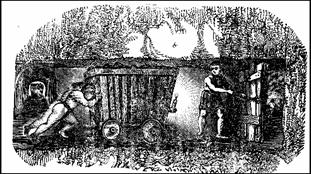
In 19th century England tens of thousands of White Children were employed as slave laborers in British coal mines. Little White Boys, seven years old, were harnessed like donkeys to coal carts and ordered to drag them through mine shafts.
In 1843, White Children aged four were working in the coal pits. In old English cemeteries can be seen epitaphs on grave stones like one which reads, "William Smith, aged eight years, Miner, died Jan. 3, 1841."
English children forced to work as chimney sweeps died miserable deaths stuck inside chimneys and suffocated. Young boys were preferred for their facility for entering narrow smoke channels. William Blake was driven nearly mad with grief at the condition of these little boy sweeps, asking in his Songs of Innocence and Experience, "Are such things done on Albion's shore?�
In 1830, the Rev. Richard Oastler, a Methodist minister in York, protested the conditions in the Bradford woolen mills where little children labored thirteen hours a day and were beaten if they fell asleep. Oastler attacked the hypocrisy of Yorkshire clergymen and politicians who condemned with great fervor the enslavement of Blacks in the West Indies while in England, "thousands of our fellow creatures...are this very moment...in a state of slavery more horrid than are the victims of that hellish system 'colonial slavery.'"
Oastler was publicly thanked by a delegation of English laborers at a meeting in York, "...for his manly letters to expose the conduct of those pretended philanthropists and canting hypocrites who travel to the West Indies in search of slavery, forgetting there is a more abominable and degrading system of slavery at home." [38] ; "In Bleak House Dickens was to satirize evangelical 'telescopic philanthropy' in the person of Mrs. Jellyby, a do‑gooder so absorbed in the welfare of the African natives of Borrioboola‑Gha that she fails to notice her own family sinking into ruin. This was precisely Carlyle's point: with Irish...dying in ditches...it was the worst sort of rose‑pink sentimentalism to worry oneself about West Indian Negroes..." [39]
An unknown poet expressed the bitter irony:
"That night a chariot passed her,
While on the ground she lay;
The daughters of her master
An evening visit to pay‑
Their tender hearts were sighing
As wrongs to Negroes were told;
While the white slave was dying
Who gained their father's gold." [40]
In the late 1830s William Dodd began his exhaustive research into the condition of the English poor. He estimated that in the year 1846 alone. 10,000 English workers, many of them children, had been mangled and mutilated by machinery or otherwise disabled for life. They were abandoned and received no compensation of any kind. Many died of their injuries. "Petition after petition has been sent to the two houses of Parliament, to the prime minister, and to the Queen, concerning this unfortunate class of British subjects, but without effect. Had they only been black instead of white, their case would have been taken into consideration long ago." [41]
The Rev. Charles Edwards Lester, the great‑grandson of the Puritan theologian Jonathan Edwards, and later the American Consul in Italy, states that if he had a choice between having his children born negro slaves in the South or poor people in England, he would choose the former: "I would sooner see the children of my love born to the heritage of Southern slavery than to see them subjected to the blighting bondage of the poor English operative's life." [42]
"John Randolph of Roanoke, traveling in England and Ireland with his black manservant Johnny, wrote to a friend back home: 'Much as I was prepared to see misery in the south of Ireland, I was utterly shocked at the condition of the poor peasantry between Limerick and Dublin. Why sir, John never fled so proud of being a Virginia slave. He looked with horror upon the mud hovels and miserable food of the White Slaves, and I had no fear of his running away." [43]
The poverty and exploitation of Whites in Britain was so enormous in its cruelty that it probably cannot even be grasped by a modern American.
Historian Oscar Hardlin writes that in America, White, "servants could be bartered for a profit, sold to the highest bidder for the unpaid debts of their masters, and otherwise transferred like movable goods or chattels.. In every civic, social and legal attribute, these victims of the turbulent displacements of the 16th and 17th� centuries were set apart. Despised by every other order, without apparent means of rising to a more favored place, these men and their children, and their children's children seemed mired in a hard, degraded life...The condition of the first Negroes in the continental English colonies must be viewed within the perspective of these conceptions and realities of (White) servitude ..." [44]
|
White Slaves Were Actually Owned by Negroes and Indians in the South to Such an Ex�tent That the Virginia As�sembly Passed the Following Law in 1677: |
The history of enslavement in America as portrayed in the tunnel vision of the corporate media has focused exclusively on the enslavement of negroes. The impression is given that only Whites bear responsibility for enslaving negroes and only negroes were slaves. In fact negroes in Africa as well as American Indian tribes such as the Cherokee engaged in extensive enslavement of negroes. The Cherokee Indians owned large plantations on which they worked their negro slaves in gangs. [45]
"It is enacted that no negro or Indian though baptized and enjoined their own freedom shall be capable of any such purchase of Christians..." [46]
��������������������������������������������� Negroes Also Owned Other Negroes in America. [47]
While Whites Languished in Chains Blacks Were Free Men in Virginia Throughout the 17th Century. [48] In 1717, it was proposed that a qualification for election to the South Carolina Assembly was to be, "the ownership of one white man." [49]
Negroes voted in the Carolina counties of Berkely and Craven in 1706, � "and their votes were taken." [50]
Blacks were toting guns or other weapons and going about armed in the service of wealthy landowners at the same time that tens of thousands of enslaved White men were forbidden arms.� In 1678 one thousand Negroes were armed by the planters and formed into a fighting militia for protection against the French. [51]
Even some of the early colonial Blacks had White Slaves!
Insurrections in North America
Philadelphia : In 1741, Blacks burned a church along with a number of other buildings and robbed a private dwelling. An investigation uncovered a conspiracy to burn the town, massacre the Whites, and establish a country of their own. Thirty were hanged for participation in the plot and others sold� elsewhere.
Haiti : The insurrection in Haiti was a momentous thing. It determined the basic White attitude toward Blacks in Virginia and other states where the refugees from San Domingo landed. Their pitiful stories were such that could not be easily forgotten. It was felt that if such a thing could happen there it could happen here. That event shocked the Whites as nothing else had ever done. The outlook of America was colored by that bloody event.
Gabriel's Revolt : In 1800, an insurrection took place in Virginia led by a slave named Gabriel. As in the cases of the Indian attacks, there was no advance warning, no suspicion that such an event was in the offing. Gabriel set out toward Richmond with a large group of Blacks armed with scythes and other farm implements. Some had firearms stolen and given to them by their masters. A violent storm caused creeks to rise which stopped the advance. A chance rider stumbled onto the army, and escaped with his life. He and his horse swam the swollen streams and rode to Richmond with the alarm. Local militias quickly formed and went to the scene. The Blacks scattered into the woods and were gradually rounded up. The ringleaders were executed and the rest returned to their plantations.
Nat Turner's Revolt : Nat Turner was different from Gabriel. Turner was weak and feeble while Gabriel was large and strong. Turner was cunning, however. He, too, conceived the plan to exterminate� Whites. His motives remain unknown. At his trial, he stated that he had always been treated kindly. Lacking physical prowess, he became a witch doctor, a thing forbidden on the plantations, but which existed without White knowledge. He had a sheet of paper on which a sun and a crucifix had been drawn in blood. There was much more to it than this, but only blacks know. When this paper was shown to other Blacks accompanied by certain words it produced a hypnotic obedience and thrill of excitement. Nat Turner also is said to have traveled throughout the whole of South side Virginia with his bloody signs and magic words. He was welcomed everywhere.
On August 21, 1831, he and his followers took axes and killed his master, his wife and children as they slept. They plundered the farm and then went on to another farm where the servants there helped his group kill a lady and her ten children. Their itinerary and timing were exact, they knew just where to go and when to arrive. Next, on to a school attended by a large number of White children. These were quickly dispatched, mostly by swinging their heads against the building to bash their brains out. Then another lady and her children were shot down as they tried to escape.
The alarm went out and local militias tracked down the insurgents, killed some, and captured 21. Nat Turner was found hiding in a woodpile. This gave birth to the well‑known saying, "There's a nigger in the woodpile." Fifty‑five whites had been killed, mostly women and children. Of the 21 insurgents captured, only thirteen were hanged including Nat Turner. He went to his death never explaining the reason for his actions. The present day establishment media presents Nat Turner as a hero, instead of the cold blooded murderer he actually was.
In Carolina in 1704, 1707, 1712, 1738 and 1741 bills were passed authorizing armed negro militias in the service of the planters. In 1742 certificates were presented tot he Black militiamen for services rendered.[52]
During the American Revolution, Lord Dunmore, the Royal Governor of Virginia appointed by the King, sought to win Virginia back for the British Crown with Black troops recruited in America, to be called the Ethiopian Regiment. Parties of Blacks in the South were armed by the British with guns, clubs and swords with the order to use them against rebellious Whites.[53]
Except for a few extremely brief asides under the euphemism "indentured servitude," no school textbooks or mass media presentations have studied in any depth the history of the massive enslavement of White People in North America.
Even if they attained their freedom, dirt‑poor Whites were forced to compete against negro slave labor. Jobs were few and Southern Planters Sat Idly as Poor Whites Died of Malnutrition for Want of Food and Medicine. Negro slaves were expensive. To protect their investments. White aristocrats usually treated their Negro slaves well, providing for adequate food, clothing and medication Even as Poor Whites in the Same Town Sickened and Died from Disease and Malnutrition.
Try to envision the 19th century scene: yeoman southern Whites, sick and destitute, watching their children dying while enduring the spectacle of negroes from the jungles of Africa healthy and well‑fed thanks to the ministrations of their fabulously wealthy White owners who cared little or nothing for the local "White Trash."
In the course of an 1855 journey up the Alabama River on the steamboat Fashion, Frederic Law Olmstead, the landscape architect who designed New York's Central Park, saw bales of cotton being thrown down from a considerable height into a cargo ship's hold. The men tossing the bales somewhat recklessly into the hold were Negroes, the Men in the Hold Were Irish. Olmstead inquired about this to a mate on the ship.
"Oh, said the mate, 'the niggers were worth too much to be risked here; if the Paddles are knocked overboard or get their backs broke, nobody loses anything.'" [54]
"When I was a boy, 'recalled Waters McIntosh, who had been a slave in Sumter, South Carolina, 'we used to sing, 'Rather be a nigger than a poor White Man,' Even in slavery we used to sing that.' Mr. McIntosh's remarks reveal...that the poor whites of the South ranked below blacks in social standing...slaves felt unbridled contempt for lower‑class whites...Frederick Douglas opened his famous Life and Times with an account of Talbot County, Maryland, which he said housed a 'White population of the lowest order...
Throughout the South the slaves of many of the larger planters lived in a society of blacks and well‑to‑do Whites and were encouraged to view even respectable laboring Whites with disdain...Ella Kelly, who had been a slave in South Carolina...You know, boss, dese days dere is three kind of people. Lowest down Is a Layer of White Folks, then in de middle is a layer of colored folks, and on top is de cream, a layer of good White folks...
The slaves noticed their masters sense of superiority toward marginal farmers as well as toward poor Whites and, by associating themselves with 'de quality White folks,' strengthened their self‑esteem...a...slave expressed no surprise that his master, who was Big Buckra, never associated with White trash. And Rosa Starke, who had been owned by a big planter in South Carolina, reported that poor Whites had to use the kitchen door when they went up to the Big House. Her mistress 'had a grand manner; no patience with Poor White Folks.'...
The many (Negro) ex‑slaves who recalled the lot of the small farmers and Poor Whites as Hard and Even as Bad as Their Own knew what they were talking about...The slaves saw enough abject poverty, disease, and demoralization among the Poor Whites...to see their own condition under Old Massa's protection as perhaps not the worst of evils." [55]
This situation engendered a rage in the descendants and survivors of White Slavery which has seldom been accounted for in the history of White working class support for the Northern abolitionist cause. We can gauge the attitude of yeoman Whites.� Especially in the border states like Kentucky and Tennessee, but throughout the United States as well, who were either neutral during the Confederacy's struggle or sided with Lincoln, from the statement of an Iowa Congressman who maintained that it was the planter aristocracy "which exalts and spreads Africans at the expense of the White Race." [56]
Some of the leaders of the Free Soil Party and many of the Unionist soldiers who made up the ranks of Lincoln's armies in Southern Ohio, Western North Carolina, Eastern Tennessee, Southern Illinois, Kentucky and elsewhere were survivors of White slaver or descendants of White Slaves. They do not view themselves as advocates of what was then referred to as racial "amalgamation."
One remarkable former member of the "poor White Trash" of the South who exhibited a lifelong solidarity with his own kind, was the phenomenally successful Andrew Johnson, military governor of Tennessee, U.S. Senator, Vice‑President and 17th� President of the United States. A prevailing myth has it that Lincoln [57] was assassinated because hidden powers knew he would be lenient to the South during Reconstruction. This view is exploded when one studies the background and views of his successor to the presidency, who was everything to the defeated Southern people (though not to their Planter‑dominated Confederate leadership, who he generally despised), that the myth‑makers claim Lincoln would have been.
President Johnson was impeached mainly through the partisan efforts of politicians such as Rep. Thaddeus Stevens and Sen. Charles Sumner, precisely because Johnson refused to cooperate in the collective Reconstruction punishment of poor White people in the South. Andrew Johnson was born in Raleigh, North Carolina, where at the age of ten he was apprenticed to the Selby tailor shop and ordered to work twelve hours a day, until he was 21 years of age.
"Andrew could hardly miss feeling the striking contrast between himself and the (White) elite ...the aristocrats' contempt was scarcely hidden. When Andrew and his cousins once ran across the path between the house of John Devereaux and that of his son, Devereaux sent his coachman to whip the boys back to their shanty...The Whip Was Habitually Used on Those the Devereaux Called 'Poor White Trash.'" [58]
After enduring nearly six years of apprenticeship, Johnson fled Raleigh. A ten dollar reward was posted for his capture. By law, no other employer in North Carolina was allowed to give him work. As long as he remained in North Carolina was allowed to give him work. As long as he remained in North Carolina he was in danger of capture. Johnson fled to Tennessee where he went into business for himself and eventually became a leader of men. Johnson has been described as having, "...strongly held predilections for the (White) laboring classes and...deepest prejudice against the blacks." [59]
As military governor of Tennessee during the war Johnson protected the White Poor [60] Johnson was a staunch Unionist, strictly devoted to preserving the county as one nation. Lincoln selected him as his vice‑president in 1864 because Johnson was a border‑state Southerner, a constituency which was Lincoln's crucial power base and one he sought to fortify with Johnson, never expecting the latter would ever be anything more than a figurehead. That Lincoln and Johnson held very different views on racial matters was evident when Lincoln introduced Johnson to a Black leader at the inauguration: "Frederic Douglas recalled that when Lincoln pointed him out to Johnson prior to the ceremonies, the vice president responded at first with a bitter expression of contempt...Douglas concluded right then and there that the Tennessean was no friend of the black race." [61]
As president, Johnson ordered the removal of Negro troops from East Tennessee and Mississippi. He also, "... reanimated (White) Southern resistance and fatally undermined the efforts to integrate the (Negro) freedmen into society...According to the Cincinnati Enquirer, Johnson wrote to Governor Thomas C. Fletcher of Missouri, 'This is a country for White Men and by God, as long as I am President, it shall be a government for White Men."
In 1859, while U.S. Senator, Johnson, "...asserted that the famous phrase in the Declaration of Independence proclaiming that all men were created equal could not apply to Negroes...the 17th president unquestionably undermined the Reconstruction process...What defeated him during his term in the White House was not so much his lack of formal education, nor even his tactlessness, but his failure to outgrow his Jefferson‑Jacksonian background. Johnson's continued identification with an America of small farmers and 'mechanics,' his attachment to a strict construction of the Constitution that was no longer in vogue, his refusal to adjust to the racial views to the needs of the Republican party, and his persistent belief in the agrarian myth, blinded him to the realities of the post‑Civil War U.S....Considering the effect of his policies upon the South, he had achieved at least in the long run what he wanted, the continued existence of viable Southern state governments within the Union and the maintenance of White Supremacy." [62]
Historically they regarded themselves as separatists and viewed the Southern planter's desire to spread Negroes into California, Oregon and other territories as a grave threat to free White labor and the Biblical principle of racial separation. [63]
Congressman David Wilmot sponsored a law to ban Black slavery in the American West. He dubbed his proposed law, "the White Man's Proviso." He was bitterly opposed by the Southern elite. Wilmot told Congress that he intended to preserve America's western frontier for "the sons of toil, my own race and color." [64]
During much of the Civil War the politician and military leaders of the Confederacy could not travel in certain parts of the Deep South without armed escorts, [65] for fear of attack from "Upcountry" Southern Whites who hated the planter aristocracy and the war they saw as being for the sole benefit of the expansion of the planter's "infernal Negroes."
Upcountry Southern Whites consisted in large part of the survivors and the children of the survivors of White Slavery who resided in the hills, mountains and Piedmont regions of the South under frontier conditions. An aristocrat described them in the 18th century: "Humanity can scarce forbear to drop a tear on reflecting on the circumstances of many of them. With a poor wretched hut crowded with children, naked, hungry and miserable without bread or a penny of money to buy any, in short they appear as objects almost too contemptible to excite the public resentment..." [66]
In the antebellum 19th century South,� "A large number of White Southerners lived in the upcountry, an area of small farms and herdsmen...engaged largely in mixed and subsistence agriculture...Little currency circulated, barter was common and upcountry families dressed in 'home‑ spun cloth, the product of the spinning wheel and the hand‑loom.'
|
White Slaves Drained the Swamps, Cleared the For�ests, Built the Roads. They Worked and Died in Greater Num�bers than Anyone Else. |
This economic order gave rise to a distinctive sub‑culture that celebrated mutuality, egalitarianism (for Whites) and ...independence...mountain counties rejected secession from the outset. One citizen of Winston County in the Northern Alabama hill country believed yeoman had no business fighting for a planter‑ dominated aristocracy: 'All tha want is to git you...to fight for their infernal Negroes and after you do their fightin' you may kiss their hind parts for o tha care." [67]
Poor Whites had to be drafted into the Confederate army. As in the North, where resistance to conscription was widespread many Southern Whites saw the conflict as "a rich man's war and a poor man's fight."
� Indeed, any slaveholder owning 20 or more Black slaves was exempt from military combat. From 1609 until the early 1800s, between one‑half and two thirds of all the White colonists who came to the New World came as slaves. Of the passengers on the Mayflower, twelve were White Slaves.[68] Both psychologically and materially Whites in modern times are called upon to bear burdens of guilt and monetary reparation for Negro slavery. � This Position Is Based Entirely on Enforced Ignorance and the Deliberate Suppression of the Record of White Slavery in North America.
Millions of Whites had been enslaved during the antebellum era in America while millions of others were too poor to afford even a mule, much less a Black slave. Slave reparations and guilty feelings are due, if one subscribes to such a thing as retroactive collective guilt, from the descendants of the minority of wealthy Whites who owned Negro slaves and who, in the South at least, were themselves generally reduced to penury in the aftermath of the Civil War.
Reparations would also have to be paid by the descendants of the Cherokee and other American Indian tribes who owned Black slaves; by the heirs of Black tribal leaders in Africa who sold them into slavery by the Dutch Jews who owned the slave ships that transported Negroes to the colonies.
Negro involvement in the enslavement of their fellow Blacks was extensive: "...in Africa...down to the 1930s, the various tribes continued to raid one another to capture slaves both for domestic use and to sell to outsiders. Moreover, in spite of the picture presented in Alex Haley's Roots, White Slave traders almost never entered the interior in pursuit of prey but rather purchased their cargo from Africans at the ocean front; coastal Africans would not allow Europeans either into or through their own countries...Before the appearance of the (Suzanne) Miers and (Igor) Kopytoff and Meillassoux volumes, [69] some scholars claimed that slavery in Africa was a response to the international slave trade, but it is now obvious that (Black) slavery was an old domestic institution that was adapted for supplying the international market when it developed." [70]
For information on Jewish involvement in the enslavement of Negroes; See History of the Jews of the Netherlands Antilles, Vol. 1, Isaac and Suzanne A. Emmanuel, pp. 74‑78. Reparations must also be paid, if the logic of the situation is to be consistent, to the modern‑day White descendants of the White Slaves of early America.
The whole discussion of Negro slavery, Southern racism and the Civil War as currently framed by the Establishment agenda, necessarily must exclude any examination of the fact of White Slavery, especially in the 17th and 18th centuries, and the condition of free White Poor in the 19th century forced to compete against Negro slave labor in the South.
The enslavement of Whites extended throughout the American colonies and White Slave labor was a crucial factor in the economic development of the colonies. Gradually it developed into a fixed system every bit as rigid and codified as Negro slavery was to become.
In fact, Negro slavery was efficiently established in colonial America because Black slaves were governed, organized and controlled by the structures and organization that were first used to enslave and control Whites. Black slaves were "late comers fitted into a system already developed." [71]
Do You Know
Who Really Brought the Black Slaves to America?
No study of the White Slave issue would be complete without mentioning something of the Black Slaver which also existed side by side with White Slavery. The truth of the following will, no doubt, anger many people because for some reason they think that the Jews are above criticism.
Say anything you please about a White Man or Woman but utter one little peep about some of the more sordid past of the Jews, and condemnation comes from all sides. Well let the condemnation come the facts of history are facts even though the enemies of truth have tried to hide and change much of it.
This portion of this study will focus on the hidden record of Blacks and Jews from the Jewish historical record. Rabbi Henry Cohen, author of the book, "Justice Justice," makes a telling point.
" [ T]he parallels between the Nazi terror and the American slave trade are more startling than we may realize. When Negroes were brought from the heart of Africa to the American South, one-third died enroute to the African coast and one-third died in the suffocating prisons on board ship. Once here, families were purposely broken up; husbands, wives, and children forced to go their separate ways. Must we be reminded of the death toll in the suffocating boxcars bound for Auschwitz or of the tearing of children from their mothers' arms." [72]
Throughout history Jews have faced charges of economic exploitation of Gentile communities around the world. Indeed, no single group of people have faced blanket expulsion in so many places around the world as frequently as have the Jews. The patter and the charges are familiar: monopolization, usury "sharp practices," selling "cheap" goods, frequent bankruptcies, etc.
All such claims seem to preface the expulsion orders and are vigorously denied both by those charged and by the Jewish writers of history. But this is not the only charge that is made against Jews. Jews have been conclusively linked to the greatest criminal endeavor ever undertaken against an entire race of people - a crime against humanity - the Black African Holocaust.
They were participants in the entrapment and forcible exploitation of millions of Black African citizens into the wretched and inhuman life of bondage for the financial benefit of Jews. The effects of this unspeakable tragedy are still being felt among the peoples of the world at this very hour.
Deep within the recesses of the Jewish historical record is the irrefutable evidence that the most prominent of the Jewish pilgrim fathers used kidnaped Black Africans disproportionately more than any other ethnic or religious group in New World history, with the exception of White slaves who were brought to the Americas at a rate of about 10 Whites to 1 Black, and participated in every aspect of the international slave trade. The immense wealth of Jews...was acquired by the brutal subjugation of Black Africans purely on the basis of skin color - a concept unfamiliar to Moses.
Now compiled for the first time, the Jewish sources reveal the extent of their complicity in Black slavery in the most graphic of terms. Until now, the facts herein were known only to a few. Most have always assumed that the relationship between Blacks and Jews has been mutually supportive, friendly and fruitful, two suffering people bounding to overcome hatred and bigotry to achieve success. But History Tells an Altogether Different Story.
Rabbi: Jewish merchants played a major role in the slave trade
Rabbi Marc Lee Raphael
http://www.blacksandjews.com/MarcLeeRaphael.html#anchor196437
The following passages are from Dr. Raphael's book Jews and Judaism in the
United States a Documentary History (New York: Behrman House, Inc., Pub,
1983),
pp. 14, 23-25.
"Jews also took an active part in the Dutch colonial slave trade; indeed,
the
bylaws of the Recife and Mauricia congregations (1648) included an imposta
(Jewish tax) of five soldos for each Negro slave a Brazilian Jew purchased
from
the West Indies Company. Slave auctions were postponed if they fell on a
Jewish holiday. In Curacao in the seventeenth century, as well as in the
British
colonies of Barbados and Jamaica in the eighteenth century, Jewish merchants
played a major role in the slave trade. In fact, in all the American
colonies,
whether French (Martinique), British, or Dutch, Jewish merchants frequently
dominated.
"This was no less true on the North American mainland, where during the
eighteenth century Jews participated in the 'triangular trade' that brought
slaves
from Africa to the West Indies and there exchanged them for molasses, which
in
turn was taken to New England and converted into rum for sale in Africa.
Isaac Da Costa of Charleston in the 1750's, David Franks of Philadelphia in
the
1760's, and Aaron Lopez of Newport in the late 1760's and early 1770's
dominated
Jewish slave trading on the American continent."
Dr. Raphael discusses the central role of the Jews in the New World commerce
and the African slave trade (pp. 23-25):
SEVENTEENTH AND EIGHTEENTH CENTURIES
JEWISH INTERISLAND TRADE: CURACAO, 1656
During the sixteenth century, exiled from their Spanish homeland and
hard-pressed to escape the clutches of the Inquisition, Spanish and
Portuguese Jews
fled to the Netherlands; the Dutch enthusiastically welcomed these talented,
skilled husinessmen. While thriving in Amsterdam-where they became the hub
of a
unique urban Jewish universe and attained status that anticipated Jewish
emancipation in the West by over a century-they began in the 1500's and
1600's to
establish themselves in the Dutch and English colonies in the New World.
These
included Curacao, Surinam, Recife, and New Amsterdam (Dutch) as well as
Barbados, Jamaica, Newport, and Savannah (English). In these European
outposts the
Jews, with their years of mercantile experience and networks of friends and
family providing market reports of great use, played a significant role in
the
merchant capitalism, commercial revolution, and territorial expansion that
developed the New World and established the colonial economies. The
Jewish-Caribbean
nexus provided Jews with the opportunity to claim a disproportionate
influence in seventeenth and eighteenth century New World commerce, and
enabled West
Indian Jewry-far outnumbering its coreligionists further north-to enjoy a
centrality which North American Jewry would not achieve for a long time to
come.
Groups of Jews began to arrive in Surinam in the middle of the seven-teenth
century, after the Portuguese regained control of northern Brazil. By 1694,
twenty-seven years after the British had surrendered Surinam to the Dutch,
there
were about 100 Jewish families and fifty single Jews there, or about 570
persons. They possessed more than forty estates and 9,000 slaves,
contributed
25,905 pounds of sugar as a gift for the building of a hospital, and carried
on an
active trade with Newport and other colonial ports. By 1730, Jews owned 115
plantations and were a large part of a sugar export business which sent out
21,680,000 pounds of sugar to European and New World markets in 1730 alone.
Slave trading was a major feature of Jewish economic life in Surinam which
as
a major stopping-off point in the triangular trade. Both North American and
Caribbean Jews played a key role in this commerce: records of a slave sale
in
1707 reveal that the ten largest Jewish purchasers (10,400 guilders) spent
more
than 25 percent of the total funds (38,605 guilders) exchanged.
Jewish economic life in the Dutch West Indies, as in the North American
colonies, consisted primarily of mercantile communities, with large
inequities in
the distribution of wealth. Most Jews were shopkeepers, middlemen, or petty
merchants who received encouragement and support from Dutch authorities. In
Curacao, for example, Jewish communal life began after the Portuguese
victory in
1654. In 1656 the community founded a congregation, and in the early 1670's
brought its first rabbi to the island. Curacao, with its large natural
harbor, was
the steppng-stone to the other Caribbean islands and thus ideally suited
geographically for commerce. The Jews were the recipients of favorable
charters
containing generous economic privileges granted by the Dutch West Indies
Company
in Amsterdam. The economic life of the Jewish community of Curacao revolved
around ownership of sugar plantations and marketing of sugar, the importing
of
manufactured goods, and a heavy involvement in the slave trade, within a
decade of their arrival, Jews owned 80 percent of the Curacao plantations.
The
strength of the Jewish trade lay in connections in Western Europe as well as
ownership of the ships used in commerce. While Jews carried on an active
trade with
French and English colonies in the Caribbean, their principal market was the
Spanish Main (today Venezuela and Colombia).
Extant tax lists give us a glimpse of their dominance. Of the eighteen
wealthiest Jews in the 1702 and 1707 tax lists, nine either owned a ship or
had at
least a share in a vessel. By 1721 a letter to the Amsterdam Jewish
community
claimed that "nearly all the navigation...was in the hands of the Jews."'
Yet
another indication of the economic success of Curacao's Jews is the fact
that
in 1707 the island's 377 residents were assessed by the Governor and his
Council a total of 4,002 pesos; 104 Jews, or 27.6 percent of the taxpayers,
contributed 1,380 pesos, or 34.5 percent of the entire amount assessed.
In the British West Indies, two 1680 tax lists survive, both from Barbados;
they, too, provide useful information about Jewish economic life. In
Bridgetown
itself, out of a total of 404 households, 54 households or 300 persons were
Jewish, 240 of them living in "ye Towne of S. Michael ye Bridge Town."
Contrary
to most impressions, "many, indeed, most of them, were very poor." There
were
only a few planters, and most Jews were not naturalized or endenizened (and
thus could not import goods or pursue debtors in court). But for merchants
holding letters of endenization, opportunities were not lacking. Barbados
sugar-and its by-products rum and molasses-were in great demand, and in
addition to
playing a role in its export, Jewish merchants were active in the import
trade.
Forty-five Jewish households were taxed in Barbados in 1680, and more than
half of them contributed only 11.7 percent of the total sum raised. While
the
richest five gave almost half the Jewish total, they were but 11.1 percent
of the
taxable population. The tax list of 1679-80 shows a similar picture; of
fifty-one householders, nineteen (37.2 percent) gave less than one-tenth of
the
total, while the four richest merchants gave almost one-third of the total.
An interesting record of interisland trade involving a Jewish merchant and
the islands of Barbados and Curacao comes from correspondence of 1656. It
reminds us that sometimes the commercial trips were not well planned and
that Jewish
captains-who frequently acted as commercial agents as well-would decide
where
to sell their cargo, at what price, and what goods to bring back on the
return trip.End of excerpt
Rabbi Marc Lee Raphael relates: "Jews also took an active part in the Dutch colonial slave trade; indeed, the bylaws of the Recife and Mauricia congregations (1648) included an imposta (Jewish tax) of five soldos for each Negro slave a Brazilian Jew purchased from the West Indies Company. Slave auctions were postponed if they fell on a Jewish holiday. In Curacao in the seventeenth century, as well as in the British colonies of Barbados and Jamaica in the eighteenth century, Jewish merchants played a major role in the slave trade.
In fact, in all the American colonies, whether French� (Martinique), British, or Dutch, Jewish merchants frequently dominated. This was no less true on the North American mainland, where during the eighteenth century Jews participated in the 'triangular trade' that brought slaves from Africa to the West Indies and there exchanged them for molasses, which in turn was taken to New England and converted into rum for sale in Africa. Isaac Da Costa of Charleston in the 1750's, David Franks of Philadelphia in the 1760's, and Aaron Lopez of Newport in the late 1760's and early 1770's dominated Jewish slave trading on the American continent. " [73]
Ira Rosenwaike relates: "In Charleston, Richmond and Savannah the large majority (over three‑fourths) of the Jewish households contained one or more slaves; in Baltimore, only one out of three households were slaveholding; in New York, one out of eighteen....Among the slaveholding households the median number of slaves owned ranged from five in Savannah to one in New York." [74]
The Jewish author Cecil Roth said: "The Jews of the Joden Savanne [Surinam] were also foremost in the suppression of the successive Negro revolts, from 1690 to 1722: these as a matter of fact were largely directed against them, as being the greatest slave‑holders of the region." [75]
Jacob Rader Marcus relates: "All through the eighteenth century, into the early nineteenth, Jews in the North were to own black servants; in the South, the few plantations owned by Jews were tilled with slave labor. In 1820, over 75 percent of all Jewish families in Charleston, Richmond, and Savannah owned slaves, employed as domestic servants; almost 40 percent of all Jewish householders in the United States owned one slave or more. There were no protests against slavery as such by Jews in the South, where they were always outnumbered at least 100 to 1....But very few Jews anywhere in the United States protested against chattel slavery on moral grounds." [76]
Author Jacob Rader Marcus describes the mockery of the Indian by Hyam Myer's "Wild West Show" in his book, The Colonial American Jew: "[Myer sought] formal permission to exhibit some Mohawks in Europe. Myers sailed with the Indians before the proper certificate was forthcoming from the Indian Commissioner, and had already begun to parade them in Holland and in the taverns of London when the Lords of Trade urged Lieutenant‑Governor Cadwallader Colden in New York to have Johnson put an end to the undertaking. From all indications Myers made no money on his grand European tour, for he ended up owing the Indians money ‑ or refusing to pay them. Then, as now, there was "no business like show business!"
Isaac Mayer Wise, the leader of the American Reform Jews, wrote of the California Indians: "...though not total savages, [they] are very primitive and ignorant....[They do] nothing besides loafing and begging...They catch trout in the river, and then sell them to buy ammunition, shoot rabbits, birds, eat various roots and wild plants, also snakes, frogs, dogs, cats, and rats, and say, 'Me work no.' In conversation with several of them I found that they have no particular home and are heathens."
The American and Foreign Anti‑Slavery Society Report of 1853: "The Jews of the United States have never taken any steps whatever with regard to the slavery question. As citizens, they deem it their policy to have every one choose which ever side he may deem best to promote his own interests and the welfare of his country. They have no organization of an ecclesiastical body to represent their general views; no General Assembly, or its equivalent.
The American Jews have two newspapers, but they do not interfere in any discussion which is not material to their religion. It cannot be said that the Jews have formed any denominational opinion on the subject of American slavery...The objects of so much mean prejudice and unrighteous oppression as the Jews have been for ages, surely they, it would seem, more than any other denomination, ought to be the enemies of caste, and friends of universal freedom."
Rabbi Bertram W. Korn states: "It would seem to be realistic to conclude that any Jew who could afford to own slaves and had need for their services would do so...Jews participated in every aspect and process of the exploitation of the defenseless blacks." [77]
Louis Epstein, author of Sex Laws and Customs in Judaism:� "The female slave was a sex tool beneath the level of moral considerations. She was an economic good, useful, in addition to her menial labor, for breeding more slaves. To attain that purpose, the master mated her promiscuously according to his breeding plans. The master himself and his sons and other members of his household took turns with her for the increase of the family wealth, as well as for satisfaction of their extra‑marital sex desires. Guests and neighbors too were invited to that luxury."
Seymour B. Liebman stated: "They came with ships carrying African blacks to be sold as slaves. The traffic in slaves was a royal monopoly, and the Jews were often appointed as agents for the Crown in their sale...[They] were the largest ship chandlers in the entire Caribbean region, where the shipping business was mainly a Jewish enterprise....The ships were not only owned by Jews, but were manned by Jewish crews and sailed under the� command of Jewish captains." [78]
Herbert I. Bloom relates: "The Christian inhabitants [of Brazil] were envious because the Jews owned some of the best plantations in the river valley of Pernambuco and were among the leading slave‑holders and slave traders in the colony."1 "Slave trade [sic] was one of the most important Jewish activities here [in Surinam] as elsewhere in the colonies."2 [79]
Arnold Wiznitzer says: "The West India Company, which monopolized imports of slaves from Africa, sold slaves at public auctions against cash payment. It happened that cash was mostly in the hands of Jews. The buyers who appeared at the auctions were almost always Jews, and because of this lack of competitors they could buy slaves at low prices. On the other hand, there also was no competition in the selling of the slaves to the plantation owners and other buyers, and most of them purchased on credit payable at the next harvest in sugar. Profits up to 300 percent of the purchase value were often realized with high interest rates....If it happened that the date of such an auction fell on a Jewish holiday the auction had to be postponed. This occurred on Friday, October 21, 1644." [80]
Rabbi Morris Raphall tells us: "[I]t remains a fact which cannot be gainsaid that in his own native home, and generally throughout the world, the unfortunate Negro is indeed the meanest of slaves. Much had been said respecting the inferiority of his intellectual powers, and that no man of his race has ever inscribed his name on the Parthenon of human excellence, either mental or moral." [81]
W.E.B. DuBois, an NAACP leader: "The Jew is the heir of the slave‑baron in Dougherty [Georgia]; and as we ride westward, by wide stretching cornfields and stubby orchards of peach and pear, we see on all sides within the circle of dark forest a Land of Canaan. Here and there are tales of projects for money getting, born in the swift days of Reconstruction_'improvement' companies, wine companies, mills and factories; nearly all failed, and the Jew fell heir." [82]
Jewish Racism by Moses Mimonides: The Encyclopedia of the Jewish Religion refers to Moses Maimonides as "the symbol of the pure and orthodox faith." His Guide to the Perplexed is considered the greatest work of Jewish religious philosophy, but his view of Blacks was Hitlerian: "[T]he Negroes found in the remote South, and those who resemble them from among them that are with us in these climes. The status of those is like that of irrational animals. To my mind they do not have the rank of men, but have among the beings a rank lower than the rank of man but higher than the rank of apes. For they have the external shape and lineaments of a man and a faculty of discernment that is superior to that of the apes."
Philadelphia Jewish weekly, The Jewish Record of January 23, 1863: "We know not how to speak in the same breath of the Negro and the Israelite. The very names have startlingly opposite sounds _ one representing all that is debased and inferior in the hopeless barbarity and heathenism of six thousand years the other, the days when Jehovah conferred on our fathers the glorious equality which led the Eternal to converse with them, and allow them to enjoy the communion of angels. Thus the abandoned fanatics insult the choice of God himself, in endeavoring to reverse the inferiority which he stamped on the African, to make him the compeer, even in bondage, of His chosen people.
There is no parallel between such races. Humanity from pole to pole would scout such a comparison. The Hebrew was originally free and the charter of his liberty was inspired by his Creator. The Negro was never free and his bondage in Africa was simply duplicated in a milder form when he was imported here...The judicious in all the earth agree that to proclaim the African equal to the surrounding races, would be a farce which would lead the civilized conservatism of the world to denounce the outrage."
Major Mordecai Manuel Noah (1785‑1851). He was considered the most distinguished Jewish layman in his time. He was such a prolific proponent of slavery, that the first Black American periodical, The Freedom's Journal, was launched in response to Noah's racist propaganda. He actually defended slavery by calling it liberty: "There is liberty under the name of slavery. A field Negro has his cottage, his wife, and children, his easy task, his little patch of corn and potatoes, his garden and fruit, which are his revenue and property. The house servant has handsome clothing, his luxurious meals, his admitted privacy, a kind master, and an indulgent and frequently fond mistress." He argued that "the bonds of society must be kept as they now are" and that "To emancipate the slaves would be to jeopardize the safety of the whole country." The Freedom's Journal called Noah the Black man's "bitterest enemy" and William Lloyd Garrison, the leading White abolitionist, called him the "lineal descendant of the monsters who nailed Jesus to the cross."
Jews and Hollywood, Anti‑Defamation League Charter: "For a number of years a tendency has manifested itself in American life toward the caricaturing and defaming of Jews on the stage, in moving pictures. The effect of this on the unthinking public has been to create an untrue and injurious impression of an entire people and to expose the Jew to undeserved contempt, and ridicule. The caricatures center around some idiosyncrasy of the few which, by the thoughtless public, is often taken as a pivotal characteristic of the entire people..."
Neal Gabler, Author of An Empire of Their Own: How the Jews invented Hollywood: "What is amazing is the extent to which they succeeded in promulgating this fiction throughout the world. By making a �shadow� America, one which idealized every old glorifying bromide about the country, the Hollywood Jews created a powerful cluster of images and ideas‑so powerful that, in a sense, they colonized the American imagination...Ultimately, American values came to be defined largely by the movies the Jews made."
Lester D. Friedman, Author of Hollywood's Image of the Jew: "Today, most people associate the blackface tradition with minstrel shows, and more particularly with Al Jolson. In actuality, many Jewish performers gained early and continued success using it. Sophie Tucker was billed as the 'World Renowned Coon Shouter' or more euphemistically as the 'Manipulator of Coon Melodies.' Eddie Cantor played Salome in drag and blackface, while George Burns often toured with an even more comically stylized blackface than Jolson's. Later George Jessel often joined Eddie Cantor on stage in various blackface routines...Indeed, it is too easy to ignore the derogatory aspects of such activities, the unconscious racism accepted and nourished by such cruel parodies, by citing historical contexts. The undisguised elements of ridicule in such blackface portrayals by Jews mimicking the outlandish stereotypes of blacks now looks suspiciously like one group's desperate need to assert its own superiority by mimicking another. Such a motivation while perhaps unconscious is nonetheless hard to ignore."
Rob Reiner, Film Director 1992: "It's all run by Jews, even Disney. That's funny, because Walt Disney was a terrible reactionary. If he found out that Jeffrey Katzenberg were running his company, he'd be spinning in his grave. That's a wonderful bit of poetic justice."
Other Issues a B'nai B'rith Magazine, May, 1925, vol. 39: �Darktown Rastus: Whuffo' yo' 'jeculate yoself to me in dat onery manner? Cicero: Whoffo'? Nigguh, who do yo' calkerate yo' is? Rastus: Yo' nigguh! mah family am quality folks an' ahm a pusson of rank. Cicero: Huh! ah'll have yo' triflin', Rastus, to know that ah'm ranker than you is.� "Jokes" like these appeared regularly in the B'nai B'rith Magazine even as the ADL fought this kind of defamation of Jews.
Andrew Goodman: "...it is true that the white man (and by this I mean Christian civilization in general) has proved himself to be the most depraved devil imaginable in his attitudes towards the Negro race...The source and cause of this need for reaction can be attributed to white contempt and neglect. The historical contempt that the white race held for the Negroes has created a group of rootless degraded people. The current neglect of the problem can only irritate this deplorable state of affairs.
The Black Muslims should constitute a warning to our society, a warning that must be heeded if we are to preserve the society. The road to freedom must be uphill, even if it is arduous and frustrating. A people must have dignity and identity. If they can't do it peacefully, they will do it defensively."
Elie Weisel, A Teacher of Hate: "There is a time to love and a time to hate; whoever does not hate when he should does not deserve to love when he should, does not deserve to love when he is able. Perhaps, had we learned to hate more during the years of ordeal, fate itself would have taken fright. The Germans did their best to teach us, but we were poor pupils in the discipline of hate....Every Jew, somewhere in his� being, should set apart a zone of hate ‑ healthy, virile hate ‑ for what the German personifies and for what persists in the German. To do otherwise would be a betrayal of the dead."[83] :
Robert A. Rockaway, is a senior lecturer in the Department of Jewish History at Tel Aviv University: "After the first World War, Jewish Gangsters became major figures in the American underworld and played prominent roles in the creation and extension of organized crime in the United States. During Prohibition fifty percent of the leading bootleggers were Jews, and Jewish criminals financed and directed much of the nations narcotics traffic. Jews also dominated illicit activities in a number of America's largest cities, including Boston, Cleveland, Detroit, Minneapolis, New York, and Philadelphia."
We presented some of the above just to show that the Jews are the worst racists that have ever existed, even while they cry out that they are not racist but that everyone else is. Furthermore, in Roberta Strauss Feuerlicht's, "The Fate of the Jews: A People Torn Between Israeli Power and Jewish Ethics," she confronts the reality of her people's western development: "[ W ]hether so many [Southern] Jews would have achieved so high a level of social, political, economic and intellectual status and recognition, without the presence of the lowly and degraded slave {both Black and White}, is indeed dubious. How ironic that the distinctions bestowed upon [Jewish] men like Judah P. Benjamin were in some measure dependent upon the sufferings of the Negro slaves they brought and sold with such equanimity." [84]
It is a relationship that needs further analysis - one that is not fully known. Hidden and misunderstood, it is indeed time to reopen the files to review and reconsider, "The Secret Relationship Between Blacks and Jew."
Throughout the history of the practice, Jews have been involved in the purchase and sale of human beings. This fact is confirmed by their own scholars and historians. In his book, "A History of the Jews," Solomon Grayzel states that "Jews Were among the Most Important Slave Dealers" in European society. [85]
Lady Magnus writes that in the Middle Ages, "The Principal Purchasers of Slaves Were Found among the Jews ...[ T ]hey seemed to be always and everywhere at hand to buy, and to have the means equally ready to pay." [86]
Henry L. Feingold stated that "Jews who were frequently found at the heart of commerce could not have failed to contribute a proportionate share of the [slave] trade directly or indirectly. In 1460, when Jews were the masters of the nautical sciences in Portugal, that nation was importing 700-800 slaves yearly." [87]
The success of these medieval merchants was enhanced by their supreme linguistic abilities. They spoke Arabic, Persian, Roman, Frankish, Spanish and Salvonic and "displayed a business acumen far in advance of the times." [88]
The Jews' participation in the slave trade, particularly their trafficking in non-Jewish slaves, incited the moral indignation of Europe's Gentile population. The Europeans reacted by taxing the Jews and some were expelled from their host countries, for this activity. [89]
The expulsion of the Jews by European governments was not unusual, with most of the complaints centered around economic exploitation, monopolizing, or "sharp practice." By 1500, with the exception of certain parts of Italy, Western Europe had closed its doors to the Jewish people. [90] The following listing is a partial record of the countries and dates of the Jew's expulsion from various European communities. [91]
������������������������������
Mainz,1012 ����������������������������������������������������������� Upper Bavaria, 1442�������������������������������������������� Genoa, 1515
France, 1182 ��������������������������������������������������������� Netherlands, 1444������������������������������������������������ Naples, 1533
Upper Bavaria, 1276 ������������������������������������������� Brandenburg, 1446���������������������������������������������� Italy, 1540
England,1290 ������������������������������������������������������� Mainz, 1462���������������������������������������������������������� Naples, 1541
France, 1306 ��������������������������������������������������������� Mainz, 1483���������������������������������������������������������� Prague, 1541
France, 1322 ��������������������������������������������������������� Warsaw, 1483������������������������������������������������������� Genoa, 1550
Saxony, 1349 �������������������������������������������������������� Spain, 1492����������������������������������������������������������� Bavaria, 1551
Hungary, 1360 ����������������������������������������������������� Italy, 1492������������������������������������������������������������� Prague, 1557
Belgium, 1370 ������������������������������������������������������ Lithuania, 1495����������������������������������������������������� Papal States, 1569
Slovakia, 1380 ������������������������������������������������������ Portugal, 1496������������������������������������������������������ Hungary, 1582
France, 1394 ��������������������������������������������������������� Naples, 1496��������������������������������������������������������� Hamburg, 1649
Austria, 1420 ������������������������������������������������������� Navarre, 1498������������������������������������������������������� Vienna, 1669
Lyons, 1420 ��������������������������������������������������������� Nuremberg, 1498�������������������������������������������������� Slovakia, 1744
Cologne, 1424 ������������������������������������������������������ Brandenburg, 1510���������������������������������������������� Bohemia/Moravia, 1744
Mainz, 1438 ���������������������������������������������������������� Prussia, 1510�������������������������������������������������������� Moscow, 1891
Augsburg, 1439
Over the next centuries the centers of Jewish development moved into the Western Hemisphere were land and commercial opportunities proved the incentives for immigration. The open and ungoverned territory and the docile and vulnerable native population offered an irresistible attraction to the "Maligned race."
They acquired great wealth in their Caribbean and South American enterprises and eventually moved into the American Northeast which became the economic focal point. It started with the forced expulsion of the Jews from the Spanish Empire and with the early explorer and "discoverer" of America, Christopher Columbus. Columbus, Jews and the Slave Trade: "Not jewels, but Jews, were the real financial basis of the first expedition of Columbus." [92]
On August 2, 1492, more than 300,000 Jews were expelled from Spain, [93] ending their five century involvement in the Black hostage trade in that region. In fact, the Spanish Jews amassed large fortunes dealing in Christian {White} slaves and became quite prominent within Spain's hierarchy. [94]
They had obtained the most important offices and positions of trust in the cabinets and counting houses of the rulers and had maintained great influence over the regional trade causing many to believe that the Jews exercised an unhealthy domination over the economy of the region. [95] The rulers were convinced enough to order all Jews to either convert to Christianity or leave Spain.
The Marranos: The Secret Jews: The Marranos were those compulsorily converted Jews and their descendants who outwardly became Christians but secretly continued to meet in the synagogue, celebrated feast days and observed the Jewish Sabbath. The name Marrano may be derived from the old Castilian Marrano {swine} or perhaps from the Arabic mahran {forbidden}.
In 1350, Spain began a series of conversion drives to convert all Jews in Spain to Christianity, and in unprecedented numbers, and with little resistance, the Jews converted. [96]
This rush to mass conversion, an event, unparalleled in Jewish history, is perhaps best summed up by Cecil Roth: "It was not difficult for insincere, temporizing Jews to become insincere temporizing Christians." [97]
The "Marranos," also called conversos {the converted}, or nefiti {the neophytes}, or "New Christians," wee simply charged with not being Catholic. The same applied to the Muslims, who were expelled in like manner and in greater numbers than the Jews. [98] Some fifty thousand Jews chose to convert rather than leave their land and their riches. [99]
Contrary to popular notions, those who left were not refugees searching for religious freedom, but entrepreneurs looking for economic opportunities. When they fled, they brought few Torah scrolls and eve fewer copies of the Jewish holy book Talmud with them. When asked what he thought most Marranos knew of Judaism after their flight from Spain and Portugal, Roth answered in one word - "Nothing." [100]
The majority fled south and eastward to North Africa and to centers like Salonika, Constantinople, Aleppo and Damascus, [101] while others sought and found refuge in the Netherlands where they "established synagogues, schools, cemeteries and a high level of wealth and culture." [102]
Most escaped "with considerable sums of money." [103] Though scattered throughout the globe by political, economic and religious circumstances, they would reunite later in a an unholy coalition of kidnappers and slave makers.
The day after the Spanish expulsion, Christopher Columbus, whose actual name was Cristobol Colon, took a group of Jewish refugees with him to the New World.[104] Queen Isabella signed the expulsion decree and Columbus' voyage order the very same day. But it was not the queen or the king who funded the voyage.
George Cohen, among many Jewish historians, proclaims that wealthy Jews financed the expeditions of Columbus, and adds that the story of Isabella's jewels "is not founded on facts," but rather it was an invention "intended to glorify the Queen." [105]
Three Marranos, Luis de Santagel {or Santangelo}, [106] a wealthy merchant, Gabriel Sanchez, [107] the royal treasurer and his assistant, Juan Cabrero, influenced Queen Isabella to help them finance the voyage. Cabrero and Santagel invested 17,000 ducats, which would be well over $100,000 today.[108]
Alfonso de la Caballeria and Diego de Deza also provided funds; Abraham Ben Samuel Zacuto provided astronomy and navigation equipment and Isaac Abravanel also assisted. Six prominent Jews accompanied Columbus including Mastre Bernal, a physician; Marco, a surgeon; Roderigo Sanchez, and inspector; Luis de Torres, an interpreter; and sailors Alfonso de la Calle, [109] and Roderigo de Triana, who is claimed to be "the first white man ever to see the new world." [110]
Torres settle in Cuba and has been credited with introducing tobacco to Europe from his vast tobacco plantations. [111] Cecil Roth's History of the Marranos: "The connection between the Jews and the discovery of America was not, however, merely a question of fortuitous coincidence. The epoch-making expedition of 1492 was as a matter of fact very largely a Jewish, or rather a Marrano, enterprise. [112] Columbus, the Jew? A few scholars, including Roth, present strong evidence that Columbus was himself a Jew. He hid his Jewishness, they say, because "no Spanish Jew could ever have expected aid from the king and queen of Spain, so the explorer claimed to be an Italian Catholic." [113]
Tina Levitan, author of Jews in American Life, found the first reference to Columbus' Jewishness in print in a diplomatic document dated fifty-eight years after the discoverer's death. The French ambassador to Spain, she reveals, refers to "Columbus the Jew," [114]
Furthermore she states: "From him we learn that Cristobal Colon {who never called himself Christopher Columbus and never spoke of wrote Italian} was the son of Susanna Fontanarossa {also spelled Fonterosa} and Domingo Colon of Pontevedra, Spain, where those bearing such surnames were Jews, some of whom had been brought before the Spanish Inquisition...Letters written by him to strangers have the customary X at the top to indicate the faith of the writer, but of the thirteen letters written to his son only one bears an X, and that letter was meant to be shown to the King of Spain. The others have in the place of the X a sign that looks like the Hebrew characters B and H, initials used by religious Jews meaning in Hebrew, 'With the Help of God.'" [115]
Harry L. Golden and Martin Rywell, authors of Jews in American History: Their Contribution to the United States of America, are quite insistent about the Jewishness of Columbus. The cite where Ferdinand, Columbus' son, writes that his father's � "progenitors were of the blood royal of Jerusalem..." [116]
In Columbus' words, "for when all is done, David, that most prudent king was first a shepherd and afterwards chosen King of Jerusalem, and I am a servant of that same Lord who raised him to such a dignity." [117]
One Jewish author insists that "all existing portraits of the discoverer gave him a Jewish cast of countenance." Another claimed that a "certain soft-heartedness in Columbus is a Jewish trait." [118]
His lineage also pointed to Jewish roots - his mother's maiden name was Suzanna Fonterosa, "daughter of Jacob, granddaughter of Abraham and a Jewess. His father, Domingo Colon, was a map-seller. Did not Columbus write the King of Spain that his ancestors were interested in maps?" [119]
Columbus, the Slave Dealing Jew? Christopher Columbus was an experienced sailor long before his infamous voyage west. Sir Arthur Helps writes that, "In the course of [his] letters [Columbus] speaks after the fashion of a practiced slave dealer." In fact, in 1498, his five ship expedition brought 600 Indians to Spain as slaves. Two hundred were given to the masters of the ships and four hundred sold in Spain.[120] Columbus employed slave labor in gold mining even before sailing for the New World. He helped to start the Portuguese West African settlement of San Jorge El Mina (St. George of the Mines) in present-day Ghana, formerly known as the Gold Coast.[121]
When the Spaniards found gold in the New World, reports Eric Rosenthal in his book, Gold! Gold! Gold!: The Johannesburg Gold Rush, they started "on a gold hunt of such intensity that the natives came to believe the white men suffered from some disease curable only by the limitless application of this metal...[When] Columbus discovered that, apart from some poor alluvial deposits, the gold simply did not exist, he forced the harmless Indian aborigines into slavery...
The entire importation of gold from the New World for the first 20 years after 1492 represented in case only $300,000 a year, and the total then recovered, worth about $5 million, cost at least 1 � millon Indian lives. [122] Columbus was anything but a blessing to the New World population. The Europeans, led by Columbus, brought unprecedented brutality to the West leaving the remains of whole communities of Red people in their wake." [123]
On Hispaniola Columbus found gold and a docile Arawak population. He lavished praise on the natives and gained their trust and affection and then proceeded to enslave them. According to Columbus: "They are cowards, a thousand running away from three, and thus they are good to be ordered about, to be made to work, plant, and do whatever is wanted, to build towns and be taught to go clothed and accept our customs." [124]
Cities began to spring up all over the island of Hispaniola. The traffic in slaves - African and Indian {and Whites} grew rapidly, and some Jews were engaged in this trade as agents for the royal families of Spain and Portugal. [125]
Whether or not Columbus was a Jew, as so many Jewish historian now claim, has not been definitively proven. It is clear that his brutality against and enslavement of the native population was financed by Jewish investors. The history books appear to have confused the word Jews for the word jewels. Queen Isabel's jewels had no part in the finance of Columbus' expedition, but her Jews did. [126] [127]
The following information is documented in 4 volumes by Elizabeth Donnan, with Documents illustrative of the slave trade in America. They can be found in the National Library Washington, D.C. and in the Carnegie Institute of Technology Library, Pittsburgh, PA.
�������� Name of Ship������������ Owners��������������������������� Nationality
Abigail ��������������������������������������������� Aaron Lopez, Moses Levy & Jacob Franks������� Jewish������ ������������������� Crown��� Isaac Levy and Natham Simpson�������������������������������������������������������������������������������������������������������������������������� Jewish
Nassau ��������������������������������������������� Moses Levy���������������������������������������������������������������������������������������������������� Jewish
Four Sisters ������������������������������������� Moses Levy���������������������������������������������������������������������������������������������������� Jewish
Anne and Eliza �������������������������������� Justus Bosch and John Adams������������������������������������������������������������������� Jewish
Prudent Betty ���������������������������������� Henry Cruger and Jacob Phoenix���������������������������������������������������������������� Jewish
Hester ����������������������������������������������� Mordecai and Davdi Gomez������������������������������������������������������������������������� Jewish
Elizabeth ������������������������������������������ Mordecai and Davdi Gomez������������������������������������������������������������������������� Jewish
Antigua �������������������������������������������� Natham Marston and Abram Lyell�������������������������������������������������������������� Jewish
Betsy ������������������������������������������������ Wm. De Woolf����������������������������������������������������������������������������������������������� Jewish
Polly ������������������������������������������������� James De Woolf��������������������������������������������������������������������������������������������� Jewish
White Horse ������������������������������������ Jan de Sweevts����������������������������������������������������������������������������������������������� Jewish
Expedition ���������������������������������������� John and Jacob Roosevelt��������������������������������������������������������������������������� Jewish
Charlotte ������������������������������������������ Moses and Sam Levy; Jacob Franks���������������������������������������������������������� Jewish
Caracoa �������������������������������������������� Moses and Sam Levy������������������������������������������������������������������������������������ Jewish���������
The Khazars (Chazars), A Non‑Semitic nation converted to Judaism and from whom most contemporary German, Polish and Russian Jews are descended, "...maintained large numbers of slaves, carried on a thriving slave trade, and may have served as a link between practices of the Hellenistic world and (the) Rus'." [128] ; "A 9th century Arabic account reports that Jews were involved in the trade in Western Europe...Carolingian charters granted Jewish traders the right to transport non‑Christian, probably Slavic, slaves to Muslim Spain." [129]
In the Midrash Rabbah, a rabbinical commentary, there is a prediction one day all gentiles will be slaves of Jews. [130] ���
In the British West Indies much of the early capital to finance White Slavery came from Sephardic Jews from Holland. They provided credit, machinery and shipping facilities.
In the 1630s Dutch Jews had been deeply involved in the enslavement of the Irish, financing their transport to slave plantations in the tropics. By the 1660s, this combination of Zionist finance and White Slave labor made the British island colony of Barbados the richest in the empire. The island's value, in terms of trade and capital exceeded that of all other British colonies combined. [131] Of the fact that the wealth of Barbados was founded on the backs of White Slave labor there can be no doubt. White Slave laborers from Britain and Ireland were the mainstay of the sugar colony. Until the mid‑1640s there were almost no Blacks in Barbados.
George Downing wrote to John Winthrop, the colonial governor of Massachusetts in 1645, that planters who wanted to make a fortune in the British West Indies must procure White Slave labor "out of England" if they wanted to succeed. [132] From their experience with rebellious Irish slaves, Dutch Jews would eventually be instrumental in the switch from White to Black slavery in the British West Indies.
Blacks were more docile, and more profitable. The English traffic in slaves in the first half of the seventeenth century was solely in White slaves. The English had no slave base in West Africa, as did the Dutch Sephardim who were not only bankers and shipping magnates but slavemasters and plantation owners themselves.
Jews were forbidden by English law to own White Protestant slaves, although in practice this was not uniformly enforced, Irish slaves were allowed to the Jewish slavers but were regarded by them as intractable.
Hence certain Jews became prime movers behind the African slave trade and the importation of Negro slaves into the New World. [133] White Slavery was the historic base upon which Negro slavery was constructed. "...the important structures, labor ideologies and social relations necessary for slavery already had been established within indentured servitude...White Servitude...in many ways came remarkably close to the 'ideal type' of chattel slavery which later became associated with the African experience." [134] ; "The practice developed and tolerated in the kidnapping of Whites laid the foundation for the kidnapping of Negroes." [135]
The official papers of the White Slave trade refer to adult White Slaves as "freight" and White Child Slaves were termed "half‑freight." Like any other commodity on the shipping inventories, White Human beings were seen strictly in terms of market economics by merchants.
The American colonies prospered through the use of White Slaves which Virginia planter John Pory declared in 1619 were "our principal wealth." "The White Servant, a semi‑slave, was more important in the 17th century than even the Negro slave, in respect in both numbers and economic significance." [136]
Where Establishment history books or films touch on White Slavery it is referred to with the deceptively mild‑sounding title of "indentured servitude," The implication being that the enslavement of Whites was not as terrible or all-encompassing as Negro �Slavery� but constituted instead a more benign bondage, that of �Servitude.��
Yet the terms servant and slave were often used interchangeably to refer to people whose status was clearly that of permanent, lifetime enslavement. "An Account of the English Sugar Plantations" in the British Museum [137] written circa 1660‑1685 refers to Black and White Slaves as "servants...the Colonyes were plentifully supplied with Negro and Christian {White} servants which are the nerves and sinews of a plantacon..." (Christian was a euphemism for White)...In the North American colonies in the 17th and 18th centuries and subsequently in the United States, servant was the usual designation for a slave." [138]
The use of the word servant to describe a slave would have been very prevalent among a Bible‑literate people like colonial Americans. In all English translations of the Bible available at the time, from Wycliffe's to the 1611 King James version, the word slave as it appeared in the original Biblical languages was translated as servant. For example, the King James Version of Genesis 9:25 is rendered: "Cursed be Canaan, a servant of servants shall he be." The intended meaning here is clearly that of slave and there is little doubt that in the mind of early Americans the word servant was synonymous with slave. [139]
In original documents of the White merchants who transported Negroes from Africa the Blacks were called servants: "...one notes that the Company of Royal Adventurers referred to their cargo as 'egers,' 'Negro‑Servants,' 'Servants...from Africa..." [140]
Oscar Handlin, Professor of History at Harvard University, debunks the propaganda that slavery was strictly a racist operation, part of a conspiracy of White Supremacy. Prof. Handlin points to the facts that:
1). Whites as well as Blacks were enslaved.
2). In the 17th century slaves of both races were called servants.
3). The colonial merchants of 17th century America had no qualms about enslaving their own White kindred: "Through the first three‑quarters of the 17th century, the Negroes, even in the South, were not numerous...They came into a society in which a large part of the (White) population was to some degree unfree...The Negroes lack of freedom was not unusual. These (Black) newcomers, like so many others, were accepted, bought and held, as kinds of servants...It was in this sense that Negro servants were sometimes called slaves...For that matter, it also applied to White Englishmen...in New England and New York too there had early been an intense desire for cheap unfree hands, for 'bond slavery, villeinage of Captivity,' whether it be White, Negro or Indian..." [141]
A survey of the various ad hoc codes and regulations devised in the 17th century for the governing of those in bondage reveals no special category for Black slaves.[142] "During Ligon's time in Barbados (1647‑1650), White indentured female servants worked in the field gangs alongside the small but rapidly growing number of enslaved black women. In this formative stage of the Sugar Revolution, planters did not attempt to formulate a division of labor along racial lines. White indentured servants... were not perceived by their masters as worthy of special treatment in the labor regime." [143]
The contemporary academic consensus on slavery in America represents history by retroactive fiat, decreeing that conclusions about the entire epoch fit the characterizations of its final stage, the 19th century Southern plantation system. Prof. Handlin informs us that legislators in Virginia sought to cover‑up the record of White bondage and its equivalence to Negro servitude: "The compiler of the Virginia laws (codifying Black slavery for the first time) then takes the liberty of altering texts to bring earlier legislation into line with his own new notions." [144]
For examples of alterations to insert the word Slave as a reference to Blacks in Virginia when it had not been used to describe them that way before, see Hening, Vol. 2, pp. iii, 170, 283, 490. What was later lawmakers sought to cover‑up? The fact that the White Ruling Class of Colonial America had cast their own White People into the same condition as the Blacks, or even worse. Richard Ligon's eyewitness report of a White Slave Revolt in Barbados in 1649 has been consistently referred� down through the years as a rebellion of Negro slaves by at least a dozen later historians such as Poyer, Oldmixon, Schomburgh et al.
In their cases this does not seem to have been a matter of deliberate falsification, but rather a complete inability to conceive of Whites as Slaves. Ligon had written that the rebels in question had not been able to "endure such slavery" any longer and the later historians automatically assumed that this had to have been a reference to Negroes. It is this persistent cognition by categorical preconception that renders much of what passes for Colonial History in our era is inaccurate and misleading
17th century colonial slavery and 19th century American slavery are not a seamless garment. Historians who pretend otherwise have to maintain several fallacies, the chief among these being the supposition that when White "servants" constituted the majority of servile laborers in the colonial period, they worked in privileged or even luxurious conditions which were forbidden to Blacks. In truth, White Slaves were often restricted to doing the dirty, backbreaking field work while Blacks and even Indians were taken into the plantation mansion houses to work as domestics: "Contemporaries were aware that the popular stereotyping of (White) female indentured servants as whores, sluts and debauched wenches, discouraged their use in elite planter households. Many pioneer planters preferred to employ Amerindian women in their households...With the...establishment of an elitist social culture, there was a tendency to reject (White) indentured servants as domestics...black women...represented a more attractive option and, as a result, were widely employed as domestics in the second half of the 17th century. In 1675 for example John Blake, who had recently arrived on the island (of Barbados), informed his brother in Ireland that his White Indentured Servant was a 'slut' and he would like to be rid of her...(in favor of a 'neger wench')." [145]
In the 17th century White slaves were cheaper to acquire than Negroes and therefore were often mistreated to a greater extent. Having paid a bigger price for the Negro, "the planters treated the black better than they did their 'Christian' White Servant. Even the Negroes recognized this and did not hesitate to show their contempt for those White Men who, they could see, were worse off than themselves..." [146]
It was White Slaves who built America from its very beginnings and made up the overwhelming majority of Slave Laborers in the Colonies not Blacks in the 17th century. Negro slaves seldom had to do the kind of virtually lethal work the White Slaves of America did in the formative years of settlement. "The frontier demands for heavy manual labor, such as felling trees, soil clearance, and general infrastructural development, had been satisfied primarily by White Indentured Servants (Slaves) between 1627 and 1643." [147]
The merchant class of early America was an equal opportunity enslaver and viewed with enthusiasm the bondage of all poor people within their grasp, including their own White kinsmen. There was a precedent for this in the English legal concept of villeinage, a form of medieval White Slavery in England. "...as late as 1669 those who thought of large‑scale agriculture assumed it would be manned not by Negroes but by servile Whites under a condition of villeinage. John Locke's constitutions for South Carolina envisaged an hereditary group of servile 'leet men'; and Lord Shaftsbury's signory on Locke Island in 1674 actually attempted to put the scheme into practice." [148]
The Random House Dictionary of the English Language defines servitude as "slavery or bondage of any kind." The dictionary defines "bondage" as "being bound by or subjected to external control." It defines "slavery" as "ownership of a person or persons by another or others."
Hundreds of thousands of Whites in Colonial America were owned outright by their masters and died in Slavery. They had no control over their own lives and were auctioned on the block and examined like livestock exactly like Black slaves, with the exception that these Whites were enslaved by their own race. White Slaves,� "found themselves powerless as individuals, without honor or respect and driven into commodity production not by any inner sense of moral duty but by the outer stimulus of the whip." [149]
Upon arrival in America, White Slaves were, "put up for sale by the ship captains or merchants...Families were often separated under these circumstances when wives and offspring were auctioned off to the highest bidder." [150] "Eleanor Bradbury, sold with her three sons to a Maryland owner, was separated from her husband, who was bought by a man in Pennsylvania." [151]
White people who were passed over for purchase at the point of entry were taken into the back country by "soul drivers" who herded them along "like cattle to a Smithfield market" and then put them up for auction at public fairs. "Prospective buyers felt their muscles, checked their teeth...like cattle..." [152] "They are frequently hurried in droves, under the custody of severe brutal drivers into the Back Country to be disposed of as servants." [153]
Those Whites for whom no buyer could be found even after marketing them inland were returned to the slave trader to be sold for a pittance. These Whites were officially referred to as "refuse."
The Virginia Company arranged with the City of London to have 100 poor White Children "out of the swarms that swarm in the place" sent to Virginia in 1619 for sale to the wealthy planters of the colony to be used as slave labor. The Privy Council of London authorized the Virginia Company to, "imprison, punish and dispose of any of those children upon any disorder by them committed, as cause shall require."
The trade in White slaves was a natural one for English merchants who imported sugar and tobacco from the colonies. Whites kidnaped in Britain could be exchanged directly for this produce. The trade in White Slaves was basically a return hall operation.
The operations of Captain Henry Brayne were typical. In November of 1670, Capt. Brayne was ordered to sail from Carolina with a consignment of timber for sale in the West Indies. From there he was to set sail for London with a load of sugar purchased with the profits from the sale of the timber. In England he was to sell the sugar and fill his ship with from 200 to 300 White Slaves to be sold in Carolina.
The notion of a "contract" and of the legal status of the White in "servitude" became a fiction as a result of the exigencies of the occasion.
In 1623 George Sandys, the treasurer of Virginia, was forced to sell the only remaining eleven White Slaves of his Company for lack of provisions to support them. Seven of these White People were sold for 150 pounds of tobacco.
The slave‑status of Whites held in colonial bondage can also be seen by studying the disposition of the estates of the wealthy Whites. Whites in bondage were rated as inventories and disposed of by will and by deed along with the rest of the property. They were bought, sold, bartered, gambled away, mortgaged, weighed on scales like farm animals and taxed as property.
Richard Ligon, a contemporary eyewitness to White Slavery, in his 1657 A True and Exact History tells of a White Slave, a woman, who was being traded by her master for a pig. Both the pig and the White Woman were weighed on a scale. "The price was set for a groat a pound for the hog's flesh and six pence for the woman's flesh..." [154]
In general, Whites were not treated with the relative dignity the term "indentured servants" connotes, but as degraded chattel;� part of the personal estate of the master and on a par with his farm animals.
The term "indentured servitude" therefore is nothing more than a propagandistic softening of the historic experience of enslaved White People in order to make a false distinction between their sufferings and those of Negro Slaves! This is not to deny the existence of a fortunate class of Whites who could in fact be called "indentured servants" according to the modern conception of the term, who worked under privileged conditions of limited bondage for a specific period of time, primarily as apprentices. These lucky few were given religious instruction and could sue in a court of law.
They were employed in return for their transportation to America and room and board during their period of service. But certain [Jewish, or their lackys] historians pretend that this apprentice system, the privileged form of bound labor, was representative of the entire experience of White bondage in America. In actuality, the indentured apprentice system represented the condition of only a tiny segment of the Whites in bondage in early America. "Strictly speaking, the term indentured servant should apply only to those persons who had bound themselves voluntarily to service but it is generally used for all classes of bond servants." [155]
Richard B. Morris in Government and Labor in Early America notes that, "In the colonies, however, apprenticeship was merely a highly specialized and favored form of bound labor. The more comprehensive colonial institution included all persons bound to labor for periods of years as determined either by agreement or by law, both minors and adults, and Indians and Negroes as well as Whites." [156]
In a reversal of our contemporary ideas about White "indenture" and Black "slavery," many Blacks in colonial America were often temporary bondsmen freed after a period of time.
Peter Hancock arranged for a Negro servant named Asha to serve for twelve months, thenceforth to be a free person.[157] "...free Negro boys bound out as apprentices were sometimes given the benefit of an educational clause in the indenture. Two such cases occur in the Princess Anne County Records; one in 1719, to learn the trade of tanner, the master to 'teach him to read,' and the other, in 1727, to learn the trade of gunsmith, the master to teach him 'to read the Bible distinctly." [158]
Newspaper and court records in South Carolina cite, "a free Negro fellow named Johnny Holmes...lately an indented servant with Nicholas Trott..." and "a Negro man commonly called Jack Cutler ‑‑ he is a free Negro having faithfully served out his time with me four years according to the contract agreed upon..." [159]
David W. Galenson is the author of an Orwellian suppression of the horrors and conditions of White Slavery entitled White Servitude in Colonial America. He states concerning White slaves, "European men and women could exercise choice both in deciding whether to migrate to the colonies and in choosing possible destinations."
This is positively misleading! At the bare minimum, hundreds of thousands of White Slaves were kidnaped off the streets and roads of Great Britain in the course of more than one hundred and fifty years and sold to captains of slave ships in London known as "White Guineamen."
Ten thousand Whites were kidnaped from England in the year 1670 alone. [160] � The very word "kidnapper" was first coined in Britain in the 1600s to describe those who captured and sold White Children into slavery ("kid‑nabbers").
Another whitewash is the heralded "classic work" on the subject, Abbot Emerson Smith's Colonists in Bondage which is one long cover‑up of the extent of the kidnapping, the denial of the existence of White Slavery and numerous other apologies for the establishment including a cover‑up of the deportation and enslavement of the Irish people. But the record proves otherwise.[161] "Cromwell's conquest of Ireland in the middle of the seventeenth century made slaves as well as subjects of the Irish people. Over a hundred thousand men, women and children were seized by the English troops and shipped to the West Indies, where they were sold into slavery..." [162]
On September 11, 1655 came the following decree from the Puritan Protectorate by Henry Cromwell in London: "Concerning the young (Irish) women, although we must use force in takinge them up, yet it beinge so much for their owne goode, and likely to be of soe great advantage to the publique, it is not in the least doubted, that you may have such number of them as you thinke fitt to make use uppon this account." � The "account" was enslavement and transportation to the colonies.
A week later Henry Cromwell ordered that 1,500 Irish boys aged 12 to 14 also be shipped into slavery with the Irish Girls in the steaming tropics of Jamaica and Barbados in circumstances which killed off White Adult Slaves by the thousands due to the rigors of field work in that climate and the savage brutality of their overseers.
In October the Council of State approved the plan. Altogether more than one hundred thousand Irish were shipped to the West Indies where they died in slavery in horrible conditions. Children weren't the only victims. Even eighty year old Irish women were deported to the West Indies and enslaved.[163]
Irish religious leaders were herded into, "internment camps throughout Ireland, and were then moved progressively to the ports for shipment overseas like cattle." [164]
By the time Cromwell's men had finished with the Irish people, only one‑sixth of the Irish population remained on their lands. [165] Cromwell did not only enslave Catholics. Poor White Protestants on the English mainland fared no better. In February, 1656 he ordered his soldiers to find 1,200 poor English Women for enslavement and deportation to the colonies. In March he repeated the order but increased the quota to "2,000 young women of England."
In the same year, Cromwell's Council of State ordered all the homeless poor of Scotland, male and female, transported to Jamaica for enslavement. [166] Of course, Cromwell and the Puritan ruling class were not the only ones involved in the enslavement of Whites.
During the Restoration reign of Charles II, the king with Catholic sympathizers who had been Cromwell's arch‑enemy, King Charles enslaved large groups of poor Presbyterians and Scottish Covenanters and deported them to the plantations in turn.
Legislation sponsored by King Charles in 1686, intended to ensure the enslavement of Protestant rebels in the Caribbean colonies, was so harsh that one observer noted, "The condition of these rebels was by this act made as bad, if not worse than the Negroes." [167] ; "By far the largest number and certainly the most important group OF White Indentured Servants (Slaves) were the poor portestants from Europe." [168]
There were four categories of status for White People in colonial America: White freemen, White freemen who owned property, White apprentices (also called "indentured servants," "redemptioners" and "free‑willers") and White Slaves.
The attempt by Abbot Emerson Smith, Galenson and many others at denying the existence and brutal treatment of White Slaves by pretending they were mostly just "indentured servants" learning a trade, regulated according to venerable medieval Guild traditions of apprenticeship runs completely counter to the documentary record. "...the planters did not conceive of their (White) servants socially and emotionally as integral parts of the family or household, but instead viewed them as an alien commodity...Having abandoned the moral responsibility aspect of pre‑capitalist ideology, masters enforced an often violent social domination of (White) servants by the manipulation of oppressive legal codes...transform(ing)...indentured servitude, with its pre‑industrial, moral, paternalistic superstructure, into a market system of brutal servitude...maintained by the systematic application of legally sanctioned force and violence." [169]
Informal British and colonial custom validated the kidnapping of working‑class British Whites and their enslavement in the colonies under such euphemisms as "Servitude according to the Custom" which upheld the force of "verbal contracts" which shipmasters and press‑gangs claimed existed between them and the wretched Whites they kidnaped off the streets of England and sold into colonial slavery. These justifications for White slavery arose in law determined by penal codes.
In other words, White slavery was permitted and perpetuated on the claim that all who were thus enslaved were criminals. No proof for this claim was needed because the fact of one's enslavement "proved" the fact of one's "criminality."
The history of White Slavery in the New World can be found within the history of the enforcement of the penal codes in Britain and America.
Slaves were made of poor White "criminals" who had stolen as little as one sheep, a loaf of bread or had been convicted of destroying shrubbery in an aristocrat's garden. They would be separated from their parents or spouse and "transported" to the colonies for life.
In 1655 four teenagers were whipped through the streets of Edinburg, Scotland, burned behind the ears and "barbadosed" for interrupting a minister, James Scott, while he was preaching in church. [170] The "convict" label was so ubiquitous that it prompted Samuel Johnson's remark on Americans: "Sir, they are a race of convicts, and ought to be content with anything we allow them short of hanging."
But even an exclusive focus on the indentured servant or "apprentice" class cannot conceal the fact of White Slavery because very often the distinctions between the two blurred. Through a process of subterfuge and entrapment, White apprentices were regularly transformed into White slaves, as we shall see.
White Slaves were owned not only by individual aristocrats and rich planters but by the colonial government itself or its governor.
White Slaves included not just paupers but such "wicked villaines" as "vagrants, beggars, disorderly and other dissolute persons" as well as White Children from the counties and towns of Britain who were stolen from their parents through no Harriet Beecher Stowe rose to prominence in chronicling the anguish and hardship of these enslaved White Children.
A large number of the White Slaves arriving in America described as "convicts" were actually political prisoners. Of the Scottish troops captured at the battle of Worcester more than 600 hundred were shipped to Virginia as slaves in 1651. The rebels of 1666 were sent as slaves to the colonies as were the Monmouth rebels of 1685 and the Jacobites of the rising of 1715. "It is now commonly accepted that the African slave trade could not have operated for over three centuries without the active participation of some African states and political leaders. The human merchandise was obtained largely as a result of political conflicts between neighboring states and tribes. Less well known are the ways in which...(White Slave laborers were obtained)...from the British Isles for the West Indies plantations in the seventeenth century. The English state ruthlessly rounded up victims of political conflict and prisoners of war at places like Dunbar, Worcester, Salisbury and, during territorial expansionism, in Ireland, for sale to West Indian merchants. In this respect English governments and African political leaders were responding to the same market forces." [171]
The Crown put tens of thousands of political dissidents in slavery, some being shipped to New England while others were deported to the plantations of the West Indies and worked to death in the island's boiler houses, mills and sugar cane fields. Cromwell sold the White survivors of the massacre at Drogheda to slave‑traders in the Barbados, "and thereafter it became his fixed policy to 'barbadoes' his opponents." [172] By 1655, half of the total White population of Barbados consisted of political prisoners sold into slavery. [173]
Establishment historians claim that only Blacks were slaves because Whites were released after a term of seven or ten years of servitude. But the history of the enslavement of Britain's political prisoners disproves this notion. Plantation owners saw it as their profitable and patriotic duty to extend the servitude of the political prisoners on the plantations far beyond the supposed ten or twenty year limit. British political prisoners were shipped into slavery in America for life, not seven or fourteen years: "...those who survived the voyage worked out their lives in bondage on the plantations of America." [174]
"After the battle of Worcester in 1652 the first mention is made of Royalists having been brought out to Barbados and sold as slaves...they had been taken prisoner at Exeter and IIchester...From there they were driven straight to Plymouth, put on a ship where they remained below deck, sleeping amongst the horses. On arrival in Barbados they were sold as chattel and employed in grinding the mills, attending to the furnaces and digging in the hot sun, whipped at the whipping post as rogues, and sleeping in stiles worse than pigs." [175]
This was no "temporary bondage." Of 1300 Cavaliers enslaved in 1652 in Barbados almost all of them died in slavery.[176] The enslavement of White political prisoners in the West Indies was debated in the English Parliament on March 25, 1659.
The practice was allowed to continue and was still in operation as late as 1746 when Scottish Highland infantrymen and French and Irish regulars of the Jacobite army were transported into slavery in Barbados after the battle of Culloden. [177]
Whites convicted of no crime whatever were made slaves by being captured by press‑ gangs in Britain and shipped into slavery in colonial America. These slave raids (also known as "spiriting") began under the reign of King Charles I, continued during the Commonwealth period and throughout the reign of Charles II. It was an organized system of kidnaping English, Welsh and Scottish workers, young and old, and transporting them to the American colonies to be sold, with the profits split between the press‑gangs and the shipmaster to whom the captured Whyites were assigned in chains.
These slave hunting gangs were viewed with covert approval by the British aristocracy who feared the overpopulation of the White underclass. Confiscatory levels of taxation and the enclosure laws had driven British small farmers and village dwellers off the land and into the cities where they gathered and "loitered," a threat to the order and comfort of the propertied classes.
17th and 18th century economists advocated the enslavement of poor Whites because they saw them as the cheapest and most effective way to develop the colonies in the New World and expand the British empire. It was claimed that by making slave laborers out of poor Whites they were saved from being otherwise "chargeable and unprofitable to the Realm."
As the plantation system expanded in the Southern American colonies, planters demanded the legalization of the practice of kidnapping poor Whites. As it stood laws were on the books forbidding kidnapping but these were for show and were enforced with very infrequent, token arrests of "spirits." � The planters' need for White slave labor expanded to such an extent that they tired of having to operate in quasi‑legal manner.
In response in February, 1652 it was enacted that: "...it may be lawful for...two or more justices of the peace within any country, citty or towne corporate belonging to this commonwealth to from tyme to tyme by warrant...case to be apprehended, seized on and detained all and every person or persons that shall be found begging and vagrant...in any towne, parish or place to be conveyed into the port of London, or unto any other port...from where such person or persons may be shipped...into any forraign collonie or plantation..." [178]
Parliamentary legislation of 1664 allowed for the capture of White Children who were rounded up and shipped out in chains. Judges received 50% of the profits from the sale of the White Youths with another percentage going to the king. With these laws, it was open season on the poor of Great Britain as well as anyone the rich despised.
In 1682 four White men from Devon, England were enslaved and transported to the colonies. The judges indicated the four for "wandering."
From 1662 to 1665, the judges of Edinburgh, Scotland ordered the enslavement and shipment to the colonies of a large number of "rogues" and "others who made life unpleasant for the British upper classes." [179]
In Charles County court in Maryland in 1690 it was agreed that the "indentures" under which seven White Slaves were being held were "kidnapper's indentures" and therefore technically invalid. But the court ruled that the White Slaves should continue to be held in slavery to their various colonial masters based on the so‑called "custom of the country." The ladies of the royal court and even the mayor of Bristol, England were not beneath profiting from the lucrative traffic in poor White People.
Every pretense was used to decoy the victims aboard ships lying in the Thames. The kidnapping of poor Whites became a major industry in such English port cities as London, Plymouth, Southampton and Dover and in Scotland at Aberdeen where the kidnapping of White Children and their sale into slaver "had become an industry."
The kidnapping of English children into slavery in America was actually legalized during the first quarter of the 17th century. In that period a large number of the children of poor parents, as well as orphan children were targeted for the White Slave trade. The poor White Children were described as a "plague" and a "rowdy element."
Aristocrats who ran the Virginia Company such as Sir Thomas Smythe and Sir Edwin Sandys viewed the children as a convenient pool of slave laborers for the fields of the Virginia colony. In their petition to the Council of London in 1618 they complained of the great number of "vagrant" children in the streets and requested that they might be transported to Virginia to serve as laborers. A bill was passed in September of 1618 permitting the capture of children aged eight years old or older, girls as well as boys. The eight year old boys were to be enslaved for sixteen years and the eight year old girls for fourteen years, after which, it was said, they would be givne land.[180]
A directive was issued for the capture of children in London, empowering city aldermen to direct their constables to seize children on the streets and commit them to the prison‑ hospital at Bridewell, where they were to await shipment to America.[181] � "...their only 'crime' was that they were poor and happened to be found loitering or sleeping in the streets when the constable passed by." [182]
The street was not the only place child slaves were to be procured however. The homes of indigent parents with large families were also on the agenda of the slave‑traders. Poor English parents were given the "opportunity" to surrender one or more of their children to the slavers. If they refused they were to be starved into submission by being denied any further relief assistance from the local government: "To carry out the provisions of the act the Lord Mayor [183] ...directed the alderman...to (make) inquiry of those parents 'overcharged and burdened with poor children' whether they wished to send any of them to Virginia...those who replied negatively were to be told they would not receive any further poor relief from the parish." [184]
The grieving parents were assured that the shipment of their children to Virginia would be beneficial to the children because it was a place where "under sever masters they may be brought to goodness." [185]
In January of 1620 a group of desperate, terrified English children attempted to break out of Bridewell where they had been imprisoned while awaiting the slave‑ships to America. They rose up and fought: "...matters were further complicated by the refusal of some of the children to be transported. In late January a kind of 'revolt' occurred at Bridewell, with some of the 'ill‑disposed' among the children declaring 'their unwillingness to go to Virginia..." [186] "A hasty letter from (Sir Edwin) Sandys to the King's secretary (Sir Robert Naunton) quickly rectified the situation."
On January 31 the Privy Council decreed that if any of the children continued to their "obstinance" they would be severely punished. It is possible that one of the children was actually executed as an example to the others! What is certain is that a month later the children, mostly boys, were forced on board the ship Duty and transported to Virginia. From thence onward, English male child slaves came to be known as "Duty Boys." [187]
There would be many more shipments of these doomed children bound for the colonies in the years ahead. "From that time on little is known about them except that very few lived to become adults. When a 'muster' or census of the (Virginia) colony was taken in 1625, the names of only seven boys were listed (of the children kidnaped in 1619). All the rest were dead...The statistics for the children sent in 1620 are equally grim...no more than five were alive in 1625." [188]
On April 30, 1621 Sir Edwin Sandys presented a plan to the English parliament for the solution of the threat poor English people posed to the fabulously wealthy aristocracy: mass shipment to Virginia, where they would all be "brought to goodness."
When control of the colony of Virginia passed from the privately‑held Virginia Company directly to the king, it was deemed more expedient, as time went on, to privatize the traffic in White Children while placing it on an even larger basis to meet the cheap labor needs of all the colonies. In this way the Crown avoided the opprobrium that might have been connected with the further official sale of English children even as the aristocracy covertly expanded this slave trade dramatically.
The early traffic in White Children to Virginia had proved profitable not only for the Virginia Company but for the judges and other officials in England who administered the capture of the children: J. Ferrar, treasurer of the Virginia Company, indicated that he had been approached by the Maarshal of London and other officials who had been involved in procuring children for the colony, proclaiming that they were owed a financial reward, "for their care and travail therein, that they might be encouraged hereafter to take the like pains whensoever they should have again the like occasion." The officials subsequently received the handsome "cut" for their part in the loathsome traffic in kidnaped White Children which they had desired.[189]
This collusion between the public and private sphere generated profits and established a precedent for many more "occasions" where "liek pains" would be eagerly taken. The precedent established was the cornerstone of the trade in Child‑slaves in Britain for decades to come; a trade whose center, after London, would become the ports of Scotland: "Press gangs in the hire of local merchants roamed the streets, seizing 'by force such boys as seemed proper subjects for the slave trade.' Children were driven in flocks through the town and confined for shipment in barns...So flagrant was the practice that people in the countryside about Aberdeen avoided bringing children into the city for fear they might be stolen; and so widespread was the collusion of merchants, shippers, suppliers and even magistrates that the man who exposed it was forced to recant and run out of town." [190]
This man was Peter Williamson who as a child in 1743 was captured in Aberdeen and sold as a slave for America with 70 other kidnaped Scottish Children in addition to other freight. After eleven weeks at sea, the ship ran aground on a sand bar near Cape May on the Delaware river.
As it began to take on water, the crew fled in a lifeboat, leaving the boys to drown in the sinking ship. The Planter managed to stay afloat until morning however, and the slavers returned to salvage their "cargo."
Peter Williamson was twice‑blessed. He not only survived the Planter but had the great good fortune to have been purchased by a former slave, Hugh Wilson, who had also been kidnaped in Scotland as a child.
Wilson had fled slavery in another colony and now bought Williamson in Pennsylvania. He did so solely out of compassion, knowing the boy would be bought by someone else had Wilson not bought him first. Wilson paid for Williamson's education in a colonial school and years later on his death, bequeathed to the lad his horse, saddle and a small sum of money, all Wilson had in the world.
With this advantage, Williamson married, became an Indian‑fighter on the frontier and eventually made his way back to Scotland, seeking justice for himself and on behalf of all kidnaped children including his deceased friend Hugh Wilson. This took the form of a book, The Life and Curious Adventures of Peter Williamson, Who Was Carried Off from Aberdeen and Sold for a Slave. But when he attempted to distribute it in Aberdeen he was arrested on a charge of publishing a "scurrilous and infamous libel, reflecting greatly upon the character and reputations of the merchants of Aberdeen." The book was ordered to be publicly burned and Williamson jailed. He was eventually fined and banished from the city.
Williamson did not give up but sued the judges of Aberdeen and took sworn statements from people who had witnessed kidnappings or who had had their own children snatched by slavers. Typical was the testimony of William Jamieson of Oldmeldrum, a farming village 12 miles from Aberdeen.
In 1741, Jamiesons's ten year old son John was captured by a "spirit" gang in the employ of "Bonny John" Burnet, a powerful slave‑merchant based in Aberdeen. After making inquiries, Jamieson learned that his son was being held for shipment to the "Plantations." Jamieson hurried to Aberdeen and frantically searched the docks and ships for his boy. He found him on shore among a circle of about sixty other boys, guarded by Bonny John's slavers who brandished horse whips. When the boys walked outside the circle they were shipped. Jamieson called to his son to come to him. The boy tried to run to his father. Father and son were beaten to the ground by the slavers.
Jamieson sought a writ from the Scottish courts but was informed, "that it would be vain for him to apply to the magistrates to get his son liberate: because some of the magistrates had a hand in those doings." Jamieson never saw his son alive again, "having never heard of him since he was carried away."
The testimony from Jamieson and from many others helped Peter Williamson to prevail. The Aberdeen merchants were ordered by the Edinburgh Court of Sessions to pay him 100 pounds sterling. Williamson was personally vindicated and his book would later be printed in a new edition. The kidnapping continued, however.
The enslavement of White Children from Great Britain became the subject of a much better known book, Robert Louis Stevenson's Kidnaped which was based on the real‑life case of James Annesley whose uncle, the Earl of Anglesey, had arranged for him to be seized and sold into slavery in America, in order to remove any challenge to the Earl's inheritance of his brother's estates. Annesley was savagely whipped and brutally mistreated in America and it appeared as if he would die in chains. He was eventually re‑sold to another master who accepted his story that he was an English lord and the heir to the Anglesey barony.
He managed to make his way back to Scotland where he wrote a book, Memoirs of an Unfortunate Young Nobleman, Returned from Thirteen Years' Slavery in America, which came to the attention of Robert Louis Stevenson.
Unfortunately this rare case involving the enslavement of a member of the English nobility attracted attention only because it involved royalty. The far more common plight of hundreds of thousands of poor British children who languished and died in slavery in the colonies was ignored and their lot remained unchanged in the wake of the publication of Stevenson's classic.
The head of one kidnaping ring, John Stewart, sold at least 500 White youths per year into slavery in the colonies. Stewart's thugs were paid twenty‑five shillings for Whites they procured by force, usually a knock in the head with a blunt instrument, or fraud. Stewart sold the Whites to the masters of the "White Guineaman" slave ships for forty shillings each. One eyewitness to the mass kidnaping of poor Whites estimated that 10,000 were sold into slavery every year from throughout Great Britain. [191] White Slaves transported to the colonies suffered a staggering loss of life in the 17th and 18th century. During the voyage to America it was customary to keep the White Slaves below deck for the entire nine to twelve week journey. A White Slave would be confined to a hole not more than sixteen feet long, chained with 50 other men to a board, with padlocked collars around their necks.
The weeks of confinement below deck in the ship's stifling hold often resulted in outbreaks of contagious disease which would sweep through the "cargo" of White "freight" chained in the bowels of the ship. Ships carrying White Slaves to America often lost half their (White) Slaves to death. According to historian Sharon V. Salinger, "Scattered data reveal that the mortality for [White] servants at certain times equaled that for [Black] slaves in the 'middle passage,' and during other periods actually exceeded the death rate for [Black] slaves." [192]
Foster R. Dulles writing in Labor in America: A History, p. 6, states that whether convicts, children 'spirited' from the countryside or political prisoners, White slaves, "experienced discomforts and sufferings on their voyage across the Atlantic that paralleled the cruel hardships undergone by Negro slaves on the notorious Middle Passage."
Dulles says the Whites were, "indiscriminately herded aboard the 'white guineamen,' often as many as 300 passengers on little vessels of not more than 200 tons burden, overcrowded, unsanitary...The mortality rate was sometimes as high as 50% and young children seldom survived the horrors of a voyage which might last anywhere from seven to twelve weeks."
Independent investigator A.B. Ellis in the Argosy writes concerning the transport of White Slaves, "The human cargo, many of whom were still tormented by unhealed wounds, could not all lie down at once without lying on each other. They were never suffered to go on deck. The hatchway was constantly watched by sentinels armed with hangers and blunder busses. In the dungeons below all was darkness, stench, lamentation, disease and death."
Marcus Jernegan describes the greed of the shipmasters which led to horrendous loss of life for White Slaves transported to America: "The voyage over often repeated the horrors of the famous 'middle passage' of slavery fame. An average cargo was three hundred, but the shipmaster, for greater profit, would sometimes crowd as many as six hundred into a small vessel...The mortality under such circumstances was tremendous, sometimes more than half...Mittelberger (an eyewitness) says he saw thirty‑two children thrown into the ocean during one voyage." [193] ; "The mercantile firms, as importers of (White) servants, were not too careful about their treatment, as the more important purpose of the transaction was to get ships over to South Carolina which could carry local produce back to Europe. Consequently the Irish, as well as others, suffered greatly...It was almost as if the British merchants had redirected their vessels from the African coast to the Irish coast, with the White Servants coming over in much the same fashion as the African slaves." [194] �����
A study of the middle passage of White Slaves was included in a Parliamentary Petition of 1659. It reported that White Slaves were locked below deck for two weeks while the slave ship was still in port. Once under way, they were "all the way locked up under decks...amongst horses." They were chained from their legs to their necks.
One White Woman Slave, Elizabeth Dudgeon, had dared to talk back to a guard. She was trussed up to a ship's grating and mercilessly whipped. One of the ship's officers relished watching her whipped: "The corporal did not play with her, but laid it home, which I was very glad to see...she has long been fishing for it, which she has at last got to her heart's content." [195] �
In order to realize the maximum profit from the trade in White Slaves, the captains of the White Guineamen crammed their ships with as many poor Whites as possible, certain that even with the most callous disregard for the lives of the Whites the financial gain would still make the trip worth the effort.
A loss of 20% of their White "cargo" was regarded as acceptable. But sometimes losses were much higher. Out of 350 White Slaves on a ship bound for the colonies in 1638 only 80 arrived alive. "We have thrown over board two and three a day for many days together" wrote Thomas Rous, a survivor of the trip. A ship carrying White Slaves in 1685, the Betty of London, left England with 100 White Slaves and arrived in the colonies with 49 left. A number of factors contributed to the higher death rates for White Slaves than Blacks. Although the goal of maximum profits motivated both trades, it cost more to obtain Blacks from Africa than it did to capture Whites in Europe.
White Slaves were not cared for as well as blacks because the Whites were cheaply obtained and were viewed as expendable. "The African slave trade was not fully established in the early 17th century...The price of African slaves was prohibitively high and the English were neither familiar with nor committed to black slavery as a basic institution." [196] ; "Sold to a master in Merion, near Philadelphia, David Evans was put to work 'hewing and uprooting trees,' land clearing, the most arduous of colonial labor, work that was spared black slaves because they were too valuable." [197] ; "Before 1650, however, the greater victims of man's inhumanity were the mass of White Christian servants who suffered at the hands of callous, White Christian masters. For the time being, with all of their troubles, the blacks had it better." [198]
In the British West Indies the torture visited upon White Slaves by their masters was routine. Masters hung White Slaves by their hands and set their hands afire as a means of punishment.
To end this barbarity, Colonel William Brayne wrote to English authorities in 1656 urging the importation of Negro slaves on the grounds that, "as the planters would have to pay much for them, they would have an interest in preserving their lives, which was wanting in the case of (Whites)..." � many of whom, he charged were killed by overwork and cruel treatment.
Ship Captains involved in the White Slaves trade obtained White Slaves with penal status free of charge and for all other categories of White Slaves paid at most a small sum to an agent to procure them, forfeiting only the cost of their keep on board ship if they died. Moreover, traders in Black slaves operated ships designed solely for the purpose of carrying human cargo with the intent of creating conditions whereby as many Black slaves as possible would reach America alive. White Slave ships were cargo ships with no special provisions for passengers.
In addition, transportation rules decreed that, in cases where White Slaves were sold in advance to individual planters in America, if the White Slave survived the voyage beyond the halfway point in the journey, the planter in America, not the captain of the slave ship, would be responsible for the costs of the White Slaves' provisions whether or not the slave survived the trip.
Captains of the slave ships became infamous for providing sufficient food for only the first half of the trip and then virtually starving their White captives until they arrived in America. "Jammed into filthy holds, manacled, starved and abused, they suffered and died during the crossings in gross numbers. Thousands were children under 12, snatched off the streets..." [199]
"...the transportation...became a profitable enterprise. Traders delivered thousands of bound laborers to Pennsylvania and exhibited a callous disregard for their...cargoes." [200]
As a result, White Slaves on board these ships suffered a high rate of disease. The number of diseased White Slaves arriving was high enough for Pennsylvania officials to recommend a quarantine law for them. Thus a new torment was to be endured for White Slaves who, "were often stopped just short of the New World, with land in sight, and forced to remain quarantined on board ships in which they had just spent a horrifying ten to twelve weeks." [201]
In 1738 Dr. Thomas Graeme reported to the colonial Council of Pennsylvania that if two ships crammed with White Slaves were allowed to land, "it might prove Dangerous to the health of the inhabitants of the Province." [202] Ships filled with diseased White Slaves landed anyway. In 1750 an island was established for their quarantine, Fisher Island, at the mouth of Schuylkill River. But the establishment of the quarantine area did nothing to protect the health of the White Slaves and the island was more typical of Devil's Island than a place of recuperation.
In 1764 a clergyman, Pastor Helmuth, visited Fisher island and described it as "a land of the living dead, a vault full of living corpses."
Even privileged 17th and 18th century "apprentices" often became slaves in the end (i.e., unpaid, forced laborers for life) based on contractual trickery, judicial malfeasance and usury employed against them during their supposedly limited term as indentured servants.
Such an apprentice would be enticed to borrow sums of money, sign a contract with impossible provisions guaranteeing his or her violation of the contractual terms and other unscrupulous means of extending both of the period of servitude as well as broadening the scope of the servant's obligations. By these means an apprentice could be transformed into a slave for life.
Free White people were sometimes induced to sign "indentures" and place themselves in voluntary "temporary" slavery with the promise of obtaining farm acreage at the end of their term of indenture. An American colony typically offered 50 acres to such persons.
This was actually little more than an organized racket. The alleged "servant" had his or her land grant entrusted to the landowner for whom they labored, with the understanding that title would pass to the servant at the end of his term of labor. But he could forfeit his rights to this promised land on the slightest pretext of his owner, on such grounds as running away (the owner's word would do) or for "indolence."
For the price of a White Slave's transport, six pounds, his owner secured a "headright" to the land which was supposedly intended to go to the "servant" but which was instead combined with the land supposedly set aside for other White Slaves and formed into an estate which would multiply in value. By this means and with an occasional additional fee to an English merchant or "spirit" who provided the landowner with kidnaped extra White Slaves, the plantation owners of colonial America played Monopoly with the fertile valleys and wooded uplands of Maryland and Virginia.
Meanwhile the rightful owners of this land lay in paupers' graves or enshackled for life. This monopolistic grip on the land market was detrimental to all White laborers. Those White slaves who did manage to obtain their freedom alter thirty or forty years as chattel, were swindled out of the spectral "freedom dues" of acreage, left to exist as landless peasants and scorned as "hillbillies" and "White trash," in spite of decades of labor under monstrous conditions of hardship. "One would like to think that some of the few survivors went on to become prominent leaders of the colony or were the founders of great families. This does not appear to be the case...Some were doubtless the progenitors of the 'poor white trash' of the South...many of the free whites who had descended from the poorer elements of the white servant class became objects of charity..." [203]
"...at no time after 1640 in either Barbados or St. Christopher, and probably Nevis, was there any cheap land enough for a man to purchase with his freedom dues...the vast majority never became landholders..." [204] ; "It then became the custom to give the servant at the end of his term, not land, but three hundred pounds of sugar, worth less than two pounds sterling...It was hardly worth the servant's while to endure the conditions which have been described for...($4 worth) of sugar." [205]
These former White Slaves' share of the accumulated wealth of the American colonies, measured by any standard, was negligible; their say in the planter aristocracy was virtually non‑existent.
They were the "expendable" by‑products and survivors of a system of exploitation governed solely by merchant companies chartered in England by aristocratic fiat. It was the exclusive government by a merchant company which Adam Smith assailed as the worst of all governments for any country.
Often working conditions were made especially gruesome toward the end of the period when the [White] servant's contract was due to expire in order to induce him to run away, lose his 50 acres and be held extra years in enslavement for fleeing. "Toward the end of the term of servitude, working conditions would often be deliberately worsened, tempting the man to run away so the master might gain these advantages." [206]
Of 5,000 "indentured servants [Slaves]" who entered the colony of Maryland between 1670 and 1680, fewer than 1300 proved their rights to their 50 acre "freedom dues." What had become of the others? More than 1400 died from overwork, chronic malnourishment and disease. The others were defrauded. "By the 18th century the White Servant class was disillusioned...The planters had...squashed the laboring Whites...They were the easy pawns of the planters, who despised them..." [207]
The statutes overseeing non‑penal indentures servitude in colonial America were mere window‑dressing and neither these statutes or the Common Law proved any obstacle to the gradual enslavement of those with the non‑penal status of "indentured servant," by means of tacking on extra time to be served, on the basis of fabricated or trumped charges and minor offenses. A Virginia law of 1619 provided that "if a servant willfully neglect his master's commands he shall suffer bodily punishment."
When Wyatt became Governor in 1621 he was ordered to see that punishment for offenses committed by White slaves would also be in terms of labor on behalf of the colonial government, such labor to be performed after the slave fulfilled his original period of service to his master.
This is the evil practice of lengthening the time required for the White Person's term of labor, a practice which quickly resulted in the lengthening of the term of "service" by years and ended in the perpetual enslavement of the White. "While it is true that the Common Law of England had the status of national law with territorial extent in the colonies, the relation of Master to servant in cases of what began as non‑penal indentured servitude, was unknown to the Common Law and could neither be derived from nor regulated by it." [208]
Both indentured servitude and the White Slavery were permitted under of the penal codes, depended for their regulation and sanction on special local statutes and tribunals which acted as the "necessities of the occasion" demanded.
The legacy of White enslavement bound up in the medieval English legal concept of "villeinage" contributed an informal framework or milieu at least, for legitimizing the enslavement of the White poor in British‑America. In this light, Richard B. Morris is only partially correct. There was in fact precedent for White Slavery in Common Law but it was little cited in the colonies, perhaps because such former legal citation would have exposed the indentures racket for what it was.
Old English law did have something of a White Slave code, based on the concept of "villeinage" from which we derive the words villain and villainy with their now blatantly pejorative connotations. With the emergence of the English Common Law (1175‑1225) came the ruse of the writ of novel dissension which dealt with who was qualified to contest land evictions. The aristocrats who drafted the writ established a category of juridical unfreedom known as villein tenure which could defeat any English peasant's claim to land, no matte how long his family had held it.
At first villain denoted a White peasant (from the French Carolingian word vilani, a general description for a peasant dependent upon a lord), and the sense of evil that was attached to the word was largely a construct of the rich who would naturally want their world order to be seen as good and therefore any White kinsman enslaved was seen as "justly deserving" of such treatment and hence had to have been bad, evil, a "villain."
It was as important for the English nobility to make this claim about English slave "villeins" as it was for American colonial merchants to label the Whites they enslaved as criminals and traitors or in the common parlance found in original documents of the period, as "rubbish and dung."
The Oxford Dictionary gives the following definition of villainy, "The condition or state of a villein, bondage, servitude, henace base or ignoble condition." [209]
In other words, the connection between villaniny and evil first came about from a premeditated association between the condition of being a slave and the state of being an evil person. Who is it that would benefit from stigmatizing White Slaves as evil beings? who but the slave holding aristocracy who could then justify any crime they committed against these "villains." Much of the common understanding of the land swindles perpetrated against the English villein class is derived from the legal treatise, De legibus et Consuetudinibus Angliae, commonly known as Bracton after Sir Henry de Bracton.
The Bracton code equates the English villein with the Roman servus or slve. The Bracton code denies all rights to the villein by placing him in the same category as the Roman servus. Villeinage was considered a hereditary condition: "Neither of Duke, earl or lord by ancestry but of villain (vylayne) people." [210] "Thou are of vylayn blood on thy father's side." [211]
This propaganda‑labeling of enslaved Whites may be better understood if we examine the original meaning and the subsequent connotations associated with the use of another name, that of "churl." We call someone a churl today who is badly bred or bad acting. Yet according to the Random House Dictionary of the English Language, originally a churl was an English "freeman of the lowest rank" ‑‑ the poorest White who was not a slave.
It is no coincidence that the names for White Slaves and White poor came to be linked with evil and bad breeding as part of a self‑serving process of appellation manufactured by their rulers. A revealing display of the opprobrium associated with both words is exhibited in a description by Sir Walter Scott, "Sweeping from the earth some few hundreds of villain churles, who are born but to plow it."
The association of these names with what Scott views as a degraded existence of plowing the earth is a holdover from plutocratic ancient Roman philosophy. "Romans considered manual occupations...as degrading in themselves..." [212] Since these were associated in the aristocratic mind with the work of slaves. Up until recently, European history was largely written from the point of view of institutional Churchianity, the wealthy, the aristocracy and the merchant class, at the expense of the laboring people. Rodney Hilton further cautions that, "historians risk falling into the trap dug for the peasants by the lawyers, for most of our evidence about freedom and serfdom depends on evidence which is a by‑product of the legal...process." [213]
The creation of an exculpatory nomenclature rigged to justify the depredations of the ruling class against the White poor by establishing an intrinsic relationship between being poor and being evil, is a masterstroke of propaganda. It leads to the internalization of these negative images in the minds of the White poor themselves.
Some memory of these connections and connotations were no doubt extant in the minds of colonial Americans and has surely contributed to the dearth of material on those who survived or were descended from White Slavery. In Britain and Europe under the laws of villeinage, survivors and descendants of White Slavery were susceptible to discrimination before the law and even reenslavement: "The former (White) Slaves, now serfs, might gradually shift into another legal category over several generations, or the taint of servility might lose much of its practical meaning as they became de facto independent, but...the descendants of (White) Slaves were for centuries considered unfree in a way that other people in equally dependent economic positions were not." [214]
This taint, which the ruling class cleverly asserted was the result of some hereditary defect among White Slaves, has been applied to many nations of White peoples from the Slavs to the Irish, Welsh and Scottish. The stigma attached to White "slave blood" by the rulers served as an effective device for:
1). Keeping such descendants from seeking redress for past wrongs.
2). Being ashamed to identify their heritage and background in the form of written memorialization.
3). Serving as a neat propaganda justification for the continuing privileges and governance of the aristocracy.
This pattern is occasionally overturned when we examine unfiltered folk literature or music. For example, in such 13th century Icelandic folk sagas as the Frostbroeora and the Laxdoela, White Slaves are portrayed as fair and Nordic in general appearance and possessed of great personal courage and honor.
Biblical provisions for bound and hired labor were cited to justify White Slavery in early America, on the grounds that it was Scriptural and therefore humane. The Body of Liberties of 1641, the first law code of Puritan New England, established four categories of servitude, citing Exodus 21:2; Leviticus 25:39‑55 and Deuteronomy 23:15‑16. However, had those Scriptures actually been obeyed, the enslavement of Christians (the heirs of the Israelites) would never have taken place.
Deuteronomy mandates that a bondsman is not to be oppressed. Exodus decrees that the term of service will under no circumstance exceed six years. Leviticus forbids forced slavery for the payment of debts as well as child slavery.[215] The permanent enslavement of racial aliens and their children was permitted.[216]
Abraham Lincoln's use of the Bible, which according to his law partner he did not believe in, to justify rights for Negro slaves, is another example of this masterful politician's distortion of fact. While it is true that Galatians 3:28 contains the famous passage about there being "neither slave nor free...in Christ Jesus," this statement is meant to have only a spiritual application.
The passage also contains the statement that there is neither male nor female in Christ, but I rather doubt Paul intended to sanction transvestitism or homosexuality. In Ephesians 6:5 slaves are ordered to obey their masters "with fear and trembling as unto Christ."
In considering the Biblical stand on slavery, it is necessary to differentiate Biblical laws concerning the enslavement of aliens and Israelites. The former could be permanent, the latter was to be temporary, even though many who claimed to be the Christian heirs of the Israelites acted otherwise.
In America, those who enslaved Blacks and disparaged the manual laborer generally did not derive their philosophy from Biblical sources, however: that legacy falls in the camp of ancient Rome. [217]
Southern planters would sometimes justify the bondage of the Negro with Biblical arguments, but this was usually a rejoinder to abolitionist attacks, rather than the main source of enslavement praxis, it is chiefly from the aristocratic notions of the Romans toward manual labor that the classic mindset of the modern slaver in the West evolved. These concepts differ considerably from the status of the manual laborer in the Bible. Jesus Christ, the "King of Kings," toiled as a carpenter for most of His life.
Then as now, religious hypocrites of "Churchianity," as it more properly may be called, ignored Bible teachings on the subject even as they cited them for purposes of their own justification in enslaving fellow White Christians for pecuniary gain. It should be noted that some individual masters in early America who felt convicted by the Scriptures regulating bonded kinsmen moderated their treatment of White bondsmen accordingly.
In colonial America, White people could be enslaved for such an "offense" as missing church services more than three times or for "prevention of an idle course of life." In 1640 a Virginia master needed to ensure further labor from his White servants in order to place his investments and land improvements on a more secure basis. He therefore falsely accused a number of his servants of a conspiracy "to run out of the colony and enticing divers others to be actors in the same conspiracy." As a result of his accusation the alleged "runaways" were severely whipped and had their term of forced labor lengthened an additional seven years, to be served "in irons."
This can be regarded as a light sentence in view of the fact that seven years was a standard addition of the term of labor for the crime of running away, or conspiring to do so, to which would then be added, in terms of additional time, the expenses incurred for capture and return of the White to his master, such costs being likely to include rewards, sheriffs and slave‑hunters' bounties and jail fees. These latter were not fixed by law until 1726 and were a source of tremendous abuse by tacking on huge costs to the capture of the runaway and then commanding that the runaway pay for these inflated costs in terms of years of his life in further forced‑labor. A White Slave who fled or was accused of fleeing often had his term of labor extended fifteen, twenty or even fifty years, as a result. White Slave Lawrence Finny received an additional seven years, eleven months of forced labor for running away, while escaped White Slave William Fisher on being caught, received an additional term of six years and 250 days. [218]
Just for being absent from the plantation at any time, a White Slave would be forced to undergo one additional year of slavery for every two hours he was absent.[219] Starving White Slaves who took extra food from their masters' overflowing larders were enslaved another two years for each commission of that "crime." Further accusations, infractions and violations added to these additions and in sum amounted to a lifetime of total enslavement and not the allegedly limited, benign White "indentured servitude" our court historians fleetingly refer to on their way to their semester‑long devotion to Negro slave studies.
Indeed, one‑half of White "indentured servants" did not live to attain their freedom. Lest anyone think this grim datum refers mainly to Whites enslaved in old age, it actually refers to Whites who were first "indentured" between the ages of 16 and 20.[220] "The truth is," wrote White Slave Edward Hill, "we live in the fearfullest age that ever Christians lived in."
Young white females in bondage were denied the right to marry, a clever device for helping extend their servitude into full‑fledged slavery since the penalty for a woman having a baby out of wedlock while a slave, was an extension of her term of slave labor another two and a half years. A white male slave had at least four years added to his time for having sex with a White female slave or for entering into a compact of marriage with her. Twenty‑three year old Henry Carman, a White slave since he had been kidnaped in London at the age of seventeen, made White Slave Alice Chambers pregnant and received an additional seven years slavery for this "crime." [221]
A Virginia law of 1672 recognized that there were masters who had lengthened the enslavement of their White Female Slaves by making them pregnant by the slave master himself. No punishment was given to the master for such acts, however.
As bad as this may seem it cannot compare with the dreadful fate that awaited the children of the enslaved White mother. The "bastard" or "obscene" children, as they were called, of unmarried White women‑slaves were bound over to the mother's slave master for a period of thirty‑one years!
This heinous child‑slavery from birth was not modified until 1765 when the Assembly of Virginia declared it to be "an unreasonable severity to such children" and limited the term of bondage for such White Children to a "mere" 21 years for boys and 18 years for girls.
The following is an entry describing one such case of infant‑enslavement: "Margaret Micabin servant to Mr. David Crawley having a bastard Child, Mr. Crawley prays the gentlemen of this Vestry to bind out the said Child as they think fit. It is ordered by the Vestry that the Church‑Wardens bind out the said Child named John Sadler born the 26th July last 1720. The foresaid child is by indenture bound unto Mr. David Crawley to serve according to Law." [222]
At other times the baby was forcibly separated from the White Slave mother shortly after birth. White woman Sally Brant was enslaved to the wealthy Quaker family of Henry and Elizabeth Drinker. The Quakers were strong campaigners against Negro slavery but had no qualms about White Slavery!
When Sally Brant's baby was born in the Drinker's country house. Sally was forced by the Drinkers to return to their main house in Philadelphia, leaving the newborn infant behind with a stranger. The White Slave father of the child was also not allowed to see his baby and the infant subsequently died.
Elizabeth Drinker, the wealthy Quaker slaveowner, kept a diary in which she philosophically noted that the death of her White Slave's baby had most likely worked out for the best. "Unmarried (White) women servants who became pregnant, as did an estimated 20 percent, received special punishment. All had to serve additional years; some had their children taken from them and sold, for a few pounds of tobacco, to another master." [223]
By 1769 all children born to even free White women who were unmarried were also candidates for enslavement: "...in 1769...the church wardens were instructed to bind out illegitimate children of free single White women." [224]
Long hours and exposure to disease and the elements were considered part of a first year "seasoning" process it was thought a good White Slave would require. A White Slave would work form sunrise to sunset in the fields and then might be put to work in a shed grinding corn until midnight or one a.m. and expected to return to the fields the next day at dawn.
In some southern colonies with extreme heat, as many as 80% of a shipment of White Slaves died in their first year in the New World. Richard Ligon, a traveling writer and eyewitness to White Slavery has written that he saw a White Slave beaten with a cane, "about the head till the blood has followed for a fault that is not worth speaking of; and yet he must be patient, or worse will follow." [225]
How many White tourists today who take winter vacations in such Caribbean islands as Jamaica and Barbados know that they are visiting the site of a gruesome holocaust against poor White people who died by the tens of thousands and were slaves in those islands long before Blacks ever were? Historian Richard Dunn has stated that the early sugar plantations of the British West Indies were nothing more than mass graves for White workers. [226] Four‑fifths of the White slaves sent to the West Indies didn't survive the first year.[227]
In 1688 a member of the nobility wrote from a British colony in the Caribbean islands to the British government, "I beg...care for the poor White Servants here, who are used with more barbarous cruelty than if in Algiers. Their bodies and souls are used as if hell commenced here and only continued in the world to come." [228] ; "Twenty or more (White) servants laboring under the supervision of an overseer led the most wearisome and miserable lives...if a servant complained, the overseer would beat him; if he resisted, the master might double his time in bondage...the overseers act like those in charge of galley slaves...The cost in (White) lives of such inhuman treatment is incalculable, but it was very, very high." [229]
One example of the horrible conditions White Slaves labored under can be seen in the case of the White Slave known to history as Boulton. In 1646 Boulton's master was suspected of cheating a colonial official of a large shipment of cotton. The master asked the White Slave if he would take the blame. If Boulton made the bogus confession in place of his master he was liable to have both his ears cut off by the colonial officials as well as having more time added to his period of bondage.
However Boulton's master promised that he would not only ignore the extra time if Boulton agreed to take the blame for him, but that he would free Goulton from slavery after Boutlton had been punished by the authorities. So desperate was Boulton to be free that Boulton agreed to pretend that his master had told him to give the cotton to the officials, but that instead he had embezzled it for his own use. Both of the White Slave's ears were subsequently cut off. Afterward, his master kept his part of the bargain and Boulton was emancipated. "Some planters grew so desperate for help that they would ransom White captives from the Indians, returning them to a servitude which, according to one complainant, 'differeth not from her slavery with the Indians." [230] "Fugitive Slave" laws, enacted to facilitate the apprehension and punishment of runaway White Slaves is another suppressed aspect of the history of early America. William Hening in his 13 volume Statutes at Large of Virginia records that the punishment for runaway Whites was to be "branded in the cheek with the letter R." they also often had one or both of their ears cut off.
In 1640 the General Court of Virginia ruled that two White slaves, "principal actors and contrivers in a most dangerous conspiracy by attempting to run out of the country and (by) enticing divers others to be actors in said Conspiracy," be whipped, branded and required to serve the colony an additional seven years in leg irons.
In the stock scenes from Hollywood films liek Glory the Negro slave's shirt is dramatically lifted to reveal a back full of hideous scars from repeated shippings. This brings tears to the eyes of one of his White New England commanders in the fictional film Glory.
Yet in reality, among the White soldiers in that scene there would have been more than a few who also bore massive scars from a whip or who had seen the scars of the lash on their White fathers' backs. The current image of Blacks as predominantly the ones who bore the scars of the whiplash is in error.
On September 20, 1776 the Continental Congress Authorized the whipping of unruly American enlisted men with up to one hundred lashes. There are cases on record of rank and file White troops receiving up to two hundred‑fifty whip‑lashes! [231] This incredible savagery represented the level of treatment poor Whites sometimes experienced at the hands of the authorities in 18th century America, "...the officer class...came to use the lash unsparingly (on)...unpropertied... recruits...the poor white rank and file..." [232]
White slaves, "found themselves powerless as individuals, without honor or respect, and driven into commodity production not by any inner sense of moral duty but by the outer stimulus of the whip." [233] ; "In 1744 provision was made for whipping escaped servants through the parish, after proof had been made before a justice of the peace that they were fugitives...Dennis Mahoon was sentenced to be stripped naked to his wait and receive thirty‑nine lashes upon his naked back.' This was his punishment for a second offense in persuading fellow servants to run away..." [234] ; "(White) servants were tortured for confessions (fire was inserted between their fingers and knotted ropes were put about their necks)..." [235]
Not only White Slaves were brutalized but also those who dared to aid them in gaining their freedom. The image of whites being hunted, whipped and even jailed for assisting fellow Whites out of slavery is completely absent from modern textbook accounts of slavery in America.
Those who helped White Slaves run away in colonial America were known as "enticers" and received 30 lashes with a whip if caught. Merely to counsel a White Slave to seek his freedom was considered by the colonial courts as illegal interference with the property rights of the rich and resulted in criminal penalties. Hening states that to reduce the number of runaway White slaves a pass was required for any person leaving the Virginia colony and masters of ships were put under severe penalty for taking any White Slave to freedom.
Advertisements regularly appeared in early American newspapers for fugitive White Slaves. One such wanted notice described a slave who had run off as having a, "long visage of lightish complexion, and thin‑flaxen hair; sometimes ties his hair behind with a string, a very proud fellow...very impudent..." [236]
Notices of runaway White Slaves in South Carolina newspapers included specific warnings against harboring or assisting the fugitive White Slaves and listed the statutory criminal penalties for doing so. Certificates of freedom were required to be carried on the person of freed White Slaves at all times.
All White workers and poor in colonial America were regarded as suspect, guilty of being fugitive slaves unless they could "give an intelligent account of themselves" or show their certificate; a very convenient arrangement for enslaving free White men and women in America by claiming they were fugitive White Slaves. White Slaves who ran away found safe haven in portions of North Carolina which became known in Virginia as the "Refuge of Runaways." The mountains of Appalachia also served as hideouts for fugitive White Slaves. The hunting of White slaves became a lucrative practice.
In Virginia in 1699 persons who successfully hunted a White Slave received 1000 lbs. of tobacco, paid for by the future labor that would be extracted form the White Slave. Richard B. Morris describes the appearance of fugitive White Slaves: "One culprit was described as having a string of bells (fastened) around his neck which made a hideous jingling and discordant noise, another wore an iron collar, and others bore the scars of recent whippings on their backs." [237]
The history of "racist White toleration" of the hunting of Negro slaves as well as the controversy surrounding the capture of fugitive black slaves in the North just prior to the Civil War is incomprehensible without being placed in the context of the body of Fugitive Slave Law that was first established for use against White Slaves.
In colonial America the fugitive White slave was considered the property of the master and the legal right to recovery was universally recognized. The Articles of the New England Confederation provided that where a White Slave fled his master for another colony in the Confederation, upon certification by one judge in the colony to which the White Slave had fled, the fugitive would be delivered back into slavery.
Classed with "thieves and other criminals," the fugitive White Slave could be pursued "by hue and cry" on land and over water, and men and boats were often impressed in the hunt for him. Magistrates, sheriffs or constables were authorized by statute to whip the fugitive white Man severely before returning him to his master, twenty to thirty‑nine lashes being the usual sentence imposed [Blacks were not commonly treated the same].
Massachusetts authorized that any White Slave who had been previously whipped for running away was to be whipped again just for being found outside his master's farm without a note of permission from the slave master.
Between February 12, 1732 and December 20, 1735, the South Carolina Gazette carried 110 wanted notices for fugitive Black slaves and forty‑one notices for fugitive White Slaves. The claims of masters in one colony upon the fugitive White Slaves in another jurisdiction were allowed from the beginning of colonial settlement in America. The U.S. Constitution upheld the colonial fugitive White Slave laws in its Article IV, section 2: "No person held to service or labor in one state, under the Laws thereof escaping into another, shall, in Consequence of any Law or Regulation therein, be discharged from such Service or Labor, but shall be delivered up on a claim of the Party to whom such Service or Labor may be due."
This law was enacted by Whites against fellow White people and allowed White slavery to continue in some parts of America right up until the Civil War. The first legal blow to the system of White bondage didn't occur until 1821 when an Indiana court began to enforce the Ordinance of 1787 prohibiting White Slavery in the old "Northwest Territory." The decision cited the Constitution of the state of Indiana which in turn drew its base from the 1787 ordinance in holding all White Slavery null, void and unenforceable. The Thirteenth Amendment to the Constitution dealt a fatal blow to White Slavery.
The enslavement of Whites in one form or another has proved very durable. bound White servitude for orphans and destitute children on contracts of indenture still occurred in New York State up until 1923 when they were finally banned.
During the American Revolution the Continental Congress, desperate for fighting manpower, permitted the recruitment of White Slaves into the army, which was tantamount to granting them their freedom. This was not particularly radical however, in view of the fact that "four score and seven years" before Lincoln's Emancipation Proclamation, Lord Dunmore, the Royal governor of Virginia, freed the Negroes in his jurisdiction in the hope they would join the "Ethiopian Regiment" he had formed and fight the patriots. [238]
In 1765, a fourteen year old Irish lad, Matthew Lyon, was orphaned when his father was executed along with other leaders of the "White Boys," an Irish farmer's association organized to resist British government confiscation of their farmlands. The boy was enslaved and transported to America where he was purchased by a wealthy Connecticut merchant. Later he was made to endure the shame of being sold to another master in exchange of two deer "which was a source of no end of scoffs and jeers" at Lyon's "irreparable disgrace of being sold for a pair of stags." [239]
By the spring of 1775 Matthew Lyon had taken advantage of the manpower shortage of the American Revolution and joined an obscure, rag‑tag band of guerrilla fighters. Lyon and his fellow rebels were destined to enter the annals of historical fame when not long afterward they appeared out of nowhere at Ticonderoga in northern New York where their commander, Ethan Allen, demanded the surrender of the mighty British fort. Matthew Lyon had joined the Green Mountain boys. "Eighty five of us," Lyon would later recall with pride, "took from one hundred and forty British veterans the Fort Ticonderoga."
The guns, cannon and ammunition obtained at Ticonderoga would supply the American army throughout the war. One of the founders of the state of Vermont, he was elected to its assembly and later to the U.S. Congress, where the eponymous firebrand wrestled a Federalist on the floor of the House of Representatives. He was the first American to be indicted under President John Adams' Sedition Act, for publishing material against central Federal government and Adams. Forced to run for Congress from a jail cell, Lyon was overwhelmingly re‑elected and returned to a tumultuous hero's welcome in Vermont.
The colonies of Rhode Island, New Jersey and Maryland declared White Slaves eligible to enlist in the Continental Army without their master's consent. Though such decrees had the effect of granting the freedom of those slaves who fought, the American Revolution did not result in a prohibition of the institution of White Slavery itself.
In rhetoric it was conceded that White Slavery was "contrary to the idea of liberty" but the system remained profitable and many Southern and middle colony White Slaves had not been allowed to join the Revolutionary Army and they remained in bondage.
The importation of White Slaves was resumed on nearly as large a scale after the American Revolution as it had existed before. Fear of rebellion by White Slaves led to the passage of a Virginia law to suppress "unlawful meetings" and directed that "all masters of families be enjoyned to take especial care that servants do not depart from their houses on Sundays or any other days without particular lycence from them."
Individual acts of rebellion by White Slaves were constant and many slavemasters were killed. "...unrest among White servants was more or less chronic." [240]
In the Caribbean colonies White Slaves revolted by burning the sugar cane of the slave master "to the utter ruin and undon of their Masters."
Lured to colonial America with the promise of teaching job, Thomas Hellier was instead enslaved as a field worker. That betrayal combined with the viciousness of his slave master's wife led him to kill the slave master's entire family with an axe in 1678. Hellier was believed to have been inspired by Bacon's Rebellion two years before.
In 1676 Nathaniel Bacon led an uprising in Virginia. A small army of former White Slaves and fugitive White Slaves joined with the 30 year old Indian fighter Bacon against the House of Burgesses and the Governor, sparked by anger at the government's apathy in the face of warring Indians and their own penurious condition after having been cheated out of the "head" acreage they were promised. There was great fear among the circle of the royal governor, William Berkeley, that the White Slaves of the entire region would rise with Bacon and "carry all beyond remedy to destruction."
Bacon's rebels burned down the city of Jamestown, plundered the plantations and expelled the royal Governor. Bacon died suddenly, allegedly of dysentery, on October 26 at the height of the insurrection, "...an incredible number of the meanest (poorest) of people were everywhere armed to assist him and his cause," and these fought on through the winter, until the last of them were captured or killed by January of 1677. Other White Slave rebellions included the risings of 1634 which took 800 troops to put down, and 1647 in which 18 leaders of the White revolt were tortured and hung.
The rulers of Barbados even passed a proclamation in 1649, "And act for an Annual Day of Thanksgiving for our deliverance from the last Insurrection of servants."
Richard Ligon was an eyewitness to this White Slave plot on Barbados: "Their sufferings being grown to a great height, and their daily complainings to one another...being spread throughout the Island; at the last, some amongst them, whose spirits were not able to endure such slavery, resolved to break through it, or die in the act; and so conspired with some others...so that a day was appointed to fall upon their Masters and cut all their throats..." [241]
And in Virginia: "After mid‑century the number of runaway (White) servants increased steadily, and in 1661 and 1663, servants in two separate (Virginia) counties took up arms and demanded freedom. The first episode occurred in York County, where servants complained of 'hard usage'...Isaac Friend, their leader, planned to bring together about forty servants. They would then 'get arms' and march through the country, raising recruits by urging servants 'who would be for liberty, and free from bondage,' to join them. Once a large enough force had been aroused, the rebels would go through the country and kill those that made any opposition, and they would either be free or die for it." [242]
More White Slave "plots" and revolts occurred in 1686 and 1692 including a rebellion the "Independents," an insurgent group of White Protestant slaves and freedmen who revolted against Maryland's Catholic theocracy.
In 1721 White slaves were arrested while attempting to seize an arsenal at Annapolis, Maryland, the arms to be used in an uprising against the Planters.
In Florida in 1768 White Slaves revolted at the Turnbull plantation in New Smyrna. The government needed two ships full of troops and cannon to put down the revolt. "If the servant class threw up one radical hero, it was Cornelius Bryan, an Irish servant, imprisoned for mutiny on countless occasions and regularly whipped by the hangman for assembling servants and publicly making anti‑planter remarks." [243]
The colonial powers were not adverse to call on unlikely policemen to suppress White slave revolts: Blacks. Blacks were admitted to the Colonial Militia responsible for policing White Slaves!
The aristocratic planters had felt the necessity to "arm part of their blackmen" to assist in suppressing White Slave revolts.[244] Armed Black militias patrolled the Carolinas from the end of the 17th century to at least 1710 when Thomas Nairne reported that Blacks continued to be members of armed colonial militias organized by local governments.
These White rebellions foreshadowed the later switch from reliance on masses of White slaves to greater and greater importation of Blacks because of their pliability and passivity. But throughout the 17th and much of the 18th century, the tobacco, sugar and cotton colonies maintained a sizable White Slave population. Negro Slaves simply cost too much to import and purchase. Whites were cheaper and more expendable, until they began to fight. "...planter, especially in the South, eventually elected to replace the restive White Servants with the more identifiable and presumably less criminal black slaves." [245] �
The toughness and sturdiness of the White Slaves who not only fought in Bacon's Rebellion but took the worst duty in the French and Indian wars and the American Revolution may have been due in part to the presence of convicts in their ranks.
Not all colonists looked with favor on the reliance upon White convict‑slave‑labor to build America. Benjamin Franklin totally opposed White Slavery and supposedly referred to White convict‑slaves shipped to America as "human serpents."
Yet when attempts were made to abolish White Slavery and thereby stop the flow of both kidnaped and convict labor into colonial America, the measures were generally voted down, as when in 1748 Virginia's Burgesses upheld the Act of 1705, which legitimized the White Slavery under a veil of legal phraseology. White convict‑labor was used for the very harshest and life‑threatening jobs others would not do, such as fighting the Indians and French in Arctic conditions with few, if any, firearms.
Benjamin Franklin had been apprenticed at age 12 to his printer‑brother, the term of his indenture was to have been for nine years, but he managed to have his contract voided while his brother was in jail for seditious publishing. As a young man, Franklin was once mistaken for a fugitive White Slave, "and in danger of being taken up on that suspicion."
The notion that Whites are particularly "hardhearted" and "racist" because they upheld a fugitive slave law against Blacks is specious when considered in light of the enactments against rebellious and fugitive White Slaves. If a tiny clique of wealthy Whites didn't feel sorry for their own people thus enslaved, and hunted them when they escaped or revolted, why would anyone expect them to exempt Negroes from the same treatment? Sometimes the reverse was true.
Whites like Harriet Beecher Stowe were solely concerned with the plight of Blacks and avoided the slavery of Whites to deny the oppression of Whites. Like the wealthy White elite of the 1990s who do nothing for the White poor but campaign tirelessly for the rights of colored people. The Quakers of colonial Philadelphia were early advocates of Black rights and abolition of Negro servitude even as they whipped and brutalized the White Slaves they continued to own.
Harriet Beecher Stowe was one of the great hypocrites of the 19th Century. A Pious Fraud whose legacy of malignant hatred for her own kind has infected many another White Man and Woman of this day. During her triumphal 1853 tour of Britain in the wake of the publication of Uncle Tom's Cabin, Stowe was the guest of Duchess of Sutherland, a woman of vast wealth who had an interest in the "betterment of the Negro."
The Sutherland wealth was based in part on one of the most criminal land‑grabs in British history. The Sutherlands had seized the ancient holdings of the traditional clans of Scotland and burned the Highland crofters off their lands, resulting in pauperism and in many cases, outright starvation of Scottish women and children.[246]
At one point the Sutherlands even hired armed guards to prevent famine‑stricken Scottish Highlander "rabble" from catching fish in the Sutherland's well‑stocked salmon and trout rivers. [247]
When Harriet Beecher Stowe returned to America she wrote a glowing account of the Sutherlands in her travel book Sunny Memories, specifically praising them for their "enlightened land policies" in Scotland, which she described as � "an almost sublime instance of the benevolent employment of superior wealth and power in shortening the struggles of advancing civilization." [248]
In response to Stowe's appalling whitewash of the crimes committed against the Scottish Highlanders, a London newspaper described Uncle Tom's Cabin as a "downright imposture" and "ranting, canting nonsense." [249] White Slaves were punished with merciless whippings and beatings. The records of Middlesex County, Virginia relate how a slave master confessed; "that he hath most uncivilly and inhumanly beaten a (White) female with great knotted whipcord, so that the poor servant is a lamentable spectacle to behold."
A case in the country from 1655 relates how a White Slave was "fastened by a lock with a chain to it" by his master and tied to a shop door and "whipped till he was very bloody."
The beating and whipping of White Slaves resulted in so many being beaten to death that in 1662 the Virginia Assembly passed a law prohibiting the private burial of White Slaves because such burial helped to conceal their murders and encouraged further atrocities against other White Slaves.
A grievously ill White Slave was forced by his master to dig his own grave, since there was little likelihood that the master would obtain any more labor from him. The White Slave's owner, "made him sick and languishing as he was, dig his own grave, in which he was laid a few days afterwards, the others being too busy to dig it, having their hands full in attending to the tobacco." [250] In New England, Nicholas Weekes and his wife deliberately cut off the toes of their White Slave who subsequently died. Marmaduke Pierce in Massachusetts severely beat a White Slave boy with a rod and finally beat him to death. Pierce was not punished for the murder.
In 1655 in the Plymouth Colony a master named Mr. Latham, starved his 14 year old White Slave boy, beat him and left him to die outdoors in sub‑zero temperatures. The dead boy's body showed the markings of repeated beatings and his hands and feet were frozen solid.
Colonial records are full of the deaths by beating, starvation and exposure of White Slaves in addition to tragic accounts such as one of the New Jersey White Slave boy who drowned himself rather than continue to face the unmerciful beatings of his master. [251]
Henry Smith beat to death an elderly White Slave and raped two of his female White Slaves in Virginia. John Dandy beat to death his White Slave boy whose black and blue body was found floating down a creek in Maryland. Pope Alvey beat his White Slave girls Alice Sanford to death in 1663. She was reported to have been "beaten to a Jelly."
Joseph Fincher beat his White slave Jeffery Haggman to death in 1664. John Grammar ordered his plantation overseer to beat his White Slave 100 times with a cat‑o'‑nine‑tails. The White Slave died from his wounds. The overseer, rather than expressing regret at the death he inflicted stated, "I could have givne him tenn times more."
There are thousands of cases in the colonial archives of inhuman mistreatment, cruelty, beatings and the entire litany of Uncle Tom's Cabin horrors administered to hapless White Slaves. In Australia, White Slave Joseph Mansbury had been whipped repeatedly to such an extent that his back appeared, "quite bare of flesh, and his collar bones were exposed looking very much like two Ivory Polished horns. It was with difficulty that we could find another place to flog him. Tony [Chandler, the overseer] suggested to me that we had better do it on the soles of his feet next time." [252]
Hughes describes the fate of White slaves as one of "prolonged and hideous torture." One overseer in Australia whose specialty was shipping White Slaves would say while applying his whip on their backs. "Another half pound mate, off the beggar's ribs." The overseer's face and clothes were described as having the appearance of, "a mincemeat chopper, being covered in flesh from the victim's body." [253]
In colonial America, in one case, the sole punishment for the murder of a White Slave (explained as an accident) consisted of the master and his wife being forbidden from owning any White Slaves for a period of three years. A White girl enslaved by a woman called "Mistress Ward," was whipped so badly that she died from it. On the finding of a jury that such action was "unreasonable and unchristian like" Mistress Ward was fined 300 pounds of tobacco. "...it was no easy task to secure the conviction of a master for the murder of his (White) servant...Convictions of masters for the murder or manslaughter of their servants were definitely the exception. In a preponderance of such trials they were acquitted or let off lightly, often in the face of incontrovertible evidence of guilt." [254]
In 1678 Charles Grimlin, a wealthy American colonial planter, was found guilty of murdering a female White Slave he owned. He was pardoned and set free. In the same year a White woman "of low origins," killed her husband, a man of some wealth.
The same judge who pardoned Grimlin sentenced the White woman (who was probably a descendant of White Slaves) to be "burned alive according to the law."� Nor should it be concluded that because some trials were held for those masters who murdered their White Slaves that this reflected a higher justice than that given to Black slaves.
In thousands of cases of homicide against poor Whites there were not trials whatsoever, murdered White Slaves were hurriedly buried by their masters so that the resulting decomposition would prohibit any enquiry into the cause of their deaths. Others just "disappeared" or died from "accidents" or committed "suicide."
Many of the high number of so‑called "suicides" of White Slaves took place under suspicious circumstances, but in every single case the slave master was found innocent of any crime. [255] At the same time, White Slaves, White Servants and poor White working men were forbidden to serve on a jury.
Only Whites who owned property could do so. Judges were recruited solely from the propertied class. When the few cases regarding the torture and murder of white Slaves reached a court it was not difficult to predict the outcome. A White orphan boy was kidnaped in Virginia and enslaved under the guise of "teaching him a trade." The boy was able to get the Rappahannock County Court to take notice of his slaver: "...an orphan complained on July 2, 1685 that he was held in a severe and hard servitude illegally and that he was taken by one Major Hawkins 'under pretense of giving him learning.' The case came before the court on August 2, but the justices decided that he must continue in the service of his present master." [256] ; "They possessed one right, to complain to the planter‑magistrates concerning excessively violent abuse. But this right, which by custom was also available to black slaves in some societies, had little or no mitigating effect on the overall nature of their treatment on the estates." [257]
Constables and local magistrates in Virginia to whom mistreated White slaves might appeal were often the same men who enslaved and assaulted them. It should be recalled that the killing and maiming of White Slaves was visited upon them by kinsmen of the same race and religion as their slaves, making the callous disregard for their human rights doubly heinous. White Slaves were whipped, broken on the wheel, shot, hung or even burned alive. [258] The whole apparatus of the institution of human slavery in English‑speaking America, which has been sparingly memorialized in the voluminous literature on Negro slavery, was first put into place in the enslavement of Whites who were kidnaped in their native land, died on board ship, suffered child slavery and separation of parents from children forever; endured fugitive slave‑laws, the banning of White Slave meetings and severe and extreme corporal punishment, sometimes unto death.
The motivation for the cover-up of the extent of White Slavery by establishment-funded and approved house scholars is obvious. To admit the true history of White Slavery and record it faithfully in modern history is to furnish empirical evidence that White Skin does not necessarily embody power of status; that the "poor White," "redneck" of the 1990s who is asked to subsidize with his taxes and make sacrifices in his living wage and job prospects so that Blacks may be "compensated for slavery." In reality owes nobody for anything!
A 1679 colonial census of Whites who fled slavery to scratch out an existence as subsistence and tenant farmers shows that they had to flee to the worst land where they existed in extreme poverty, forming yeoman peasant communities in the hills. It is instructive to note that this White yeomanry was mocked and scorned by both the wealthy White planter elite as well as the Negroes.
Rich, White plantation owners joined with the Negroes in insulting White Slaves and poor White people, referring to them as "poor‑white earth scratching scum," "redshanks," "redlegs" [forerunner of the "redneck" racial insult current nowadays], "Hill Billys" and "Scotland Johnnies." "The servants were regarded by the planters as 'white trash.'" [259] White Slaves were taunted in the West Indies by Blacks who would chant the ditty, "Yella hair, speckly face and dey feet brick red" at them. [The epithet "redshanks" developed into the name redlegs which has since become a term for all survivors and descendants of White Slaves in the Caribbean region.
Various merchants and aristocrats of the 18th and 19th centuries despised the independence of these survivors of White Slavery when they encountered them in the British West Indies. The chief hallmark of the redlegs has been their absolute refusal to interbreed with the Negroes and their independent subsistence lifestyle of fishing and gardening. Her is a typical 19th century description of them by an aristocrat: "...that lowest of all beings, the 'redshanks.' The latter were miserable and degraded White Men who, priding themselves on their Caucasian origin, looked with contempt upon the African race." [260]
In 1654 Henry Whistler called the White slaves of Barbados "rubbish, rogues and whores." [261] In England they had been referred to by Edmund Burke as a "swinish multitude," by Samuel Johnson as "rabble" and by Sir Josiah Child as "loose, vagrant... vicious...people."
While the public articulation of such negative epithets against Black people as "nigger" is regarded as a sacrilegious incitement to "hate crimes," hateful terms of abuse of White people such as "redneck" are gleefully used in newspapers and television today to express the contempt with which the corporate elite openly hold White working and poor people.
It is a travesty of historiography that out of deference to the vast political house‑of‑cards that has been built upon the myth that only Blacks were merchandised in the Atlantic lave trade, historians have failed to consistently describe White Chattel by the scientifically accurate term for their condition, THAT OF SLAVE. By avoiding this description, many academics have perpetuated the propaganda of the plutocracy which inflicted these horrors upon White humanity. Powerful colonial land companies motivated by gigantic profits were loath to admit truths subversive of the fictions which permitted the smooth functioning of "business as usual." The label given the White laborer in bondage was crucial to a correct understanding of his condition.
In the founding era of colonial America, both White and black slaves were referred to as "servants." Once the term slavery came into universal usage (a word derived from the enslavement of Slavic peoples), objective observers of the time who were without mercenary ties to the traffic in White "servants" called them slaves:� "Contemporary observers described it as 'White Slavery' and referred to indentured servants as 'White Slaves.'" [262]
Some who in England lived fine and brave,
Was there like horses forc'd to trudge and slave.
Some view'd our Limbs turned us around,
Examining like Horses we were sound.
Some felt our hands others our legs and Feet,
And made us walk to see we were compleat,
Some view'd our Teeth to see if they was good,
And fit to Chaw our hard and homely food.
No shoes nor stocking had I for to wear
Nor hat, nor cap, my hands and feet went bare.
Thus dressed unto the fields I did go,
Among Tobacco plants all day to hoe.
Till twelve or one o'clock a grinding corn,
And must be up at day break in the morn.
For I was forc'd to work while I could stand,
Or hold the hoe within my feeble hands.
Forc'd from Friends and Country go go...
Void of all Relief...Sold for a Slave.
From the writing of White Slave John Lawson, 1754. [263]
"Honored Father: '...O Dear Father...I am sure you'll pity your distressed daughter. What we unfortunate English people suffer here is beyond the probability of you in England to conceive. Let it suffice that I am one of the unhappy number toiling day and night, and very often in the horse's druggery, with only the comfort of hearing me called, 'You, bitch, you did not do half enough.' Then I am tied up and whipped to that degree that you's not serve an animal. I have scarce anything but Indian corn and salt to eat and that even begrudged. Nay, many Negroes are better used...after slaving after Master's pleasure, what rest we can get is to wrap ourselves up in a blanket and lay upon the ground. This is the deplorable condition your poor Betty endures..." From a letter by White Slave Eliabeth Sprigs in Maryland to her father John Sprigs in London, England, September 22, 1756). [264]
[1] Register for the Privy Council of Scotland, third series, vol. 1, p 181, vol. 2, p 101.
[2] William D Phillips, Jr. Slavery From Roman Times to Early Transatlantic Trade, p. 18.
[3] Karras pp. 52
[4] Daniel Defoe, Moll Flanders.
[5] Elaine Kendall, Los Angeles Times, September 1, 1985.
[6] Eugene D. Genovese, Roll, Jordan Roll: The World the Slaves Made, p. 31.
[7] William D. Phillips, Jr., Slavery From Roman Times To The Early Transatlantic Trade, p. 18.
[8] Thomas Wiedemann, Greek and Roman Slaver, selection 187, p. 174.
[9] William Phillips, p. 52.
[10] William Phillips, pp. 62.
[11] William Phillips, p. 69.
[12] William Phillips, pp. 63‑64.
[13] Charles Verlinden, The Slave in Medieval Europe, Vol. 1, p. 213.
[14] Richard Hellie, Slavery in Russia, 1450‑1725, p. xvii.
[15] Hellie, p. 118.
[16] William Philips, p. 63.
[17] Ruth Mazo Karras, Slaver and Society in Medieval Scandinavia, p. 49.
[18] Karras, p. 52.
[19] Journal of Negro History, No. 52, pp. 251‑273.
[20] Thomas Burton, Parliamentary Diary: 1656‑59, Vol. 4, pp. 253‑274.
[21] The Americas, Vol. 41, No. 2, p. 21.
[22] Some Observations on the Island of Barbados, Calendar of State Papers, Colonial Series, p. 528.
[23] Morley Ayearst, The British West Indies, p. 19.
[24] Letters from America, London, 1792.
[25] pp. 343‑346.
[26] William Hening, Statutes at Large of Virginia, Vol. 1, pp. 174, 198, 200, 243, 306. For records of wills in which "Lands, goods & chattels, cattle, moneys, Negroes, English servants, horses, sheep and household stuff" were all sold together see the Lancaster County Records in Virginia Colonial Abstracts, Beverly Fleet.
[27] Jewish Cecil Gray, History of Agriculture in the Southern United States to 1860, Vol. 1, pp. 316, 318.
[28] Marcellus Rivers and Oxenbridge Foyle, England's Slavery, 1659.
[29] Memoirs of Pere Labat, 1693‑1705, p. 125.
[30] Colonial Office, Public Records Office, London, 1667, No. 170.
[31] Compact Edition of the Oxford English Dictionary, p. 2,858.
[32] Hellie, p. 711.
[33] Daniel DeFoe, Moll Flanders, Penguin classics edition, p. 380.
[34] On Duty with Inspector Field, in Household Words, June 14, 1851, pp. 265‑267.
[35] His First Voyage, Reburn Melville.
[36] Chattel Slavery and Wage Slaver, Marcus Cunliffe, p. 73.
[37] History of the United State, Bancroft, Vol. IV, p. 445.
[38] Cecil Driver, Tory Radical: The Life of Richard Oastler, pp. 36‑55.
[39] Eugene R. August, introduction to Thomas Carlyle's The Nigger Question, Crots Classics edition, p. xvii.
[40] Anonymous. First printed in the Birmingham Journal, April 4, 1833.
[41] The Factory System Illustrated, William Dodd, Boston edition, pp. 25‑26.
[42] The Glory and the Shame of England, Lester, Vol. 1, p. viii.
[43] Cunliffe, p. 6.
[44] Origins of the Southern Labor System, William and Mary Quarterly, April, 1950, p. 202.
[45] Red over Black: Black Slavery among the Cherokee Indians, R. Halliburton, Jr., p. 20.
[46] Statutes of the Virginia Assembly, Vol. 2, pp. 280‑281.
[47] Charleston County Probate Court Records, 1754‑1758, p. 406.
[48] A Documentary History of Slavery in North America, Willie Lee Rose, p.� 15; Free Negro in Virginia, John Henderson Russell, 1619‑1865, p. 233ff; Who Built America?, Bruce Levine, et al., Vol. 1, p. 52.
[49] Journals of the Commons House of Assembly of the Province of South Carolina: 1692‑1775, Vol. 5, pp. 294‑295.
[50] Levine, p. 63.
[51] No Peace Beyond the Line: The English in the Caribbean, Carl and Roberta Bridenbaugh, 1624‑1690; pp. 359‑360.
[52] White Servitude in Colonial Sought Carolina, Warren B. Smith, p. 98.
[53] The Disaffected in the Revolutionary South, Ronald Hoffman; Explorations in the History of American Radicalism, pp. 281‑282.
[54] Slavery and Other Forms of Unfree Labor, Ste. Croix, p. 27.
[55] Rather Be a Nigger Than a Poor White Man, Eugene D. Genovese; Slave Perceptions of Southern Yeoman and Poor Whites, in Toward a New View of America, pp. 79, 81‑82, 84, 90‑91.
[56] The Race Issue in Indiana Politics During the Civil War, Emma Lou Thornbrough, Indiana Magazine of History, June, 1951.
[57] Little has been published about the early life of Abraham Lincoln. However, during a search of some old property records and will in a small courthouse in central North Carolina, Alex Christopher the author of "Pandora's Box,"; in one of the old will books dated around 1840, he found the will of one A.A. Springs. Upon reading the will he was shocked and amazed at the secret that it disclosed, but one must remember that it is a known fact that wills, even though they are classified public records the same as property and corporation records, they are rarely combed through as he was doing at the time, and these records hold many dark secrets that can be hidden in public view, but are never uncovered because there are very few who research these old records.
����� This practice of hiding secrets in public view and the conspirators can say, when faced with the facts and accused of concealing the records; they can reply "Well it was there in the public record in plan view for any and all to find." In the will of A.A. Springs was the list of his property. it went into detail to whom the property was to be dispersed and it included his children. Mr. Christopher and others were looking to find what railroads and banks this man might have owned and had left to his son Leroy Springs. He didn't find anything like that, but he did find the prize of the century. On the bottom of page three of four pages was a paragraph where the father, A.A. Springs, left to his son an enormous amount of land in the state of Alabama which amounted to the land that is today known as Huntsville, Alabama and then he went into detail to name the son and at first Mr. Christopher and the others with him couldn't believe what they were seeing, but there it was the name of the son and it was "ABRAHAM LINCOLN!"
����� This new information that they had about the Springs (real name Springstein) family, this was just another twist to add to the already manipulative family. This new information about Lincoln built a fire under them to see where this new lead would take them, because everything they had found in the railroad and banking saga had been areal mind-bender. They figured this one would be the same; so they inquired at the local archives and historical records on families and found a reference to one Abraham Lincoln in the family genealogy of the family of the Carolina by the name of McAdden, in a published genealogy on the family. The family members in the Carolinas were in a limited edition that at one time could be found in the public libraries. The section on Lincoln and the story went something like the following: "In the late spring of the year of 1808 Nancy Hanks, who was of the family lineage of the McAdden family was visiting some of her family in the community of Lincolnton, North Carolina. While on her stay with family in the Carolina', she vistaed with many of the neighboring families that she had known for many years; one such visit was the Springs family. The sordid details had been omitted but obviously the young Nancy Hanks had found herself in a compromised position and was forced to succumb to the lust of A.A. Springs. She became pregnant as a result. There were no details of a love affair or an act of violence on a helpless female. Abraham Lincoln was the result of that act, which leads one to wonder if the name Lincoln was real or a fabricated name for the are of conception was Lincolnton. Was there really a Thomas Lincoln? Since the Spring were of the race that called themselves Jewish, that made Lincoln part Jewish and as part of the Springs family, he also became a relative of the Rothschild family by blood."
���� The following information was derived from information that exists in the Smithsonian, National Archives, the Congressional Library, Courtroom Police files, public and private libraries and storage vaults across the United States and Europe:� "Abraham Lincoln was slapped three times with a white glove by a member of the Hapsburg royal family of Germany (Payseur family relatives) during a White House reception in 1862. The German royal family member demanded a pistol duel with the, then, President of the United States, Abraham Lincoln. The blows to the face stunned Lincoln but he non-verbally refused to participate in the duel by bowing his head before walking out of the reception room. What had ol' honest Abe done to so enrage and up-set the royal European personage?
���� It seems that the practice of promiscuity was running rampant in many families in those days and the German King Leopold had, had an illegitimate daughter named Elizabeth who was sent to America, where she lived in a very comfortable manner. Although Leopold could not recognize her position, he was very interested in her life.
���� In the early or mid 1850s, Abraham Lincoln and Elizabeth began having sexual liaisons that produced twin daughters named Ella and Emily in 1856. The regal German father who was so royally up-set with ol' honest Abe probably had full knowledge of what the true blood line of Lincoln really was. Abraham's wife, Mary Todd Lincoln, did not find out about Elizabeth, Ella and Emily until 1865. Previous to being informed about Elizabeth and the twins, Mrs. Lincoln had developed a ravaging dependency on opium. Her main supplier of the drug was a former member of the Confederate Intelligence community, he was a former member because the Southern gentlemen did not approve of his drug pushing and unreliable behavior. It was because of his involvement with the Souther Intelligence Community, Mary's supplier - John Wilks Booth - knew about the lover and the illegal twins.
���� After being spurned by the Confederate intelligence community, Mary's 'candy man' approached and became involved with the Rothschild Empire of Europe, for he realized the European banking moguls would be very interested in his pipeline to the White House.
���� (At this time) Abraham was searching for an issue that would unite the North and South AFTER the Civil War ended. The issue needed to be popular to all levels of American citizenry so they could 'rally around the Stars and Stripes' thus rapidly healing the wounds of the bloodiest war in history. Lincoln was seriously considering one major movement or event that would galvanize his fellow Northern and Southern patriot countrymen into cutting loose the United States of America from the dictatorial grip of the Hapsbergs bloodline of banking control in Europe. All the time, the Rothschilds were trying to take control of the entire world monetary system, and at that time the Rothschilds were trying to get a foot-hold in America and find a way around the British, Virginia Company, and French Bourbon family that were gaining control in this country through government help...
���� Lincoln found himself in real hot water, because under the Virginia Company covenant the 48 families that formed it were all of the Holy Grail Bloodline. This country was to be an extension of what all the royal families of Europe controlled. The royalty of Europe is Hapsburg, no matter what their name is. The royal family of England is one such example. Now what Lincoln did is he wanted to become independent of the cogenant (in favor of his family) on the Rothschild side...the Rothschilds and their family bloodline have always been undermining the affairs of the Hapsbergs and stealing the monetary control away from them. No matter what the history books say, the Rothschilds didn't get (total) real control on things in America and the Federal Reserve until the Springs usurped the Payseur family companies in the early 1920s...
���� (But Lincoln had fallen from Rothschild grace also and so, due, in part to his Executive Order to print United States Greenbacks, thus interfering with the Jewish International Banks profits) It appears that the Rothschild family wanted Lincoln embarrassed to the maximum degree. (So) Mary Todd's drug dealer (John Wilks Booth) was hired to kidnap the President of the United States. Abraham would be put on a boat for a two month cruise of the Atlantic where he would be injected with and addicted to opium and then dumped on the streets of Washington. While the forcefully addicted President was stumbling around our nation's capital, the press would be informed of Elizabeth, Ella and Emily.
��� The drug pusher (Booth) and collaborator (agent) of the Rothschilds had his perfect accomplice in the plot to kidnap and discredit the leader of the North American continent in the First Lady Mary Todd Lincoln. After being informed of Abe's lover and the twins and the kidnap plot by her drug supplier, Mary was promised that after her husband resigned or was impeached, she and Abe would be moved to Europe to live happily ever after with plenty of opium.
���� Superficially Mary expressed a desire to live in Europe with plenty of opium and no Civil War or politics to distract her husband or family. But her drug suppler had totally underestimated the confusion, desperation and anger of Mary Todd Lincoln.
���� The plotters decided the Presidential snatch needed to take place in a public, yet discreet location where minimum witnesses would be present. There were too many potential witnesses at the White House. Two hours before the capture was to take place, Mary Todd had on the floor, a tantrum, because Abe had decided not to go out of the White House that night. Mary's outrageous outburst caused Abe to change his mind and the First family departed.
���� Several minutes after arriving at the kidnap location, Mary instructed the family bodyguard to take a position that placed the First Family out of his visual sight. The position also required the bodyguard to traverse several flights of stairs to reach Abe and Mary should he be needed for any reason...
���� A wagon with a wooden cover arrived at the back entrance of the kidnap location with several men including Mary's opium supplier. The plan was for the drug pusher to traverse the backstairs entrance, silently move down a hallway, and open an unlocked door to a darkened room where Mary and Abe were sitting.
���� After entering the room, Mary's drug man (Booth) would tell the President an urgent message was waiting for him at the War Department. Before descending down the backstairs, Abe would be knocked out with a chloroform loth. The kidnappers would load the limp body into the covered wagon and swiftly stow Lincoln on an opium boat for a novel 'cruise' of the Atlantic Ocean.
���� When Booth actually opened the door to the darkened room where Abe and Mary were sitting, he went into a panic and shock. Abe was asleep with his head on Mary's left shoulder and the First Lady had her head turned toward the left looking at the door...When she was sure the man who opened the door was Booth, she turned and looked at the President to be sure the pistol she was pointing would explode beneath the lower left earlobe of her husband.
���� Before Mary pulled the trigger, John Wilkes Booth, drug supplier to the First Lady, realized he was the patsy in all this mess. But he did not know if he was only Mary's patsy or also a chump for the Rothschild family. Were the men hiding around the back door of Ford's Theater there to help Booth with the kidnapping or there to point the false finger at the 'innocent' Booth? Booth was not about to run into the hallway or down the backstairs to find out the answer to that question.
���� The only escape route was to jump the balcony and crash onto the stage during the performance. That night, Booth gave a literal interpretation of the theatrical phrase 'brake a leg' as he fractured one of his during his leaping act from 'lethally looney Mary' and the men lurking around the back entrance of Ford's Theater.
���� In a novelty case on a wall in Ford's Theater is 'The Gun That Shot Abraham Lincoln.' If anyone (assassin) were to kill a head of state, they would use a revolver, because several bullets might be needed to accomplish the murder and stop any guards during the escape. One would only use a one-shot pistol if they were absolutely sure they had intimate access to the victim.
���� The gun on the wall of Ford's Theater is a derringer-the perfect weapon for the left handed female assassin who did not attend her husbands funeral. Mary Todd was not hiding in her room due to overwhelming grief and sorrow; she was imprisoned in her room with two armed guards for two weeks after killing her husband.
���� In the 1860s, an act of Congress mandated the compensation of widows of former and active Congressmen, Senators, Vice Presidents and Presidents. The mouth and duration was ratified by both Houses of Congress for each widow. Mary Todd Lincoln applied for her widowers compensation three times and was denied the mandated compensation three times by both Houses of Congress. An unknown benefactor paid for Mary's passage to Europe where she died in small cottage in Germany.
���� In 1867, the Secret Service was founded so that drunken municipal law enforcement could not unwittingly participate with drug-addicted First Ladies or Gentlemen in vengeful high-brow killings of philandering Presidents of the United States. (To cover up the murders committed which would reflect a bad light for the presiding Administration, such as the Foster murder is doing at the present time).
���� Before Booth jumped out of the balcony of the Presidential Box of the Ford Theater, he shouted at General Riley and his wife who were sitting to the right-front of the Lincolns. Booth's words expressed his innocence but also sealed the fate of the Rileys. Within a week of the shooting, General Riley and his wife were packed off to an insane asylum where they both died of 'unknown causes' within 30 days of being committed." (Pandora's Box, by Alex Christopher, pp. 282-286).
���� In 1861, the American people entered into the presidential administration of one of the most brutal, cold-blooded tyrants in history. His administration, hostile to Liberty, ended the heritage of our early American forefathers and entrenched a system of criminal politics, monopoly, and injustice in its place. When Lincoln became President, morality and Bible Law were swept aside and an alien reign of terror began. The North became one vast prison camp.
��� English tyrant Oliver Cromwell had no regard for human life. Neigher did Abraham Lincoln. Cromwell was the homicidal maniac who brought the Jews back into England and into power after they had been banished from the country centuries earlier. Lincoln brought them to power here. What is referred to among the White-wing as our Zionist Occupational Government or ZOG, was born in America under Lincoln's rule. Our captivity to the Edomite Jewish Bankers began in 1860 when their abolitionist puppet and his Black Republican party rose to power.
���� Abraham Lincoln's war was the second American revolution. His revolution for nigger equality and the idolatry of Union worship over threw the victorious results of our first American revolution in 1776. The American people, especially the White Christian patriots who should have known better, need to understand this. A few years after Cromwell's death in 1658, a British mob dug up his remains, removed the head and hung the rest of this race-traitor by the heels. In the not too distant future, Lincoln's remains will no doubt get the same treatment, when an educated American people realize the extent of his crimes against this nation.
[58] Andrew Johnson, A Biography, Hans L. Trefousse, p. 21.
[59] Trefousse, p. 223.
[60] Trefousse, pp. 164‑165.
[61] Trefousse, p. 190.
[62] Trefousse, pp. 225, 233, 236, 319, 378‑379, 352.
[63] Nehemiah 13:23‑27; Ezra 10:10‑14; Hosea 5:7
[64] Free‑Soiler, Charles B. Going, David Wilmot, p. 174.
[65] The Civil War, The United States at War Audio Classics Series, Part Two, Jeffrey Rogers Hummel.
[66] Ronald Hoffman, pp. 288‑289
[67] Reconstruction: America's Unfinished Revolution, 1863‑1877, Eric Foner, pp. 11‑13.
[68] Bound Over, John Van der Zee, p. 93.
[69] Slavery in Africa: Anthropological and Historical Perspectives.
[70] Hellie, pp. 22‑24.
[71] Life and Labor in the Old South, Ulrich B. Phillips, pp. 25‑26.
[72] Rabbi Henry Cohen, Justice Justice: A Jewish View of the Black Revolution, p. 48.
[73] Jews and Judaism in the United States a Documentary History (New York: Behrman House, Inc., Pub, 1983), p. 14. Rabbi Marc Lee Raphael is the Nathan and Sophia Gumenick Professor of Judaic Studies, Professor of Religion, and Chair, Department of Religion, The College of William and Mary, and a Visiting Fellow of Wolfson College, Oxford University. He has been the editor of the quarterly journal, American Jewish History, for 19 years, and a visiting professor at Brown University, the University of Pittsburgh, HUC‑JIR, UCLA, and Case Western Reserve University. He came to The College of William and Mary in 1989 after 20 years at Ohio State University. He is the author of many books on Jews and Judaism in America, and his most recent publication (with his wife Linda Schermer Raphael) is When Night Fell: An Anthology of Holocaust Short Stories (Rutgers University Press, 1999). He is now writing Judaism in America for the Contemporary American Series of Columbia University Press.
[74] "The Jewish Population in 1820," in Abraham J. Karp, ed., The Jewish Experience in America: Selected Studies from the Publications of the American Jewish Historical Society (Waltham, Massachusetts, 1969, 3 volumes), volume 2, pp. 2, 17, 19.
[75] "The Jewish Population in 1820," in Abraham J. Karp, ed., The Jewish Experience in America: Selected Studies from the Publications of the American Jewish Historical Society (Waltham, Massachusetts, 1969, 3 volumes), volume 2, pp. 2, 17, 19. History of the Marranos (Philadelphia: Jewish Publication Society of America, 1932), p. 292.
[76] United States Jewry, 1776‑1985 (Detroit: Wayne State University Press, 1989), p. 586.
[77] "Jews and Negro Slavery in the Old South, 1789‑1865," in Abraham J. Karp, The Jewish Experience in America: Selected Studies from the Publications of the American Jewish Historical Society (Waltham, Massachusetts, 1969), pp. 184, 189. [Dr. Korn is a rabbi, historian; A.B., Cincinnati, 1939; Hebrew Union College‑Jewish Institute of Religion, Cincinnati, Ordination M.H.L. 1949; Sr. rabbi, Reform Congregation Keneseth Israel, Elkins Park, Pennsylvania, 1949‑; Chaplain, USNR, 1944‑; Visiting professor, American Jewish History, Union College‑Jewish Institute of Religion, New York, 1962‑; Honorary Overseer Gratz College of Pennsylvania; visiting professor, American Jewish History, Dropsie University of Pennsylvania; 1970‑; Recipient Merit Award, American Association for State & Local History, 1969.]
[78] New World Jewry 1493‑1825: Requiem for the Forgotten (KTAV, New York, 1982), pp. 170, 183. [Liebman is an attorney; LL.B., St. Lawrence University, 1929; M.A. (Latin American history), Mexico City College, 1963; Florida chapter American Jewish Historical Society, 1956‑58; Friends of Hebrew University, 1958‑59; American Historical Society Contributor to scholarly journals on Jewish history.
[79] 1. "A Study of Brazilian Jewish History 1623‑1654, Based Chiefly Upon the Findings of the Late Samuel Oppenheim," Publications of the American Jewish Historical Society, vol. 33 (1934), p. 63. 2. The Economic Activities of the Jews of Amsterdam in the Seventeenth and Eighteenth Centuries (Port Washington, New York/London: Kennikat Press, 1937), p. 159.�� [Bloom is a rabbi; B.A., Columbia University, 1923, Ph.D., 1937; M.H.L., Jewish Institute of Religion, 1928, D.D., 1955; rabbi, Temple Albert, Albuquerque, New Mexico, 1928‑31. President Kingston Ministerial Association, 1945‑46, and 1959‑60; B'nai B'rith; Zionist Organization of America; vice‑president, National Prison Chaplain Board, since 1962; Social Action Committee of Central Conference of American Rabbis, since 1947; Author: The Jews of Dutch Brazil, 1936; The Economic Activities of the Jews of Amsterdam, 1937.]
[80] Jews in Colonial Brazil (1960), pp. 72‑3; [Note: Wiznitzer, Arnold Aharon, educator; Born in Austria, December 20, 1899; Ph.D., University of Vienna, 1920; Doctor of Hebrew Literature, Jewish Theological Seminary of America; Emeritus research professor, University of Judaism, Los Angeles; Contributor to historical journals in the United States and Brazil including the Journal of Jewish Social Studies and the Publications of the American Jewish Historical Society. Former president, Brazilian‑Jewish Institute of Historical Research.]
[81] Jews in the South
[82] The Souls of Black Folk (1903) note: When DuBois tried to republish the book in 1953, he succumbed to pressure to replace the word "Jew" with "foreigner."
[83] Legends of Our Time (1968), pp.177‑78.
[84] Roberta Strauss Feuerlicht, The Fate of the Jews: A People Torn Between Israeli Power and Jewish Ethics, pp. 187-188 note 5.
[85] Solomon Grayzel. A History of the Jew: From Babylonian Exile to the End of World War II, p. 312.
[86] Lady Magnus, Outlines of Jewish History, revised by M. Friedlander, p. 107; Jewish Encyclopedia, Vol. 11, p. 402: "At the time of Pope Gregory the Great (590-604) Jews had become the chief traders in this class of traffic."
[87] Henry L. Feingold, Zion in America: The Jewish Experience from Colonial Times to the Present, pp. 42-43.
[88] Marcus Arkin, author of Aspects of Jewish Economic History, pp. 44-45, reveals that in some European provinces, Jewish traders "appear to have held almost a monopoly of international commerce - so much so that the words 'Judaeus' and 'mercator' appear as synonyms in Carolingian documents." See S.D. Goitein, Jewish Letters of Medieval Traders, pp. 6,16-18. Also, Magnus, p. 152, confirms the same. Notice the juxtaposition of the first two sentences of the Magnus passage: "They accepted the state of things, and so long as they were let alone, commence, too, became in Jewish hands a dignified, a useful, and an honorable calling. They dealt in slaves, as was the necessity of the time, and these slaves were the better off for having Jewish masters; their trading fleets sailed on the Mediterranean, and their ready-tongued travelers brought the products of the East to the markets of the West. But gradually all this sort of commerce became impossible...Then, by force of feeling as well as by law, the slave trade was put down."
���� The Universal Jewish Encyclopedia, Vol. 9, p. 565, states that, for the same reason the Jews were "especially adapted" to the slave trade.
[89] Encyclopedia Judaica, Vol. 14, pp. 1660-64; Economic History of the Jews, pp. 271-72; According to Magnus (p. 106), however, "Selling people into slavery has a dreadful sound, but in those days it was not quite so dreadful a thing, nor eve so avoidable a one, as it would be in these. Great tracts of cultivated land were constantly being laid waste; what was to be done with the vanquished dwellers thereon?" S.D. Goitein, A Mediterranean Society, The Jewish Communities of the Arab World as Portrayed in the Documents of the Cairo Geniza, Vol. 1, p. 147, reasons similarly.
[90] Yosef Hayim Yerushalmi, "Between Amsterdam and New Amsterdam: The Place of Curacao and the Caribbean in Early Modern Jewish History,' Publications of the American Jewish Historical Society (p. 72, 1982-1983, p. 173) changed to (AJHQ)
American Jewish Historical Quarterly, Vol. 51; Lee Anne Durham Seminario, The History of the Blacks, The Jews and the Moors in Spain (Madrid, 1975), pp. 40-42.
[91] Richard Siegel and Carl Rheins, editors, The Jewish Almanac, 1980, pp. 127-129.
[92] George Cohen, The Jew in the Making of America, p. 33.
[93] Seymour B. Liebman, The Jews In New Spain: Faith, Flame, and the Inquisition, p. 32: The actual number is in dispute. Some authorities have said that 160,000 families were expelled, while others have said 800,000 individuals; few have estimated over one million.
[94] Harry L. Golden and Martin Rywell, Jews in American History: Their Contribution to the United States of America, p. 5; Feuerlicht, p. 39; "The golden age of Jewry in Spain owed some of its wealth to an international network of Jewish slave traders. Bohemian Jews purchased Slavonians {Whites} and sold them to Spanish Jews for resale to the Moors." Also, Jewish Encyclopedia, Vol. II, p. 402.
[95] M. Kayserling, Christopher Columbus and the Participation of the Jews in the Spanish and Portuguese Discoveries, pp.28-31,83.
[96] Max I. Dimont, The Jews in America, The Roots, History and Destiny of American Jews, p. 23.
[97] Dimont, p. 24
[98] Dimont, p. 27.
[99] Dimont, p. 27; Liebman, The Jews in New Spain, p. 32: Father Mariana, a Jesuit, sated: "Many persons [condemned] the resolution adopted by...Ferdinand in expelling so profitable and opulent a people, acquainted with every mode of collecting wealth."
[100] Dimont, p. 28.
[101] Simeion J. Maslin, "1732 and 1982 in Curacao," American Jewish Historical Quarterly changed from PAJHS, Publications of the American Jewish Historical Society, Vol. 72 (December 1982), p. 158; According to Lee Anne Durham Seminario, The History of the Blacks, The Jews and the Moors in Spain (Madrid, 1975), p. 17, Jews were familiar with North Africa: "There are some Catalonian and Majorcan maps of the fourteenth century, drawn from the knowledge gleaned from Jewish merchants who could travel with relative freedom in North Africa, and showing, with surprising accuracy, the routes from the Mediterranean to the land of the Negroes in Guinea and the western Sudan.
[102] Maslin, p. 160.
[103] Dr. M. Kayserling, "The Colonization of America by the Jews, Publications of the American Jewish Historical Society, Vol. 2 (1894), p. 75.
[104] Max J. Kohler, "Luis De Santangel and Columbus," Publications of the American Jewish Historical Society, Vol. 10 (1902), p. 162: Columbus himself, in his journal, calls attention to the "coincidence" of his first voyage of discovery with the expulsion of the Jews from Spain, in the following passage: "So, after having expelled the Jews from your dominions, your Highness, in the same month of January, ordered me to proceed with a sufficient armament, to the said regions of India." For further clarification see Kaysering, Christopher Columbus, p. 85 and p. 85 note.
[105] G. Cohen, p. 37; Kayserling, Christopher Columbus, p. 74, states the same: "This story...has recently been relegated to the realm of fable."
[106] Cecil Roth, History of the Marranos, pp. 272-273: "The first royal grant to export grain and horses to America was made in favor of Luis de Santangel, who may thus be reckoned the founder of two of the greatest American industries." Kohler, "Columbus," p. 159: "In Emilio Castelar's 'Life of Columbus,' Century Magazine, Vol. 44 (July, 1892), p. 364, an interesting passage concerning Columbus' indebtedness to the Jews reads as follows: "It is a historical fact that one day Ferdinand V, on his way from Aragon to Castile, and needing some ready cash, as often happened, owing to the impoverishment of those kingdoms, halted his horse at the door of Santangelo's house in Calatayud, and dismounting, entered and obtained a considerable sum from the latter's inexhaustible private coffers." Also, Kayserling, Christopher Columbus, shows that this same Luis de Santangel, who was then chancellor of the royal household and comptroller general of Aragon, personally advanced nearly all this money (pp. 55-79). He says (p. 75): At that time "neither Ferdinand nor Isabella, had at their disposal enough money to equip a fleet." See Kohler, "Columbus," p. 160).
[107] Roth, Marranos, p. 272: "Gabriel Snaches, the High Treasurer of Aragon, who was another of the explorer's most fervent patrons, was full Jewish blood, being a son of a converso couple..."
[108] Two hundred years later a fully equipped sailing vessel might have cost $30,000.
[109] Roth, Marranos, p. 272-273: "Mestre Bernal, who had been reconciled in 1490 for Judaizing." ; "Rodrigo Sanches, a relative of the High Treasurer, joined the party as Superintendent at the personal request of the Queen."; Luis de
Torres, the interpreter, was, according to Golden and Rywell, the first European to set foot in the new land; Alsonso de la Calle, whose very name denoted that he was born in the Jewish quarter.'
[110] According to Golden and Rywell, p. 9: "It was two o'clock in the morning when he shouted 'Land, Land.' The sails were shortened and at daybreak Friday, October 12, 1492, a new world was before them." Columbus claimed that it was he who first sighted land in order to claim the royal gratuity of ten thousand maravedis and a silk waistcoat promised to the one who made the first sighting. See Kayserling, Christopher Columbus, pp. 91, 110.
[111] Levitan, p. 4; Golden and Rywell, p. 9, claim that Torres "acquired great tracts of land from the Indians." A family member, Antonio de Torres, later commanded twelve of Columbus' fleet {Golden and Rywell, p. 7}; Israel Abrahams, Jewish Life in the Middle Ages, p. 138; "Tobacco, so far as its use in Europe is concerned, was also discovered by a Jew, Luis de Torres, a companion of Columbus. The Church, as is well known, raised many objections to the use of tobacco, and King James I's pedantic treatise only voiced general prejudice. Jewish Rabbis, on the other hand, hailed the use of tobacco as an aid to sobriety." Abrahams, p. 139, "It is worth noting that Jews early took to the trade in tobacco, a trade which they almost monopolize in Europe today." Torres is also claimed to have named the turkey calling it "tukki," the Hebrew word for peacock. See Jack Wolfe, A Century with Liow Jewry, 1833-1944, p. 10.
[112] Roth, Marranos, p. 271.
[113] Tina Levitan, Jews in American Life, p. 4; See also Cecil Roth, Personalities and Events in Jewish History, pp. 192-211.
[114] Levitan, p. 5.
[115] Levitan, p. 5.
[116] Golden and Rywell, p. 7; Friedrich Heer, God's First Love: Christians and Jews over Two Thousand Years, pp. 04-106; Heer discusses Columbus' interest in the messianic implications of his western explorations and his repeated references to prophecy as well as other indications of his Jewish descent.
[117] Golden and Rywell, p. 7.
[118] Lee M. Friedman, Jewish Pioneers and Patriots, pp. 6263.
[119] Golden and Rywell, p. 7, cite the works of Celso G. de la Riega (Geographical Society of Madrid, 1898) and Henry Vignaud (American Historical Review, n.d.).
[120] Golden and Rywell, p. 18 note; Sir Arthur Helps, The Spanish Conquest in America, Vol. 1, pp. 113-114.
[121] Eric Rosenthal, Gold! Gold! Gold!: The Johannesburg Gold Rush, p. 71 note.
[122] Humboldt is paraphrased in Rosenthal, p. 71; According to a translation of the Spanish-Jewish historian Joseph ben Joshua Hakkohen found in Richard J.H. Gotthell's, "Columbus in Jewish Literature," PAJHS, Vol. 2 (1894), p. 136, upon Columbus' arrival in the "new World": "Columbus rejoiced when he saw that the natives had much gold, and that they were disposed to be friendly...He placed [among the Indians] thirty-eight men in order that they might learn the language of the people and the hidden places of the country, until the time when he should return to them...Columbus took with him ten Indians..."
���� Columbus' chief aim was to find gold, writes M. Jayserling, Christopher Columbus, p. 86: "[I]n a letter to the queen he frankly declared that this gold might even be the means of purifying the souls of men and of securing their entrance into Paradise. Thus he stipulated that he was to have a tenth of all pearls, precious stones, gold, silver, spices and other wares, in short, a tenth of everything found bought, bartered, or otherwise obtained in the newly discovered land.�
[123] See Mark A. Burkholder and Lyman L. Johnson's, Colonial Latin America, pp. 28-33, in which they chronicle the legacy of Christopher Columbus and the brutal conditions imposed by the Spaniards on the indigenous citizens of the "New World."
[124] Carl Ortwin Sauer, The Early Spanish Main, p. 32; Burkholder and Johnson, p. 26.
[125] Burkholder and Johnson, p. 28; Liebman, The Jews in New Spain, p. 47.
[126] G. Cohen, pp. 33, 37. See also Kayserling, Christopher Columbus, p. 110.
[127] This section on the Jews and the slave trade was taken from "The Secret Relationship Between Blacks and Jews, Vol. 1, pp. 7-17.
[128] Hellie, p. 24.
[129] Karras, pp. 14‑15.
[130] Soncino edition, section Ecclesiastes, p. 58.
[131] The British Empire in America, John Oldmixon, Vol. 2, p. 186.
[132] Documents Illustrative of the History of the Slave Trade to America, Elizabeth Donnan, pp. 125‑126.
[133] An Historical Account of the Rise and Growth of the British West Indies, Dalby Thomas, pp. 36‑37; The Role of the Sephardic Jews in the British Caribbean Area in the Seventeenth Century, G. Merrill; Caribbean Studies, Vol. 4, No. 3 [1964‑65]; 32‑49.
[134] White Servitude, Hilary McD. Beckles, pp. 6‑7, 71.
[135] From Columbus to Castro, Eric Williams, p. 103.
[136] Laboring and Dependent Classes in Colonial America, Marcus W. Jernegan, p. 45.
[137] Stowe Manuscripte 324, f. 6.
[138] Compact Edition of the Oxford English Dictionary, p. 2,739.
[139] cf. Genesis 9:25 in the New International Version Bible.
[140] Handlin, p. 205.
[141] Handlin, pp. 202‑204, 218.
[142] Hening, Vol. 1, pp. 226, 258, 540.
[143] Natural Rebels, Beckles, p. 29.
[144] Handlin, p. 216.
[145] Natural Rebels, Beckles, pp. 56‑57.
[146] Bridenbaugh, p. 118.
[147] Natural Rebels, Beckles, p. 8.
[148] Handlin, p. 207.
[149] White Servitude, Beckles, p. 5.
[150] Labor in America: A History, Foster R. Dulles, p. 7.
[151] Van der Zee, p. 165.
[152] To Serve Well and Faithfully, Labor and Indentured Servants in Pennsylvania, Sharon Salinger, 1682‑1800, p. 97.
[153] Jernegan, p. 225.
[154] p. 59.
[155] A History of Colonial America, Oliver P. Chitwood, p. 341.
[156] p. 310.
[157] Bridenbaugh, pp. 120‑121). Black indentured servants in the 18th century even had an "education clause" in their contracts.
[158] Jernegan, p. 162.
[159] Warren B. Smith, p. 106.
[160] History of the United States, Vol. 2, Edward Channing, p. 369.
[161] For more on Abbot Emerson Smith's errors cf. Warren B. Smith, White Servitude in Colonial South Carolina, p. ix.
[162] Slavery in Colonial America, America's Revolutionary Heritage, George Novack, p. 142.
[163] The Curse of Cromwell: A History of the Ironside Conquest of Ireland, D.M.R. Esson, 1649‑53, p. 176.
[164] D.M.R. Esson, p. 159.
[165] Esson, p. 168.
[166] Eric Williams, p. 101.
[167] Acts Passed in the Island of Barbados, Richard Hall, p. 484.
[168] Warren B. Smith, p. 44.
[169] White Servitude, Beckles, pp. xiv and 5.
[170] Calendar of State Papers, Colonial Series, America and West Indies, Vol. 5, p. 1,113.
[171] White Servitude, Beckles, p. 52.
[172] Eric Williams, p. 101.
[173] The 'Redlegs' of Barbados, Jill Sheppard, p. 18.
[174] Glencoe, John Prebble, p. 65.
[175] A History of Barbados, Ronald Tree, p. 35.
[176] Bridenbaugh, pp. 110‑111; Heinrich von Uchteritz, Kurze Reise, pp. 3‑10.
[177] Sheppard, p. 3.
[178] Egerton Manuscript, British Museum.
[179] Register for the Privy Council of Scotland, third series, Vol. 1, p. 181; Vol 2. p. 101.
[180] The Transportation of Vagrant Children from London to Virginia, 1618‑1622, Robert C. Johnson, in Early Stuart Studies, p. 139.
[181] Johnson, pp. 130‑140.
[182] Johnson, p. 142.
[183] Sir William Cockayne.
[184] Johnson, p. 142.
[185] Johnson. p. 143.
[186] Johnson, p, 143.
[187] The First Republic in America, Alexander Brown, p. 375.
[188] Johnson, p. 147.
[189] The Records of the Virginia Company of London, Susan M. Kingsbury, ed., Vol. 1, p. 424 and Johnson, pp. 144‑145.
[190] Bound Over, Van der Zee, p. 210.
[191] Information in a pamphlet by M. Godwyn, London, 1680.
[192] Salinger, p. 91.
[193] Jernegan, pp. 50‑51.
[194] Warren B. Smith, p. 42.
[195] Journal of Ralph Clark, entry of July 3, 1787.
[196] White Servitude, Beckles, p. 3.
[197] Van der Zee, p. 138.
[198] Bridenbaugh, p. 120.
[199] Kendall, p. 1.
[200] Salinger, p. 88.
[201] Salinger, p. 89.
[202] Minutes of the Provincial Council of Pennsylvania, Colonial Records, 4:306.
[203] Johnson, p. 147; Jernegan, pp. 56 and 178.
[204] Bridenbaugh, p. 113.
[205] Eric Williams, pp. 102‑103.
[206] Kendall, p. 7.
[207] Rebels and Ractionaries, Beckles, pp. 18‑19.
[208] Massachusetts and the Common Law, American History Review, cf. Richard B. Morris, 1926.
[209] Compact Edition of the Oxford English Dictionary, p. 3,631.
[210] St. Werburge, Bradshaw, 1513.
[211] Caxton, 1483.
[212] William Phillips, p. 28.
[213] Freedom and Villeinage in England, Past and Present, Hilton, July, 1965, p. 6.
[214] Karras, p. 36.
[215] cf. 25:40‑41.
[216] Leviticus 25:45‑46, Exodus 21:4, which destroys the whole basis of Abraham Lincoln's Second Inaugural Address.
[217] see Classical Antiquity and the Proslavery Argument, Slavery and Abolition, J. Drew Harrington, May 1989.
[218] Petitions, Chester County, Pennsylvania, Court of Quarter Sessions, August 1731 and June, 1732.
[219] White Servitude, Beckles, p. 84.
[220] Bridenbaugh, p. 123.
[221] Johnson, p. 148.
[222] The Vestry Book and Register of Bristol Parish Virginia, 1720‑1789.
[223] Levine, p. 52.
[224] Jernegan, p. 180.
[225] Ligon, p. 44.
[226] Sugar and Slaves: The Rise of the Planter Class in the English West Indies, p. 302.
[227] Van der Zee, p. 183.
[228] Sir Thomas Montgomery to the Lords of Trade and Plantations, August 3, 1688, Calendar of State Papers, Colonial Series, 1685‑1688, p. 577.
[229] Bridenbaugh, p. 107; Pere Biet, Voyage, p. 290.
[230] Van der Zee, p. 85.
[231] Reflections of 'Democracy' in Revolutionary South Carolina, in The Southern Common People, Walter J. Fraser, Jr., p. 16.
[232] Frasher, p. 17.
[233] White Servitude, Beckles, p. 5.
[234] Warren B. Smith, p. 76.
[235] Rebels and Reactionaries, Beckles, p. 14.
[236] Jernegan, p. 51.
[237] Government and Labor in Early America, Morris, p. 435.
[238] Ronald Hoffman, pp. 281‑282.
[239] Life and Services of Matthew Lyon, Pliny H. White, p. 6.
[240] Bridenbaugh, p. 108.
[241] Ligon, p. 45.